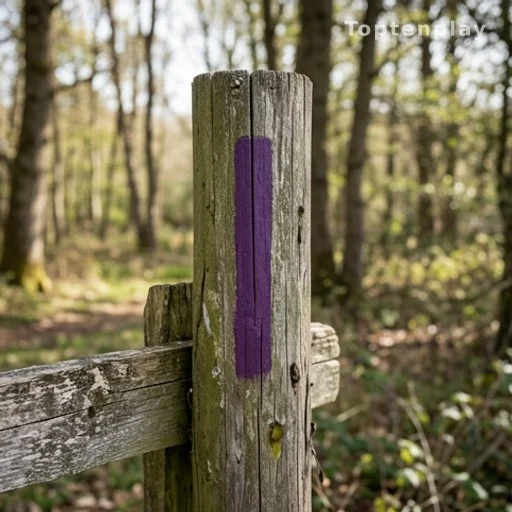
The law was created with a specific problem in mind. In rural and heavily wooded areas, standard «No Trespassing» signs are vulnerable: they fade in the sun, rust in wet climates, and are frequently stolen or vandalized. Paint on a living tree or a stone boundary marker, by contrast, is far more durable and far harder to remove without a trace.
The practical result is that a hiker, hunter, or off-road driver who ventures onto unfamiliar land in one of these 22 states cannot rely on the absence of a sign as a defense. If the fence post or tree line shows purple paint, the legal boundary has been clearly communicated — whether or not the visitor was aware of the law.
A law born out of rural necessity
The Purple Paint Law emerged in response to the practical challenges of marking large, remote private landholdings in the United States. Texas is widely recognized as one of the first states to codify the rule, and the concept has since spread to 21 other states. The specific requirements — stripe dimensions, height from the ground, spacing between marks — vary by state, so landowners must follow their local statute precisely for the markings to be legally valid.
22 states where purple paint is the law as of 2026
As of 2026, the following states officially recognize purple paint as a legally valid trespass deterrent: Alabama, Arkansas, Arizona, Florida, Georgia, Idaho, Illinois, Indiana, Kansas, Maine, Maryland, Missouri, Montana, North Carolina, Oregon, South Carolina, Tennessee, Texas, Utah, Virginia, West Virginia, and Wyoming.
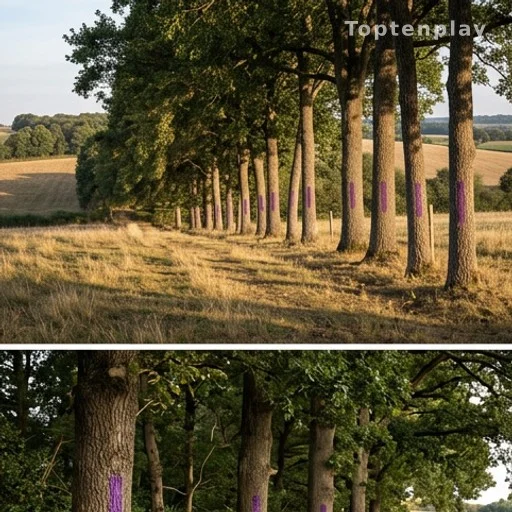
The geographic spread is notable. The law covers states from the Deep South to the Rocky Mountain West, from the Mid-Atlantic coast to the Pacific Northwest. Texas is often credited as one of the earliest adopters, and the law has since spread steadily as other rural states recognized its practicality for large landholdings and timber properties.
Not every state has settled on purple. Colorado, for instance, allows landowners to use orange paint for the same purpose. Purple, however, is by far the most widely adopted color nationally, which is why awareness of its meaning has become increasingly important for anyone traveling through rural America.
Why paint outperforms the traditional posted sign
The durability argument is central to why legislatures across the country have passed these laws. A metal or plastic «No Trespassing» sign nailed to a post at the edge of a 500-acre timber property faces years of exposure to rain, ice, UV radiation, and the occasional rifle shot. Paint applied directly to a tree or stone is embedded in the surface and does not detach, corrode, or blow away in a storm.
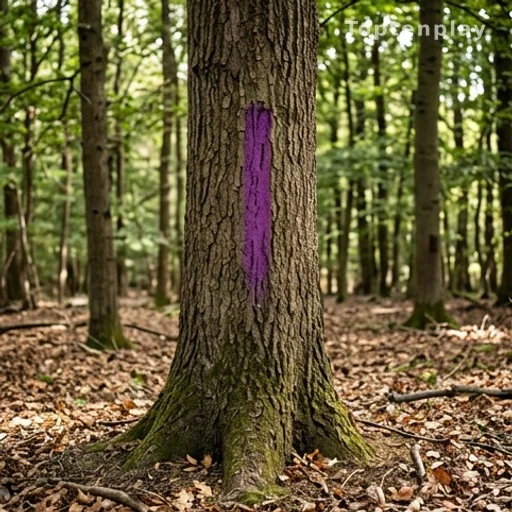
Sign theft is also a documented problem on rural properties, particularly in areas popular with hunters or off-road enthusiasts. A landowner who replaces stolen signs repeatedly faces both the cost of new signs and the legal ambiguity created by a boundary that appears unmarked. Purple paint eliminates that vulnerability entirely.
Suggested Posts

A mystery object in hand turns out to be a vintage tape dispenser
A small, polished golden-brown object sat in someone's hand with no obvious purpose — no label, no instructions, no obvious mechanism. Online searches and…