A dish that impresses your guests without costing you more than thirty minutes in the kitchen: that’s exactly the promise of turkey tenderloin with Boursin, and it delivers. Most creamy recipes hide complexity somewhere—a long reduction, a sauce that splits, a delicate cooking to watch. Not here.
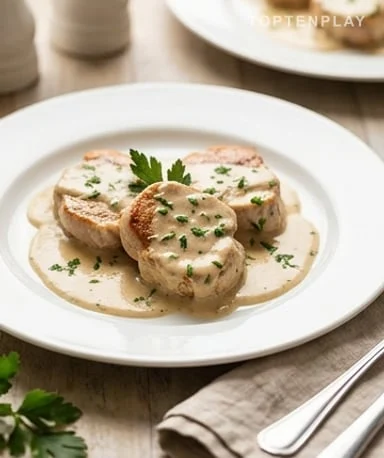
What you get on the plate is golden meat with slightly caramelized edges, coated in a dense, shiny sauce that smells of roasted garlic and fresh herbs. Turkey, often perceived as dry, reveals a melt-in-your-mouth texture here that you didn’t expect. The Boursin sauce is neither light nor watery: it coats, it clings, it stays. An ivory cream color dotted with green, a texture that strings if you lift your fork—this dish, you’ll put back on the table the following week.
Why you’ll love this recipe
Ingredient Notes

A few simple ingredients—turkey, Boursin, cream—for a result well above the effort put in.
- Turkey tenderloin : This is the most tender part of the turkey, with a texture similar to veal when cooked properly. It heats up quickly and stays juicy as long as you don’t cook it over too high heat. Choose a thick piece, between 500 and 700 g, and avoid pre-packaged pieces that are too thin, which dry out as soon as they hit the pan. If you can’t find turkey tenderloin, a thick chicken breast or veal fillet will work—cooking time changes slightly, but the logic of the recipe remains the same.
- Boursin garlic and fine herbs : It plays a dual role: natural thickener and concentrated flavor bomb. Melting into the hot cream, it releases its aromatic oils and creates a smooth sauce without having to stir for ten minutes. Take it out of the fridge at the same time as the meat so it’s at room temperature—it will melt more evenly, without lumps. The light version exists, but the sauce will be less dense and less shiny on the table.
- Heavy cream : It serves as a fluid base that dilutes the Boursin without neutralizing it. Heavy cream is important: with a light version, the sauce tends to curdle when heated, and you end up with a grainy texture instead of a velvety one. Twenty centiliters is enough—beyond that, the sauce would be too liquid and lose the coating texture that is its strength.
- Chicken broth : It is used to deglaze the pan after searing and to recover all the caramelized juices stuck to the bottom—that’s where the real flavor of the meat is concentrated. Pour it hot directly into the pan and scrape the bottom with a flat spatula: you’ll see the dark deposits dissolve into the liquid in seconds. A quality cube makes a difference, but homemade broth is even better if you have it on hand.
- Onion and garlic : They build the aromatic base that supports the Boursin without covering it. The melting onion brings a slight sweet sweetness, the garlic a round and persistent warmth. Finely slice the onion so it becomes translucent quickly—no large chunks that would stay crunchy in the final sauce. Very finely chopped garlic only needs a small minute in the pan before adding the broth: beyond that, it risks turning slightly bitter.
- Butter + olive oil : The combination of the two allows searing at high temperature without burning. Butter alone would darken too quickly; oil stabilizes the heat and goes higher. Butter, on the other hand, brings a characteristic golden color and a roundness in the mouth that oil alone doesn’t give. A spoonful of each is enough—no need for more.
Prepare the meat before even turning on the heat
Take the turkey tenderloin out of the fridge at least fifteen minutes before cooking. This detail is often ignored, and it’s a mistake that costs dearly in texture: cold meat placed in a hot pan sears on the surface but remains raw in the center much longer, which forces prolonged cooking and inevitably dries out the edges. Cut the tenderloin into thick medallions about three centimeters—this thickness allows a nice golden crust without overcooking the center. Dry each medallion well with paper towels before seasoning: moist meat doesn’t brown, it steams and stays pale. Salt at the last moment, just before the pan, and pepper generously on both sides.

Sear over high heat and resist the urge to touch too much
In a large pan or skillet, heat the butter and oil over medium-high heat until the butter foams and begins to sizzle. Place the medallions without crowding—they need space to brown, not steam. The sound you hear should be a sharp, continuous sizzle, not a timid crackle. Leave them without moving for three to four minutes: the crust forms on its own and releases naturally when ready. If you pull the medallions too early, the crust stays stuck to the pan. Turn them once, give the other side another two to three minutes, then remove the meat and place it on a plate. It will rest while you build the sauce, and those few minutes of rest make all the difference for final juiciness.
Build the sauce in the juices, not separately
Don’t rinse the pan, don’t change it. Those golden deposits stuck to the bottom are the soul of the sauce—concentrated flavor you can’t recreate otherwise. Lower the heat slightly to medium and add the sliced onion directly to the still-hot cooking fats. It softens in two to three minutes, absorbing the aromas of the seared meat, with a slight sweet smell that starts to rise. Add the chopped garlic, stir for thirty seconds, then pour in the hot chicken broth all at once. Scrape the bottom of the pan vigorously with a flat spatula: you’ll see the caramelized deposits dissolve into the liquid and darken it a few shades to a golden brown. This deglazing takes barely a minute, but it concentrates flavors that no seasoning added later can replicate.
Let the Boursin melt at its own pace, not yours
Lower the heat to low before adding anything else. Pour in the cream and mix to incorporate it into the broth, then break the Boursin into large pieces directly into the hot sauce. Don’t touch for thirty seconds—let the heat start to soften it. Then stir gently in regular circles: you’ll see the pieces collapse, lose their shape, and gradually incorporate into the cream to give an ivory-colored, smooth, slightly pearly sauce. The smell that comes off is immediate and dense: creamy garlic, herbs, a slight lactic acidity. Taste before adding salt—the Boursin is already well-seasoned and the sauce can very easily end up too salty. A turn of the black pepper mill at the end of the sauce, nothing more.
Put the meat back to finish gently
Return the medallions to the sauce and coat them generously by tilting the pan slightly to let the sauce flow over. Cover partially and cook over very low heat for eight to ten minutes. The turkey finishes cooking in the sauce, which will thicken slightly from the gentle heat and the meat. At this stage, just watch that it doesn’t boil—a slight simmer on the surface is ideal, a vigorous boil quickly turns into a disaster for texture. At the end of cooking, the sauce should coat the back of a spoon without running off like water. Chop fresh parsley at the last moment and serve immediately: a cheese sauce that waits twenty minutes in the turned-off pan becomes thick and sticky, far from the creaminess we seek.

Tips & Tricks
- Always dry the meat with paper towels before searing: surface moisture creates steam in the pan and prevents the crust from forming. Instead of golden meat with character, you get a gray surface without texture or taste.
- Add the Boursin over low heat, never at a boil: at high temperature, the fats in the cheese separate from the aqueous phase and you end up with a grainy, oily sauce. Gentle heat is what keeps the sauce smooth, homogeneous, and shiny to the end.
- If the sauce seems too thick at the end of cooking, add one to two tablespoons of hot broth and stir gently: it will loosen immediately. On the other hand, if it’s too liquid, let it simmer uncovered for two more minutes without a lid—it will tighten on its own without intervention.
- Never put the meat back into a rapidly boiling sauce: repeated thermal shocks contract the muscle fibers and turn a tender tenderloin into rubbery pieces. A barely visible simmer on the surface is the absolute rule for this final step.

Can I replace the turkey tenderloin with chicken?
Yes, a thick chicken breast or chicken fillet works very well with this sauce. The cooking time is slightly shorter on the searing side—two minutes per side is enough—but the logic of the recipe remains exactly the same. Avoid thin chicken breasts that dry out too quickly in the sauce.
Can I prepare the sauce in advance?
The sauce can be made a few hours ahead, stored in the refrigerator, and reheated over very low heat with a splash of cream to loosen it. However, the turkey must be cooked the same day: reheated meat quickly loses its melt-in-your-mouth texture and becomes cottony. For entertaining, prepare the sauce in advance and sear the meat at the last minute.
How do I prevent the turkey from being dry?
Two rules to follow: take the meat out of the fridge 15 minutes before cooking, and finish cooking over very low heat in the sauce, avoiding any boiling. A simple simmer on the surface is enough. The searing over high heat must be quick—the goal is the crust, not cooking through.
Can I use a different cheese instead of Boursin?
Boursin garlic and fine herbs is hard to replace identically because it combines meltability, fat, and aromatic complexity in one ingredient. A garlic-herb cheese like Kiri or Philadelphia with an extra garlic clove can work in a pinch, but the sauce will be less dense. Fresh goat cheese gives a more tangy result, interesting if you like that contrast.
What should I serve with this dish?
Anything that can absorb the sauce is a good idea: homemade mashed potatoes, steamed potatoes, white rice, fresh tagliatelle, or green beans. Avoid sides that are too bland and get lost in the sauce—a bit of lamb’s lettuce or a green salad on the side balances the richness of the dish.
The sauce splits or curdles during cooking—what to do?
That happens when the heat is too high when incorporating the Boursin. If the sauce starts to curdle, immediately lower the heat to minimum and add two tablespoons of cold cream while stirring vigorously: this stabilizes the emulsion in most cases. Prevention is simpler than correction: always add the cheese over low heat, never at a boil.
Turkey Tenderloin with Boursin
French
Main course
Golden turkey medallions simmered in a creamy Boursin garlic and fine herbs sauce, ready in thirty minutes. A simple dish that looks like you spent hours in the kitchen.
Ingredients
- 600 to 700g turkey tenderloin
- 150g Boursin garlic and fine herbs (at room temperature)
- 20cl heavy cream
- 10cl chicken broth (hot)
- 1 medium yellow onion, finely sliced
- 1 clove garlic, very finely chopped
- 1 tbsp olive oil
- 10g butter
- salt and black pepper from the mill
- 1 handful fresh parsley, chopped, for serving
Instructions
- 1Remove the turkey tenderloin from the refrigerator 15 minutes before cooking. Cut into medallions about 3 cm thick. Dry thoroughly with paper towels, salt and pepper both sides.
- 2In a large pan or skillet, heat the oil and butter over medium-high heat until the butter foams. Place the medallions without crowding and sear for 3 to 4 minutes without moving, until golden brown. Turn and sear the other side for 2 to 3 minutes. Set aside on a plate.
- 3In the same pan over medium heat, sauté the sliced onion for 2 to 3 minutes until soft and translucent. Add the chopped garlic and stir for 30 seconds.
- 4Pour in the hot chicken broth and scrape the bottom of the pan vigorously with a flat spatula to loosen all the caramelized cooking juices.
- 5Reduce the heat to low. Pour in the heavy cream and mix. Add the Boursin cut into pieces and stir gently in circles until a smooth, ivory, homogeneous sauce is obtained. Taste before adjusting salt.
- 6Return the medallions to the sauce and coat generously. Cover partially and cook over very low heat for 8 to 10 minutes—a slight simmer is enough. Sprinkle with fresh chopped parsley and serve immediately.
Notes
• Taste the sauce before salting: the Boursin is already well-seasoned, the sauce can easily become too salty without checking.
• If the sauce is too thick at the end of cooking, add 1 to 2 tablespoons of hot broth and stir gently to loosen.
• Storage: 2 days in the refrigerator in an airtight container. Reheat over very low heat with a splash of cream to restore original creaminess.
Nutrition Facts (per serving, estimated)
| 485 kcalCalories | 38gProtein | 5gCarbs | 34gFat |