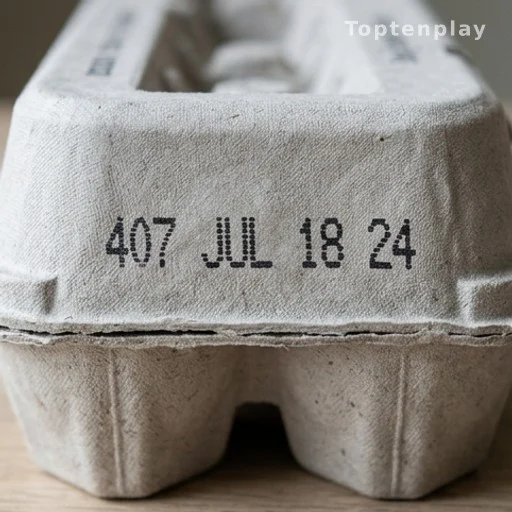
Under USDA regulations, eggs can remain on store shelves for up to 30 days after that Julian date. That means a carton stamped 032 could legally be sold until early March. When you are choosing between two cartons, the one with the higher Julian number is always the fresher option.
Most shoppers walk past this code entirely, focusing instead on the calendar date printed on the front or top of the carton. Food scientists, however, treat the Julian date as the real freshness benchmark — because it is the only figure tied directly to the moment of packing, with no rounding or retailer discretion involved.
EXP, SEL, USE-BY: three calendar dates with three different meanings
Beyond the Julian date, cartons carry up to three separate calendar-style labels, and each one means something different. The EXP (Expiration) date is the last day a retailer is legally permitted to sell the eggs. It cannot be set more than 30 days after the Julian pack date.
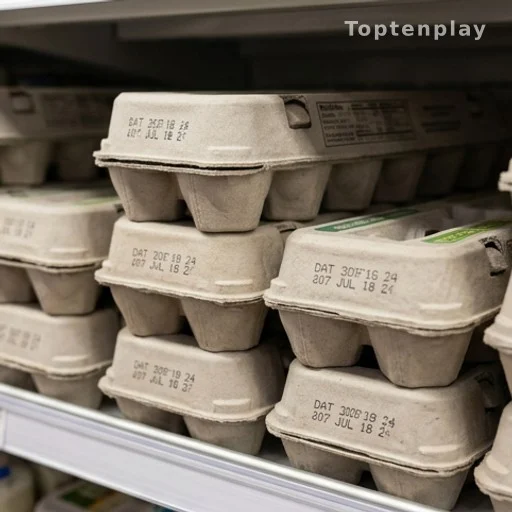
The SEL (Sell-By) date functions similarly — it is roughly 30 days from packing and signals to store staff when the product should be rotated off the shelf. Neither the EXP nor the SEL date means the eggs are unsafe to eat on the following day; they are inventory management tools as much as consumer guides.
The USE-BY date is the most generous of the three, set by the manufacturer at up to 45 days from packing. It represents the window during which the producer guarantees peak quality. An egg eaten on day 44 is technically within spec — but its nutritional profile will differ meaningfully from one eaten on day five.
Finally, the P-code — a letter «P» followed by four to six digits — is the USDA plant identification number. It has nothing to do with freshness, but it is the number food safety investigators use to trace a specific carton back to the exact packing facility in the event of a recall or contamination concern.
How egg dating is regulated in the US
In the United States, the USDA sets the rules for egg carton labeling on graded eggs. The Julian pack date is mandatory on all USDA-graded cartons. Calendar sell-by or expiration dates are optional at the federal level but required by many states, and they cannot exceed 30 days past the Julian date. The P-code plant number is assigned by the USDA and allows rapid traceability during food safety investigations.
Choline, lutein, and protein: what egg freshness actually means for your nutrition
The practical reason to care about the Julian date goes beyond taste. Eggs are among the richest dietary sources of choline, a nutrient the body uses to build and maintain brain cell membranes. Research in nutritional science links adequate choline intake to protection against cognitive decline. Like most nutrients in whole foods, choline begins to degrade as the egg ages.
Suggested Posts

He found a mystery object in a drawer — the internet solved it
A man helping his girlfriend tidy her room came across an unfamiliar object tucked inside a drawer — two handles, a curved shape, and…