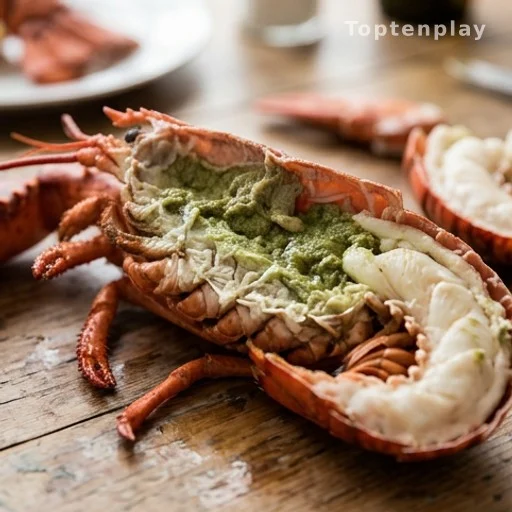
Specifically, the tomalley serves as the lobster’s combined liver and pancreas. Like the human liver, its primary job is to filter impurities, process nutrients, and neutralize toxins that the animal encounters in its marine environment.
Not everything found inside a lobster raises the same concern. The red, coral-like bits sometimes visible alongside the tomalley are the lobster’s roe — its eggs. These are widely considered safe to eat and are treated as a delicacy in many culinary traditions. The tomalley is an entirely different matter.
Why the tomalley acts as a concentrated toxin sponge
The very function that makes the tomalley biologically essential to the lobster is what makes it potentially dangerous to eat. Because it is a filtration organ, it absorbs and retains whatever contaminants are present in the surrounding ocean water.

That means heavy metals, PCBs, and other environmental pollutants can accumulate directly in the tomalley tissue. Eating it is, in effect, consuming the concentrated waste filter of the sea — not the clean flesh of the animal.
This bioaccumulation concern is not theoretical. Environmental scientists have documented elevated levels of industrial pollutants in the tomalley of lobsters caught in coastal waters affected by human activity, making the organ a particularly unreliable food source from a liver health and toxicology standpoint.
What is bioaccumulation?
Bioaccumulation refers to the gradual build-up of substances — such as heavy metals or chemical pollutants — in an organism’s tissues over time. Filtration organs like the liver are particularly vulnerable because they process everything the animal ingests or absorbs from its environment. In lobsters, the tomalley performs this role, which is why toxin levels there can be significantly higher than in the muscle meat.
PSP and the specific risks for older adults
Beyond heavy metals, tomalley carries a second documented risk: Paralytic Shellfish Poisoning (PSP). PSP is caused by naturally occurring toxins produced by certain algae, which shellfish and crustaceans can accumulate in their organs during algal bloom events.

Medical professionals and environmental scientists strongly advise against eating tomalley, with the warning directed in particular at older adults, pregnant women, and anyone focused on long-term wellness. These groups face a higher risk of serious complications from foodborne toxins.
Suggested Posts

A mystery object in hand turns out to be a vintage tape dispenser
A small, polished golden-brown object sat in someone's hand with no obvious purpose — no label, no instructions, no obvious mechanism. Online searches and…