📌 Stir-fried noodles with Chipotle chili: the cooling technique that transforms the texture
Posted 1 March 2026 by: Admin
Technical Basics Of A Mastered Asian Recipe
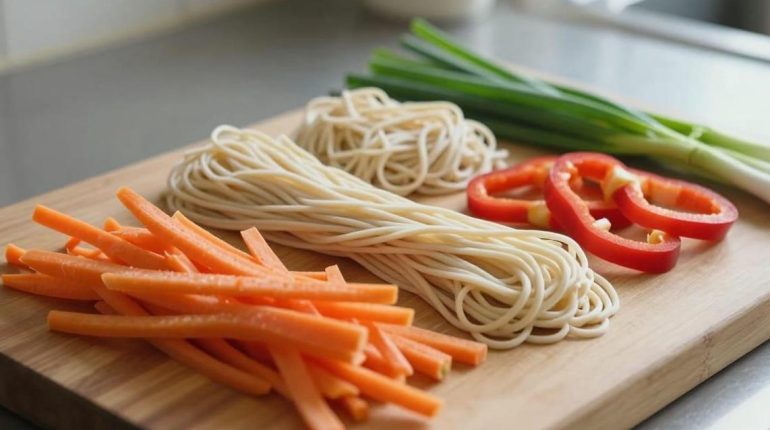
The success of a stir-fried noodle dish relies on rigorous preparation that begins long before cooking. In this recipe, every gesture is part of a professional logic where nothing is left to chance. Cooking the noodles in unsalted boiling water is already a first specificity: unlike Italian pasta, Asian noodles are self-sufficient and will be seasoned later by the sauce. Immediate rinsing with cold water after cooking is not an incidental detail but an essential technique that stops the cooking process instantly, removes excess starch, and guarantees that firm and non-sticky texture characteristic of authentic stir-fried noodles.
The preparation of the vegetables reveals another dimension of this culinary rigor. The carrots are julienned, the red pepper cut into thin strips, creating visual harmony and homogeneous cooking times. Even more subtle: the strategic separation of the scallions, whose bulb and green parts will play distinct roles. The sliced bulbs will bring their sweetness at the start of cooking, while the green part will be used in two stages: 5 cm sections integrated into the final stir-fry, and decorative bias cuts reserved for plating. This methodical organization, a true French-style mise en place adapted to Asian cuisine, then allows for a fluid execution in the wok where every second counts.
The Signature Chipotle Chili Sauce: The Balance Of Flavors
It is in the preparation of the sauce that this recipe reveals its true fusion identity. Six carefully measured ingredients come together to create a gustatory symphony where Asia meets Mexico: soy sauce and oyster sauce bring the deep umami of Asian tradition, while grape seed oil and Chipotle chili introduce that smoky and spicy note characteristic of Mexican cuisine. Sugar balances the whole, crushed coriander seeds add a lemony aromatic touch, and a few turns of the pepper mill complete this architecture of flavors.
The ingenuity lies in the strategic use of Chipotle chili oil, employed twice: first integrated into the sauce to infuse every bite, then used as the cooking fat in the wok. This double presence intensifies the aromatic depth of the dish without creating saturation, the smoky scent diffusing progressively through the vegetables and noodles. The prior preparation of this sauce also allows for an optimal emulsion of the ingredients, guaranteeing that at the time of service, every element of the dish will be uniformly coated in this sweet-salty-spicy balance that marks the identity of this recipe.
This homemade sauce, made in moments, radically transforms what could be simple stir-fried noodles into a distinctive culinary creation, ready to deploy all its power during the final wok cooking.
Sequential Cooking: Timing And Power Build-up
Wok stir-frying relies on a timing discipline that this recipe breaks down with surgical precision. In a pan or wok heated to high temperature, the staggered cooking begins with the carrots and sliced onions, which require exactly one minute to begin their transformation while preserving their crunch. This first step is non-negotiable: starting the cooking with high-density vegetables allows for structuring the aromatic base of the dish.
After this initial minute, the red pepper and minced garlic join the wok for two additional minutes. This calculated progression respects the specific cooking times of each ingredient, guaranteeing that the carrots retain their firmness while the garlic releases its aromas without burning. The Chipotle chili oil, already present from the start, acts as a thermal vector and progressively infuses the vegetables with its smoky notes.
The final phase marks the apotheosis of this orchestration: the scallion green sections, the previously cooled noodles, and the prepared sauce converge in the wok. Cooking continues until the noodles are reheated and the sauce uniformly coats the whole, creating this textural cohesion where each element retains its integrity while participating in the overall harmony. This progressive stir-fry technique transforms distinct ingredients into a unified composition, ready to receive its final touches.
Final Plating And Signature Touches
Once textural cohesion is achieved in the wok, the recipe shifts into its aesthetic and sensory dimension. Plating is not just a simple transfer to the plate: it activates the tactile contrasts that sublimate the taste experience. Cashew nuts, added at the time of service, introduce that dry and frank crunch that opposes the suppleness of the sauce-coated noodles. This break in texture is not ornamental but functional, creating an alternation between the tenderness of the stir-fried vegetables and the mineral resistance of the nuts.
The scallion greens sliced on the bias complete this visual architecture. Arranged as a finish, they bring immediate vegetable freshness while recalling the cooked sections integrated earlier in the preparation. This double presence of the scallion (cooked and raw) generates an aromatic stratification: sweet and candied notes from the bulb versus the chlorophyll-like vivacity of the fresh green.
The bright colors of the vegetables — orange of the carrots, red of the pepper, vibrant green of the scallions — emerge under the glossy film of the Chipotle sauce. This shine is not an artifice: it testifies to the successful emulsion between the spicy oil and the liquid elements of the sauce. The cashew nuts, lightly browned, visually punctuate the dish with beige touches that counterbalance the chromatic intensity of the vegetables. This mastered plating transforms stir-fried noodles into a culinary creation where every visible element announces a precise gustatory promise, from the first bite to the last.