Suivez-nous
3 June 2026

Melting Gratin Dauphinois

Prep Time
20 minutes
Cook Time
85 minutes
Total Time
105 minutes
Servings
6 to 8 servings

People often think that gratin dauphinois is a heavy dish, drowned in cheese and reserved for big meals. In reality, a good gratin dauphinois is more subtle: thin potatoes, well-seasoned cream, slow cooking, and that melting texture that instantly calms the atmosphere at the table.
Publicité
Final result
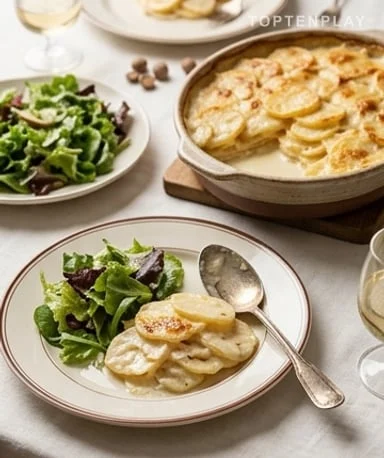
A well-golden gratin dauphinois, creamy without being heavy, with potatoes melting to the core.

When it comes out of the oven, the top should be golden blond, with a few more amber edges that slightly stick to the dish. When the spoon dips in, the potato slices separate gently, coated in a thick, garlic-scented cream. You can smell the warm nutmeg, the reduced milk, and that buttery touch that makes you want to serve a slightly too generous portion.

Why you’ll love this recipe

Creamy without cheese : The meltiness comes mainly from the potato starch and slow cooking. No need to hide the dish under a layer of cheese to get a truly comforting texture.
Perfect to make ahead : The gratin even benefits from resting a few minutes after cooking. The cream stabilizes, the portions hold better, and the flavor becomes rounder.
Simple but demanding : The ingredients are ordinary, but every step counts. Slices too thick or an oven too hot quickly changes the result.
Real comfort food : It’s the dish that arrives steaming in the middle of the table, with a smell of mild garlic and warm cream. It pairs very well with roast chicken, grilled fish, or a bright green salad.

Ingredient Notes

Ingredients

Potatoes, heavy cream, whole milk, garlic, and nutmeg: few ingredients, so you have to choose them correctly.

  • Potatoes : They form the structure of the gratin and release the starch that binds the cream. Choose melting or all-purpose varieties like Monalisa, Charlotte, or Bintje, and cut them into regular 2-3 mm slices to avoid a firm center and overcooked edges.
  • Heavy cream : It brings creaminess and that round flavor that makes the gratin charming. Heavy cream gives a more stable and silkier sauce; to lighten, replace only part with milk, otherwise the gratin becomes more watery.
  • Whole milk : It loosens the cream and helps the potatoes cook gently without turning the dish into a compact block. Whole milk is preferable to semi-skimmed because it gives a more velvety sensation in the mouth.
  • Garlic : It flavors the dish without taking over when you simply rub the dish with a cut clove. For a stronger taste, add a small hint of chopped garlic to the milk-cream mixture, but stay measured to keep the mild side of the gratin.
  • Nutmeg : It wakes up the cream with a warm, almost woody note that goes very well with potato. Grate it at the last moment if possible, or replace it with a touch of thyme if you want a more herbaceous flavor.
  • Butter : It’s not mandatory, but it helps grease the dish and adds a slight hazelnut note to the golden edges. A thin layer is enough, otherwise the gratin can become greasy instead of melty.

Cut the potatoes thinly enough

Success starts even before turning on the oven. Thin, regular slices cook at the same rate, absorb the milk-cream mixture better, and give that tender texture where the spoon glides without resistance. A mandoline really helps, but a good knife is enough if you take your time. Above all, do not rinse the potatoes after cutting: the surface starch is precious, it thickens the cream during cooking and prevents a too-liquid sauce. Visually, the slices should be pale, slightly moist, and flexible enough to overlap without breaking.

Cut the potatoes thinly enough
The potatoes are cut thinly and not rinsed after cutting: the starch really helps bind the gratin.

Flavor the dish before filling it

Rubbing the dish with a garlic clove cut in half seems trivial, but it’s what gives the gratin its discreet and deep aroma. The garlic heats gently against the ceramic, blends with the cream, and leaves a round rather than aggressive smell. If you butter the dish, do it in a thin layer: the goal is to prevent the potatoes from sticking and to promote lightly golden edges, not to soak the gratin. When arranging the first slices, try to overlap them slightly, like roof tiles, for even cooking and a good hold when serving.

Heat the cream without rushing it

The milk-cream mixture should be warm, seasoned, but never boiled violently. By heating it gently with salt, pepper, and nutmeg, you distribute the flavors better and start the potato cooking more gently. The pot should give off a milky and spicy scent, with small vapors, not big bubbles that stick to the bottom. Taste the liquid before pouring: it should seem a bit saltier than expected, because the potatoes will absorb a good part of the seasoning. A bland gratin, frankly, is often just a gratin that wasn’t salted properly.

Let the oven work slowly

A gratin dauphinois does not rush. At 160-170°C, the cream has time to thicken, the potatoes become tender, and the top takes on a golden color without burning. If the oven is too hot, the top colors quickly while the center remains firm, with a dry texture on the edges and too liquid at the bottom. You can cover the dish at the beginning if the surface colors too fast, then uncover at the end of cooking to get that lightly gratiné top that still quivers. The good sign is a knife blade that sinks in without effort and cream that gently bubbles on the sides.

Give it a real resting time

Resting is not a formality; it’s what transforms a burning, unstable dish into a melting gratin that serves cleanly. Ten to fifteen minutes are enough for the cream to tighten around the potatoes and for the flavors to become more distinct. At that point, the top remains warm, the edges are slightly caramelized, and the inside retains a gentle heat rather than an aggressive steam. If you serve too quickly, the cream runs onto the plate and the layers fall apart. Be patient a little, then serve with a well-dressed salad to contrast the creaminess.

Give it a real resting time
Gentle cooking does all the work: the potatoes absorb the cream and become melting without drying out.

Tips & Tricks
  • Do not rinse the potatoes after cutting, as their natural starch helps the cream thicken and gives a more cohesive texture.
  • Season the milk-cream mixture before assembling the gratin, because it is much harder to correct the salt once the layers are stacked.
  • Opt for a gentle, long cooking, because the potatoes must absorb the cream gradually rather than only cooking on the surface.
  • Let the gratin rest before serving, because the cream firms up slightly and the portions hold better.
Close-up
We aim for a coating texture, tender layers, and a lightly gratiné top, not a thick crust.
FAQs

Should I put cheese in a gratin dauphinois?

No, not in the traditional version. The meltiness comes mainly from the potatoes, cream, milk, and slow cooking, not from a layer of grated cheese.

Why shouldn’t you rinse the potatoes after slicing?

The surface starch helps bind the cream during cooking. If you rinse the slices, the gratin may end up more liquid and less coating.

Which potato to choose for a melting gratin dauphinois?

Choose a melting or all-purpose variety like Monalisa, Charlotte, or Bintje. They bake well in the oven and keep a tender texture without turning completely into purée.

Can you prepare gratin dauphinois ahead?

Yes, you can bake it ahead and then reheat gently in the oven. It will even be easier to serve because the cream will have had time to stabilize.

Why is my gratin dauphinois still liquid?

The problem often comes from rinsed potatoes, insufficient cooking, or an oven that is too hot which colors the top too quickly. Extend the cooking at a gentle temperature until the cream is absorbed and the potatoes are tender.

Melting Gratin Dauphinois

Melting Gratin Dauphinois

Easy
French
Side dish

Prep Time
20 minutes
Cook Time
85 minutes
Total Time
105 minutes
Servings
6 to 8 servings

A creamy and melting gratin dauphinois, made with thinly sliced potatoes, whole milk, cream, and a touch of garlic. A true comfort food recipe, simple but demanding on cooking.

Ingredients

  • 2 kg melting or all-purpose potatoes
  • 35 cl heavy cream
  • 35 cl whole milk
  • 1 garlic clove
  • 10 g butter for the dish
  • 8 g fine salt
  • 2 g ground black pepper
  • 1 pinch freshly grated nutmeg

Instructions

  1. 1Preheat the oven to 165°C.
  2. 2Peel the potatoes then cut them into thin slices of 2-3 mm. Do not rinse them after cutting.
  3. 3Cut the garlic clove in half and rub the inside of the gratin dish. Then lightly butter the dish.
  4. 4Pour the milk and cream into a saucepan. Add salt, pepper, and nutmeg, then heat gently without boiling.
  5. 5Arrange a layer of potatoes in the dish, pour a little of the milk-cream mixture, then repeat until all ingredients are used up.
  6. 6Check that the potatoes are well covered with liquid, then bake for 1h15 to 1h30.
  7. 7The gratin is ready when the top is golden, the cream is almost absorbed, and a knife blade inserts easily.
  8. 8Let it rest for 10-15 minutes before serving so the texture holds better.

Notes

• Do not rinse the potatoes: their starch helps achieve a bound cream.

• If the top colors too quickly, cover the dish with baking paper then uncover at the end of cooking.

• Grated cheese is possible for a gratiné version, but it is not necessary in the traditional recipe.

• Reheat leftovers in the oven rather than the microwave to keep a better texture.

Nutrition Facts (per serving, estimated)

410 kcalCalories 8gProtein 38gCarbs 25gFat
Publicité
Partager sur Facebook