The butter foaming in the hot pan, that little golden smoke rising — Sunday starts well when it starts like this. This loaded omelette is ten minutes of cooking for a result that looks like a real restaurant brunch, made at home with whatever you have in the fridge.

What you see on the plate: a clean fold, a surface as golden as light caramel, and underneath, all the filling waiting. The cheddar has already started to melt in the heat of the eggs, the small cubes of turkey ham are slightly caramelized on the edges. The red peppers still keep some of their crunch. And when you cut into it with a knife, the wilted spinach appears in dark green between the strings of cheese.
Why you’ll love this recipe
Ingredient Notes
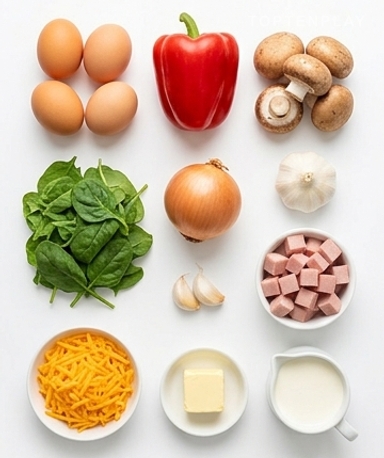
All the fresh ingredients gathered: crunchy vegetables, turkey ham, grated cheddar, and room temperature eggs.
- The eggs : Take them out of the fridge twenty minutes before cooking. Eggs at room temperature whisk better, cook more evenly, and yield a more flexible omelette. It’s a detail that really changes the final texture.
- Heavy cream : Just a tablespoon in the egg mixture. This is what gives that velvety texture we’re looking for — not rubbery firm, but not liquid either. 30% fat crème fraîche works the same if you have no other option.
- Turkey ham : Cut it into one-centimeter cubes rather than leaving it in slices. This allows it to brown in the butter and develop a slightly grilled edge. Get it plain rather than smoked — otherwise it takes up too much space flavor-wise.
- Cheddar : Grate it yourself if you can. Pre-shredded cheddar in bags contains anti-caking agents that prevent smooth melting. A medium cheddar grated at the last minute melts much better and gives real golden strings.
- Butter : It replaces oil here, and not just for the taste. Butter also gives you a visual cue: when it foams and just starts to color, the pan is at the right temperature to pour the eggs.
Filling first — not the other way around
Many people cook the eggs first and find themselves waiting for the filling. The eggs cool down, the texture changes. Always start with the filling. Melt the butter over medium-high heat and toss in the turkey ham cubes, red pepper, mushrooms, and onion. Let it all sit for three to four minutes without stirring too much — the onion will become translucent, the mushrooms will release their water and then reabsorb it with a slight nutty scent. Add the garlic and spinach. In thirty seconds, the leaves wilt and turn from bright green to an almost opaque dark green. Set aside on a plate.

Why I never prepare my eggs any other way
The trick of placing eggs in warm water sounds trivial. It isn’t. Five minutes in a bowl of warm water — not boiling — relaxes the internal membrane. The white and yolk whisk together more easily, and the resulting foam is more stable. Then whisk vigorously with the cream, salt, and pepper until you get a homogeneous mixture, slightly foamy on the surface. This is what will give that flexible, creamy texture to the finished omelette.
The part everyone gets wrong: the heat
An omelette is cooked over medium-low heat. Not high. As soon as the butter is melted and slightly foaming, pour in the egg mixture. Stir briefly with a rubber spatula — two or three passes as if you were starting scrambled eggs. Then, let it be. Tilt the pan so the remaining liquid part flows to the edges and under the omelette. Repeat two or three times. The top should stay slightly shiny when you add the filling: it’s the sign that it will finish setting with residual heat without drying out.
Folding — a matter of practice
Place the grated cheddar on one half of the omelette, the filling on top, then a final layer of cheese. Cover the pan with a lid for thirty seconds. The steam finishes cooking the top and melts the cheese without you needing to touch anything. When you lift the lid, the top is matte and set, the cheese strings between the vegetables. Slide the spatula under the half without filling and fold it over the other. It sticks a bit the first time. The second time, you’ll have it.

Tips & Tricks
- Don’t salt the mushrooms at the start of cooking: salt makes their water come out too fast and you end up with a filling that boils rather than sautés. Salt at the end of cooking, at the same time as the garlic.
- If your omelette tears during folding, it’s almost always because the heat was too high. Overcooked egg becomes dry and brittle. Lower the heat next time — the texture changes completely.
- Leftover filling keeps for two days in the fridge in a closed container. The next morning, it’s five minutes of prep: you reheat the filling while you prepare the eggs.

How do I avoid a rubbery omelette?
The number one culprit is heat that’s too high. At high heat, egg proteins contract too quickly and yield a hard, dry texture. Cook over medium-low heat and remove from the heat as soon as the top is just set — it finishes cooking with residual heat.
Can I prepare the filling in advance?
Yes, it’s even recommended. The filling keeps for two days in an airtight container in the refrigerator. In the morning, just reheat it quickly in the pan while you whisk the eggs — the omelette is ready in less than 15 minutes.
What cheese can I use instead of cheddar?
Grated Gruyère works very well and strings even better when melted. Emmental or Comté give a milder result. Avoid soft cheeses like fresh mozzarella — too much water, it makes the omelette soggy.
Can I skip the heavy cream?
Yes. The cream adds velvetiness but the omelette remains good without it. Replace it with a tablespoon of whole milk for a slightly less rich but equally flexible result. Avoid semi-skimmed or skimmed milk — too much water in the mix.
Does the omelette reheat well the next day?
Honestly, an omelette should be eaten the same day. Reheated, the texture changes: the eggs harden and the vegetables soften. If you have leftovers, they work better in a toasted sandwich than reheated alone in a pan.
What size pan should I use?
A pan 24 to 26 cm in diameter for 3 eggs is the right measure. Too small, the omelette will be too thick and hard to fold. Too large, it spreads out and dries out before the center is cooked. A non-stick pan in good condition is essential.

Loaded Turkey Ham and Vegetable Omelette
French
Main Course
A soft and generous omelette, filled with sautéed vegetables, golden turkey ham, and melting cheddar. Ready in 30 minutes, ideal for brunch or an express dinner.
Ingredients
- 3 eggs (at room temperature)
- 1 tbsp (15 ml) heavy cream
- 2 tbsp (30 g) butter (divided in two)
- Salt and black pepper to taste
- 80 g turkey ham, cut into 1 cm cubes
- 80 g (½ pepper) red pepper, cut into small dice
- 100 g button mushrooms, sliced
- 50 g (½ onion) onion, finely sliced
- 1 clove garlic, pressed or minced
- 30 g (1 handful) fresh spinach
- 40 g cheddar, freshly grated
Instructions
- 1Take the eggs out of the refrigerator 20 minutes before cooking. Place them in a bowl of warm water (not boiling) for 5 minutes.
- 2In a pan over medium-high heat, melt 1 tbsp of butter. Sauté the turkey ham, pepper, mushrooms, and onion for 3 to 4 minutes without stirring too much.
- 3Add the garlic, salt, pepper, and cook for 1 minute. Add the spinach and let it wilt for 30 seconds. Transfer to a plate and set aside.
- 4In a bowl, whisk the eggs vigorously with the heavy cream, a pinch of salt and pepper until you get a homogeneous and slightly foamy mixture.
- 5In the same cleaned pan, melt the remaining butter over medium-low heat. Pour in the egg mixture and stir briefly 2 to 3 times with a rubber spatula.
- 6Tilt the pan so the liquid part flows to the edges and under the omelette. Repeat 2 to 3 times until the top is almost set but still slightly shiny.
- 7Spread half the cheddar over one half of the omelette, add all the filling, then cover with the remaining cheddar.
- 8Cover the pan with a lid and cook for 30 seconds, until the cheese is melted and the top is matte.
- 9Fold the omelette in half using the spatula and slide it onto a warm plate. Serve immediately.
Notes
• The filling can be prepared up to 2 days in advance and stored in an airtight container in the refrigerator. Reheat it quickly in the pan before filling the omelette.
• For a lighter version, replace the heavy cream with whole milk and reduce the butter to 1 tsp for cooking the eggs.
• Leftovers keep for 24 hours in the fridge but do not reheat ideally alone — they are better in a toasted sandwich.
Nutrition Facts (per serving, estimated)
| 400 kcalCalories | 22 gProtein | 7 gCarbs | 32 gFat |