The Asian Fusion Recipe Revolutionizing Baked Salmon
Ninety minutes flat separate a raw salmon fillet from a complete Asian gastronomic experience. This recipe deconstructs the codes of traditional baked salmon thanks to a tripartite marinade of unsettling simplicity: Kikkoman sweet soy sauce, sesame oil, and honey. Three ingredients, zero complex technique.
The revolution lies in thermal precision. At 200°C top and bottom heat, the salmon cooks between 12 and 15 minutes depending on the thickness of the steaks. This precise timing guarantees the sought-after texture: “cooked, but not dry”. The prior sesame coating creates a golden crust that seals in moisture during cooking.
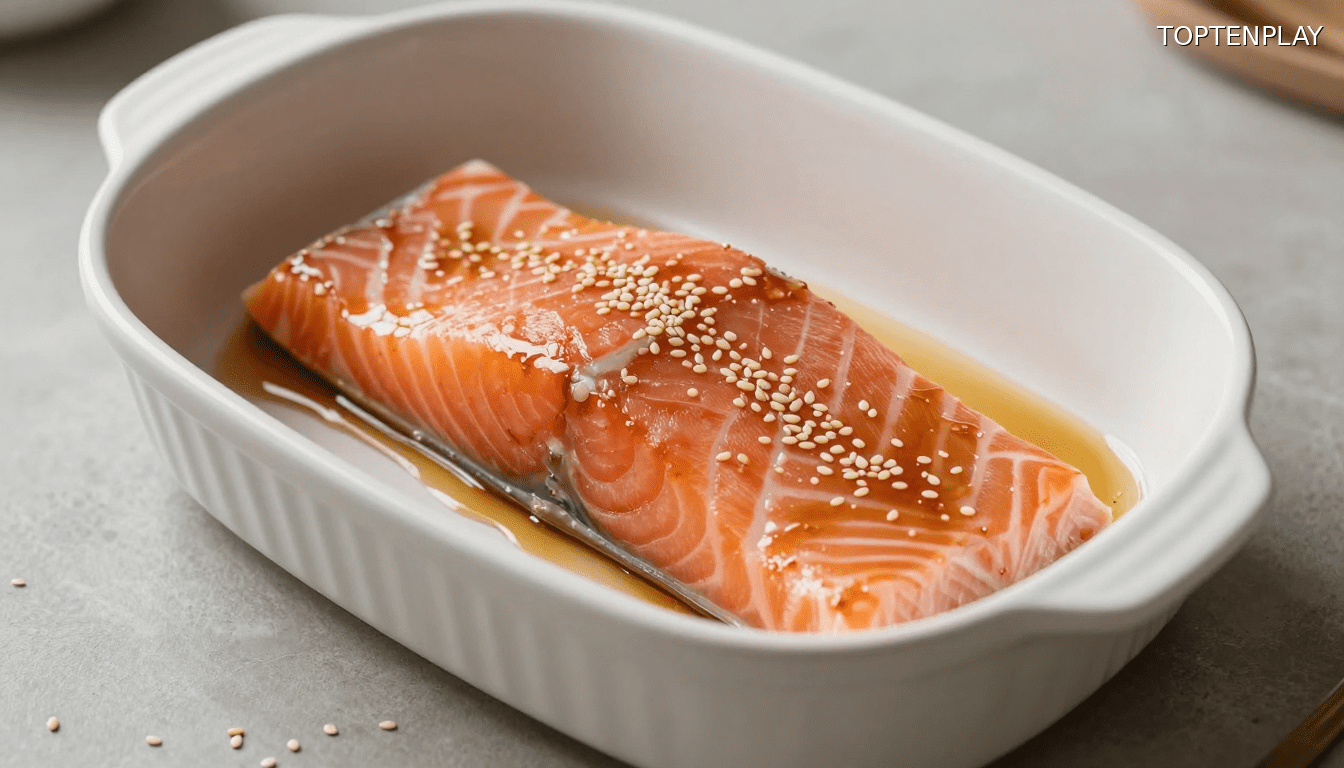
The protocol eliminates any hazardous improvisation. The steaks rest in a baking dish, lightly peppered, uniformly covered with marinade. This uniformity conditions the aromatic success: every square inch of flesh absorbs the sweet-salty mixture before receiving its rain of sesame seeds.
The efficiency of the process disrupts baked salmon standards. Where some recipes multiply steps and exotic ingredients, this one marries Asian sophistication and accessibility. The preheated oven becomes the sole conductor of a transformation that respects the delicate texture of the fish while infusing it with deep umami notes.

The Alchemy Of The Marinade: Three Ingredients For Perfect Balance
Kikkoman sweet soy sauce forms the savory backbone of this preparation. Its fermented profile brings that umami dimension that naturally amplifies the richness of the salmon without masking it. Honey acts as a double agent: it softens the salty intensity while promoting a superficial caramelization that traps aromas during cooking.
Sesame oil completes this gustatory triangle with its aromatic depth. A few milliliters are enough to diffuse those characteristic toasted notes that immediately signal Asian cuisine. The homogeneous mixture obtained in a simple bowl creates a liquid emulsion that adheres perfectly to the fish flesh.
Light prior peppering structures the seasoning. Unlike the salt already present in the soy sauce, freshly ground black pepper adds that spicy kick that wakes up the palate without denaturing the sweet-salty balance. The uniformity of the coating conditions the distribution of flavors: every bite must deliver the same aromatic intensity.
This minimalist gustatory chemistry proves that a successful marinade requires neither long maceration nor an endless list of ingredients. The quality of the components takes precedence over their quantity. Sesame sprinkled before cooking completes the protective coating that will guarantee a crispy texture and a moist heart.

Mastering The Timing: The Millimetric Cooking That Makes The Difference
The oven preheated to 200°C with top and bottom heat creates the ideal thermal environment. This double heat source envelops the fillets uniformly, guaranteeing that the sesame coating grills delicately while the flesh cooks to the core. Preheating eliminates any risk of uneven cooking that would dry out the edges before the center reaches optimal temperature.
The thickness of the steaks imperatively dictates the cooking time. A 2-centimeter fillet requires exactly 12 minutes, while a more generous piece demands 15 minutes maximum. Beyond that, the flesh loses its characteristic tenderness and turns dry. This narrow window requires active monitoring: salmon “cooked but not dry” is located in that critical zone where proteins coagulate without expelling their moisture.