📌 Yellow ladybugs: why their rarity reveals an unsuspected survival mechanism
Posted 23 January 2026 by: Admin
The Science Behind Rare Ladybug Colors
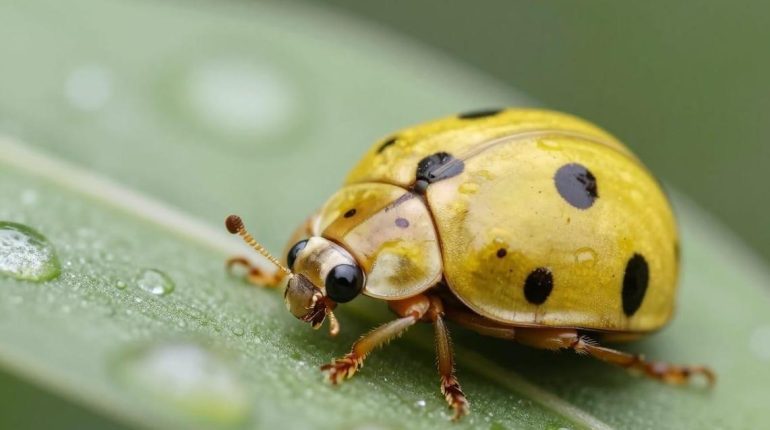
Yellow ladybugs belong to the Coccinellidae family, a remarkably diverse group of insects with over 5,000 recorded species worldwide. Unlike the red ladybugs that dominate our collective imagination, yellow variants represent a tiny fraction of this population. Their rarity is no accident: it stems from precise evolutionary mechanisms.
Ladybug coloration serves vital biological functions. Bright hues – whether red, orange, or yellow – act as a warning signal to predators. This phenomenon, called aposematism, communicates an unequivocal message: “I am toxic, do not consume me.” Ladybugs indeed secrete bitter chemical compounds that repel birds and other potential hunters.
Yellow species, significantly less widespread, often exhibit subtle variations in their defensive chemical composition. Some sport black or white spots, or no distinctive markings at all. The Asian ladybug (Harmonia axyridis), for example, can present a pale yellow form, although its red and orange variants largely dominate.
This chromatic diversity responds to specific environmental pressures: climate adaptation, food availability, and camouflage strategies depending on the habitat. Each color tells a distinct evolutionary story, forged over millennia of adaptation. Encountering a yellow ladybug is thus like observing a fascinating whim of nature, a rare expression of unsuspected biodiversity.
The Universal Symbolism of the Classic Ladybug
Long before science decrypted their defense mechanisms, red ladybugs with black spots had already established themselves as icons of good fortune in the collective imagination. From European folklore to Asian traditions, these tiny beetles have embodied luck, protection, and hope for centuries.
In medieval Europe, peasants considered ladybugs precious allies against devastating aphids. Their arrival in crops heralded abundant harvests, earning them the nickname “God’s little creatures” in French. The English named them “ladybirds” in reference to the Virgin Mary, whose traditional red cloak recalled their scarlet shell.
This sacred dimension spans continents. In Asia, crossing paths with a ladybug signals the imminent arrival of a visitor or the resolution of a persistent problem. Scandinavian sailors welcomed them on board as omens of favorable navigation. Even the simple act of counting their spots gave rise to predictions: each black spot announced a month of happiness or a coin to come.
Their harmless appearance – round, colorful, small – reinforces this magical perception. Unlike insects that evoke disgust or fear, ladybugs inspire tenderness and wonder. They embody a benevolent, almost fairy-like nature that rewards the attentive observer.
But when this familiar creature dons an unusual yellow coat, the symbolism shifts toward unexplored territory, where tradition meets the unknown.
The Spiritual Meaning of the Yellow Ladybug
This chromatic shift changes everything. Where red evoked passion, protection, and divine blessing, yellow introduces a radically different symbolism: that of transformation, enlightenment, and renewal.
In spiritual traditions, yellow is the color of intellectual awakening and expanded consciousness. Crossing paths with a yellow ladybug is no longer an ordinary omen of good fortune – it is a signal for heightened attention. Some see it as the announcement of an imminent creative period, others as an invitation to adopt a new perspective on a stagnant situation.
The very rarity of this appearance amplifies its symbolic impact. Unlike red ladybugs that regularly visit gardens and balconies, the yellow variant appears unexpectedly, almost theatrically. This unpredictability reinforces the impression of a personalized message, as if the universe were orchestrating this precise encounter for this precise moment.
Spiritual practitioners also associate yellow with the solar plexus chakra, the seat of self-confidence and personal power. In this light, observing a yellow ladybug suggests a propitious moment to assert one’s choices, regain autonomy, or dispel persistent doubts.
Whether or not one adheres to these interpretations, the wonder remains. Faced with this unusual visitor, a question naturally arises: why precisely now, why here?
Why This Rare Visitor Crosses Your Path
This question calls for a dual answer, both scientific and existential. From a biological point of view, yellow ladybugs follow the same dispersal patterns as their counterparts: searching for aphids, seasonal migrations, seeking shelter for hibernation. Their presence in a garden or on a window is often a matter of simple geographical chance.
Yet, their rarity transforms this banality into a striking event. Statistically, crossing paths with a yellow ladybug remains exceptional in most temperate regions. This mathematical improbability naturally feeds the impression of a significant coincidence, of being in the “right place at the right time” that goes beyond mere chance.
Entomologists point out that these insects often emerge during meteorological transitions: the first days of spring, the last warmth of autumn. Pivotal moments in the natural calendar that coincide, symbolically, with our own periods of personal or professional change.
Some will see a Jungian synchronicity, others a fortuitous alignment between biological and psychological cycles. The essence perhaps lies elsewhere: in the attention paid to this micro-event, in the ability to stop and observe this small winged being that defies our visual expectations.
For beyond rational or mystical explanations, this encounter recalls an elementary truth: nature retains its share of unpredictability, even in our most familiar environments.