What makes the recipe remarkable is its restraint. At a time when American home cooking was increasingly drawn toward convenience products and elaborate presentations, this dish relied on four pantry staples: potatoes, heavy cream, onion, and cheese. No sauce to prepare separately, no layered casserole dish to wrestle with at the table.
The muffin tin format was the quiet innovation. Each guest received a self-contained, golden-edged portion — no serving spoon required, no uneven slices, no collapsed gratin. It was, in the language of today’s food culture, inherently shareable and portion-controlled, though no one would have used those words in 1958.
The gratin goes individual
Potato au gratin — layers of sliced potatoes baked in cream and cheese — is a French classic that became a staple of American home entertaining through the mid-20th century. The traditional format is a large shared baking dish, which makes portioning and serving at a table awkward. Baking the same preparation in a muffin tin to create individual cups is a practical adaptation that appears to have been developed independently by home cooks, with no single documented origin.
Four ingredients, one pan: the full recipe broken down
The ingredient list is deliberately short. The recipe calls for 2 lbs (900g) of Yukon Gold or Russet potatoes, peeled and sliced to ⅛-inch thickness. Alongside them: 1½ cups of heavy cream (or half-and-half for a lighter result), ½ cup of finely minced yellow or sweet onion, and 2 cups of shredded sharp cheddar or Gruyère. Salt and white pepper are added to taste, with an optional pinch of nutmeg.
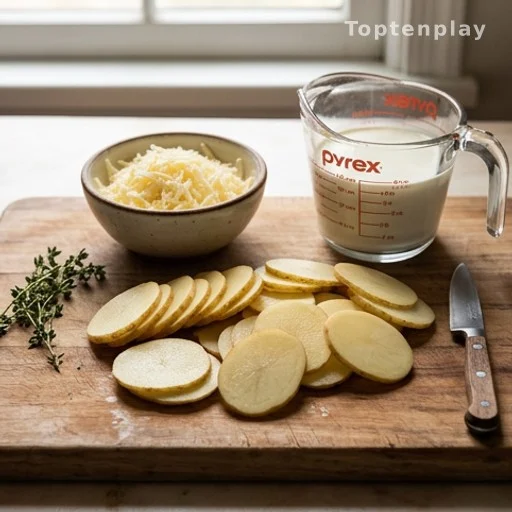
The technique begins before the oven is even switched on. The muffin tin must be generously greased — with butter or nonstick spray — because, as the original notes warn, «these cups cling if under-greased.» The oven is set to 375°F (190°C).
One instruction stands out as both counterintuitive and essential: do not rinse the potato slices after cutting. The surface starch left on each slice is what naturally thickens the cream as the cups bake, binding the layers together without any added flour or thickener. It is a technique that predates the widespread use of cornstarch in home kitchens and remains just as effective today.
Muffin tin engineering: why the format works so well
The standard 12-cup muffin tin does more than shape the portions — it fundamentally changes how the gratin cooks. Each cup has a high ratio of exposed surface area to volume, which means more of the cream reduces and caramelizes, and more of the cheese forms a crisp, browned crust. A traditional gratin dish, by contrast, produces mostly soft interior with a single top layer of browning.

The result is described as «golden, bubbling portions with crisp, caramelized edges» — a texture profile that a large baking dish simply cannot replicate uniformly across every serving. The edges of each muffin cup act like a miniature gratin dish wall, concentrating heat and encouraging that caramelization on all sides.