📌 Taro: how this millennial tuber improves heart health and revolutionizes sustainable agriculture
Posted 25 January 2026 by: Admin
Taro: The Forgotten Treasure of Global Agriculture
Long before wheat shaped Mediterranean civilizations or corn fed the Americas, a discreet tuber was already thriving in the tropics. Formal archaeological evidence places the cultivation of taro (Colocasia esculenta) more than 10,000 years ago, ranking this plant among the very first species domesticated by humanity. This antiquity reveals a rarely highlighted truth: taro is not a recent food fad, but a millennial nutritional pillar.
Its geographical trajectory testifies to an exceptional capacity for adaptation. Starting from Southeast Asia, taro conquered the Pacific archipelagos, crossed the Indian Ocean to Africa, then reached the Caribbean via trade routes. This massive diffusion explains the multiplicity of its names: kalo for the Hawaiians who made it a sacred food, dasheen in the Caribbean islands, arbi in South Asia. Each name reflects a deep cultural anchoring, a sign that this tuber far exceeds its status as a simple starch.
The agricultural resilience of taro fascinates as much as its history. Unlike demanding crops requiring sophisticated irrigation or fertile soils, this plant thrives in hostile environments: marshy areas, depleted lands, hot and humid climates. This robustness transforms taro into a strategic ally for tropical regions facing climatic challenges, while shedding light on why so many traditional societies granted it a central place in their diet and rituals.
Nutritional Profile: Why Science is Rediscovering Taro
This historical legitimacy is based on precise biochemical foundations. Taro distinguishes itself from refined starches by its composition of slow-digesting complex carbohydrates, avoiding the sharp glycemic peaks characteristic of white bread or processed potatoes. This gradual release of energy supports mental concentration and physical endurance over several hours, a crucial advantage for traditional agricultural populations as well as for contemporary lifestyles.
The density of dietary fiber in taro deserves particular attention. Beyond their satiating effect, these fibers regulate the insulin response and promote the balance of the intestinal microbiota. This dual action explains why taro displays a lower glycemic load than many modern substitutes, positioning this tuber as a strategic alternative for metabolic management.
The micronutritional arsenal completes this solid energy base. Vitamin C strengthens cellular immunity, vitamin E protects against oxidation, while the potassium-magnesium-manganese trio supports heart function, nerve transmission, and bone health, respectively. These elements are not present in symbolic traces: their concentration reaches nutritionally significant thresholds according to recent phytochemical analyses.
Two final characteristics reinforce its profile: the natural absence of gluten opens taro to exclusion diets, while its minimal lipid content preserves cardiovascular health. This rare combination—sustainable energy, metabolic regulation, mineral richness, dietary compatibility—explains the renewed scientific interest in a food that traditions had never abandoned.
From Root to Leaves: Exploiting Every Part of the Plant
This nutritional richness takes on full meaning when considering the integral use of the plant. Unlike conventional tubers where only the root finds culinary use, taro values every plant component according to techniques passed down over generations.
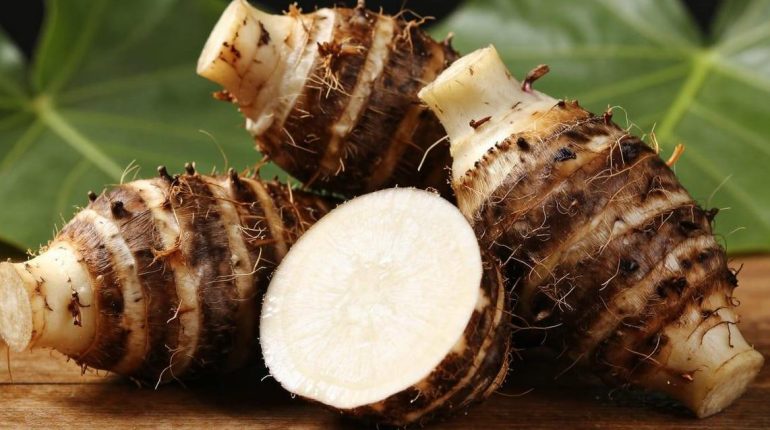
The tuber itself offers remarkable plasticity in the kitchen. Boiled or steamed, it reveals a creamy texture and a slightly nutty taste that easily accommodates various seasonings. Roasted or fried, it develops a crispy crust prized in chip or fry-type preparations. Pureed, it rivals the potato while providing superior nutritional density. This versatility extends to desserts—ice creams, cakes, puddings—where its subtle flavor does not mask other ingredients.
Taro leaves, however, are the revelation for anyone unaware of their potential. After complete cooking to neutralize calcium oxalate crystals, they deliver exceptional concentrations of vitamins A and C, iron, and calcium. Philippine laing—leaves simmered in spiced coconut milk—illustrates how this neglected part becomes a complete dish. Traditions of leaves stuffed with rice or as vegetables, such as soups enriched with young shoots, testify to a culinary wisdom maximizing available resources.
This zero-waste approach is not a contemporary fad, but a millennial agricultural logic where every cultivated element deserves transformation. Taro thus embodies a nutritional model where the optimization of plant resources precedes current food sustainability concerns by several centuries.
Health Impact and Sustainability: The Concrete Assets of Taro
This integral valuation finds its extension in the measurable benefits for human health and agricultural ecosystems. Taro operates at the rare intersection where nutritional performance and environmental resilience converge without compromise.
On the cardiovascular level, the potassium-fiber combination documented in the tuber supports natural blood pressure regulation. The 591 mg of potassium per 100 g of cooked taro promotes sodium balance, while soluble fibers contribute to maintaining stable cholesterol. Antioxidants—notably vitamin E and beta-carotene—protect cells from oxidative stress, a mechanism involved in cellular aging and chronic inflammation.
The resistant starch present in taro cooled after cooking acts as a prebiotic, nourishing the intestinal microbiota without glycemic peaks. This property explains why populations traditionally consuming taro display lower diabetes rates than regional averages, according to several epidemiological studies conducted in the Pacific.
But the decisive asset of taro lies in its minimal ecological footprint. Capable of thriving in waterlogged soils where most crops fail, it requires neither costly drainage nor intensive chemical inputs. Its tolerance for depleted lands makes it an ally of agroecological systems seeking to restore natural fertility. The complete use of the plant—root, leaves, sometimes stems—eliminates waste in the field, a luxury few industrial crops can claim.
This dual efficiency positions taro as a concrete response to contemporary food challenges, where optimal nutrition and regenerative agriculture no longer oppose but reinforce each other.