📌 Sweetened condensed milk flan: the creamy recipe in 15 minutes for a result worthy of a Latino dessert
Posted 18 February 2026 by: Admin
The Secret of an Irresistible Flan: The Alliance of Condensed Milk and Golden Caramel
There are desserts that cross borders effortlessly, carried by their sheer deliciousness. Sweetened condensed milk flan is one of them. Directly inspired by the great pastry traditions of Latin America, it stands out as one of the most seductive preparations there is — and yet among the most accessible.
Its secret? A unique ingredient that changes everything: sweetened condensed milk. Unlike the classic flan, whose texture can sometimes lack character, this version develops a remarkable density, a deep creaminess, and a light caramelized note that literally melts in the mouth. Condensed milk acts as a natural texture enhancer, concentrating sweetness and richness without extra effort.
The other asset of this dessert is its disarming simplicity. Six ingredients are enough — sweetened condensed milk, whole milk, eggs, sugar, vanilla, and water — to obtain a result worthy of a festive table. Fifteen minutes of preparation, and the promise of a dessert that impresses without stressing, whether for a family meal or for entertaining guests.
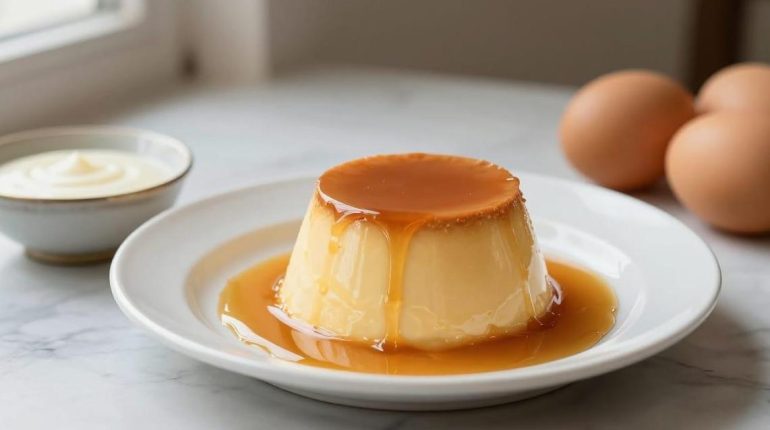
The golden caramel that generously coats the flan upon leaving the refrigerator completes this gourmet picture. An association as simple as it is effective, where each element plays a precise role. Because behind this apparent ease lie a few technical gestures that make all the difference between an ordinary flan and an exceptional one.
From the Saucepan to the Mold: Mastering the Caramel and the Flan Mixture
These technical gestures that make the difference begin with the very first step: the caramel. In a small saucepan, the sugar and water heat over medium heat — without ever being stirred. The rule is absolute: observe, tilt the saucepan slightly to homogenize the cooking, but do not touch. The sugar melts gradually until it reaches that deep amber hue that marks a perfect caramel.
As soon as this color is reached, speed becomes imperative. The caramel is immediately poured into the mold, which is tilted in all directions to coat the entire base uniformly. A few minutes are enough for it to harden and form that shiny bottom that will give the flan its visual signature.
The flan mixture requires the same attention. The sweetened condensed milk and whole milk are first mixed until completely homogeneous — this alliance constitutes the creamy heart of the dessert. The eggs are then incorporated one by one, whisked gently: too much vigor would incorporate air and create unsightly bubbles during cooking.
Last decisive step: filtering through a fine sieve. This gesture, often neglected, guarantees a perfectly smooth mixture, without lumps or impurities. The preparation is then gently poured over the set caramel — and it is at this precise moment that the magic begins to happen. The final texture depends largely on what happens in the oven.
The Bain-Marie: The Cooking Ritual That Makes All the Difference
It is in the oven that the flan’s fate is decided — and the method matters as much as the ingredients.
The filled mold is placed in a large dish, surrounded by hot water up to halfway: the bain-marie creates a gentle and enveloping heat, which cooks the mixture uniformly without ever being aggressive. The oven, preheated to 170°C, maintains this stable atmosphere for 45 to 50 minutes.
The criterion for perfect cooking is not measured by a thermometer but by the eye: the edges must be well set, while the center remains slightly wobbly. This jiggle is not a sign of insufficiency — it is precisely what we are looking for. The flan will continue to firm up as it cools. Too intense a heat would cause the opposite effect: a grainy, porous texture that betrays all the care given to the previous steps.
Once out of the oven, the flan rests at room temperature before joining the refrigerator for a minimum of three hours. This rest is not optional: it transforms the still-supple mixture into a firm, dense, and melting cream.
Unmolding is the ultimate technical gesture. A knife blade gently runs along the edges to loosen the flan from the mold, then a quick flip onto a plate releases the golden caramel — which naturally flows in a generous layer over the entire dessert. The visual result is striking, and it faithfully announces what the spoon will confirm.
Personalizing Your Flan: Variations and Chef’s Tips for a Perfect Result
This flan, already remarkable in its classic version, offers a creative margin that cooking enthusiasts will appreciate.
The first tip takes ten seconds: run the mixture through a blender before pouring it over the caramel. This simple gesture homogenizes the preparation to a level that the whisk cannot reach, guaranteeing an even silkier and more uniform texture upon tasting.
The most seductive variation remains the substitution of whole milk with coconut milk. The result? A flan with soft exotic notes, reminiscent of island desserts without betraying the sweet-caramelized balance of the original recipe. A simple exchange of ingredients is enough to transport this classic to new gustatory horizons.
What makes this dessert particularly precious is its effort-to-result ratio: 15 minutes of preparation and 50 minutes of cooking for a result of disarming elegance. A dessert that impresses without constraint, ideal for both an intimate dinner and a festive table.
The recipe adapts, personalizes, and travels — but always retains that melting, dense signature generously coated in golden caramel that makes it, from the first bite, a dessert that you never prepare just once.