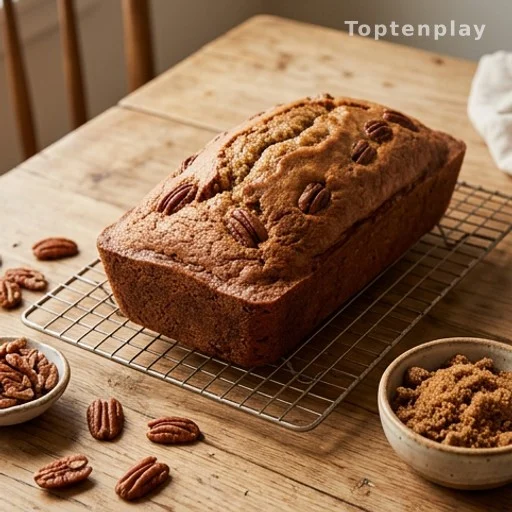
At its core, the loaf is a quick bread, meaning it rises with baking soda rather than yeast and requires no kneading, no proofing, and no stand mixer. Everything comes together in a single large mixing bowl. The flavor profile sits somewhere between a rich banana bread and a gourmet pecan pie — deeply caramelized, warmly spiced, and dense with toasted nuts.
The recipe calls for 2 cups of all-purpose flour, 1 cup of packed dark brown sugar, 1 teaspoon of baking soda, half a teaspoon of salt, 1 teaspoon of ground cinnamon, and half a teaspoon of ground nutmeg. Three large eggs at room temperature complete the base, ensuring a smooth blend and a steady lift in the oven.
The avocado oil swap that keeps the crumb moist without heavy dairy
The most distinctive choice in this recipe is the fat. Where most quick bread recipes default to melted butter or neutral vegetable oil, this one calls for half a cup of avocado oil. The author is direct about the reasoning: avocado oil has a neutral flavor that won’t compete with the pecans or spices, a high smoke point that suits oven baking, and a fat profile — rich in monounsaturated fats — that she associates with heart-healthy cooking.

The practical result is a crumb that stays moist for days without the heaviness that butter can introduce. For anyone avoiding dairy, it also makes the loaf entirely dairy-free without any noticeable compromise in texture or taste. The recipe notes that melted coconut oil or light olive oil work as direct substitutes for those who don’t have avocado oil on hand.
The wet ingredients are kept deliberately simple: the avocado oil, three eggs, and one teaspoon of pure vanilla extract are whisked together in a separate bowl until smooth and uniform before being folded into the dry mixture. Keeping wet and dry ingredients apart until the last moment is a standard quick bread technique that prevents overdevelopment of gluten and keeps the final texture tender rather than tough.
What makes a quick bread quick
Unlike yeast breads, quick breads use chemical leaveners — baking soda or baking powder — to rise, which means no proofing time and no kneading. The technique originated as a practical solution for home bakers who needed results fast, and it became a staple of Southern American baking from the 19th century onward. Pecan-based baked goods are a regional signature across Alabama, Georgia, and the wider Deep South, where pecan trees are abundant.
Why toasting the pecans first is non-negotiable
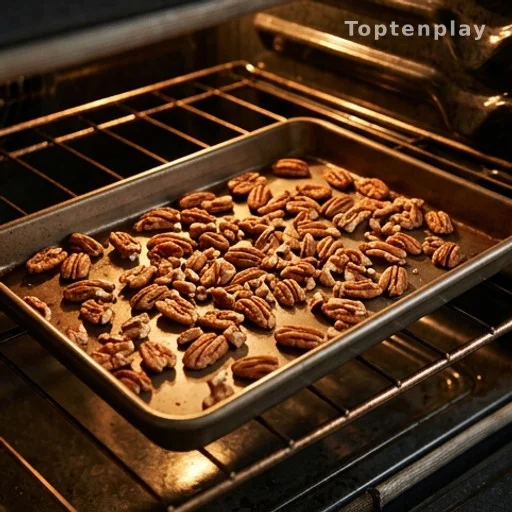
The recipe is unambiguous on one point: toast the pecans first. The 1.5 cups of pecan halves, roughly chopped, go onto a small baking sheet and into the preheated 350°F (175°C) oven for five to seven minutes, until fragrant. The explanation is both practical and scientific — toasting releases the nuts’ natural oils, which intensifies their flavor dramatically and, crucially, prevents them from sinking to the bottom of the batter during baking.
The chemistry behind the loaf’s appealing crust also gets attention. When the batter hits the hot oven, the baking soda creates a gentle, steady lift. Simultaneously, the dark brown sugar and the proteins in the toasted pecans undergo the Maillard reaction — the same browning process responsible for the crust on a well-seared steak or a perfectly baked baguette. The result is a deeply golden, slightly crisp exterior that gives way to a moist, tender interior.