📌 Summer cake: how buttermilk makes this strawberry dessert exceptionally soft
Posted 25 March 2026 by: Admin
The Secrets Of An Exceptional Cake
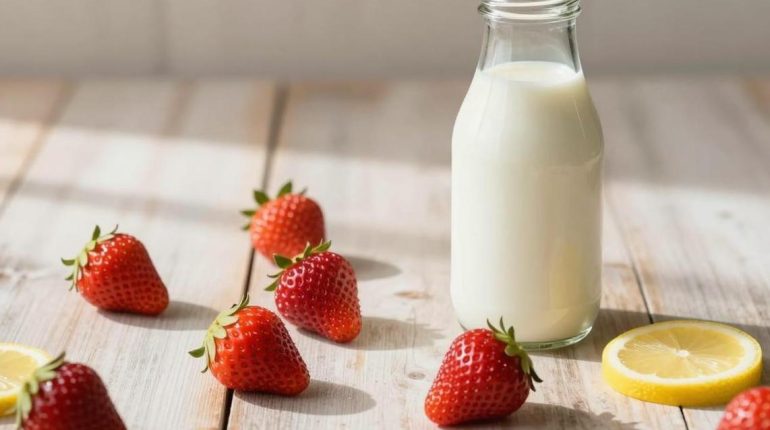
This strawberry lemonade and buttermilk cake reveals a rare alchemy: three apparently ordinary ingredients merge to create a spectacular texture. Fresh strawberries bring their natural juiciness, lemon breathes in a tangy note that wakes up the taste buds, while buttermilk plays the role of chemical developer. When it comes into contact with baking powder and baking soda, the latter triggers a reaction that literally transforms the structure of the batter, producing an incredibly soft and airy crumb impossible to obtain with classic milk.
This accessible recipe gives a result worthy of professional pastry shop windows. Unlike sophisticated desserts requiring complex techniques or rare ingredients, this one relies on precision of execution rather than difficulty. Each bite combines fruity sweetness and lemony freshness in a texture that literally melts in your mouth.
This cake’s versatile character makes it the perfect ally for summer occasions: it withstands transport for picnics, remains delicious at room temperature during family snacks, and impresses as a dessert after a light meal. Its ability to capture the essence of summer in a simple slice explains why this recipe designed for sunny days deserves special attention to the techniques that guarantee its success.
The Technique Of Professional Pastry Chefs
The success of this cake rests on three precise technical gestures that pastry chefs master instinctively. The first, called creaming the butter, consists of beating the softened butter with the sugar for 3 to 5 minutes until a pale and airy mixture is obtained. This crucial step incorporates thousands of microscopic air bubbles that will serve as the structure for the cake, transforming a dense batter into a light dessert. Without this prolonged whisking, the final texture would lose all its characteristic softness.
Sifting the dry ingredients constitutes the second technical pillar. By passing the flour, baking powder, baking soda, and salt through a fine sieve, lumps are eliminated and the leavening agents are uniformly dispersed throughout the mass. This homogeneous distribution guarantees that each portion of batter will rise identically, avoiding compact areas or irregular air bubbles.
The third decisive technique concerns alternating incorporation: adding the sifted flour and buttermilk in three parts, always starting and ending with the dry ingredients. This method avoids overworking the batter, as mixing just enough to combine the elements preserves the air bubbles created during creaming. Excessive mixing after adding the flour develops gluten and produces a rubbery cake instead of a tender and crumbly crumb.
Room temperature for all liquid ingredients—eggs, butter, buttermilk—completes these essential gestures. Cold ingredients cause the batter to separate and prevent correct emulsion, compromising the final structure even before baking.
Mastering Baking And Glazing
Once the batter is prepared according to the rules of the art, the oven becomes the field where the final success is played out. The temperature of 175°C represents the perfect balance: high enough to immediately activate the baking powder and soda, but moderate enough to prevent the crust from browning before the center is cooked. The toothpick test remains the infallible indicator after 45 to 50 minutes: it must come out clean or with a few moist crumbs, never with sticky liquid batter.
Since domestic ovens all have temperature variations, monitoring from 40 minutes is an indispensable precaution. Five minutes of excessive baking transforms a soft cake into a dry and crumbly dessert, irremediably compromising the work accomplished during preparation.
Cooling takes place in two strategic phases. Fifteen minutes in the pan allow the still fragile structure to firm up without collapsing during unmolding. Then, thirty minutes on a wire rack complete the process by letting residual moisture evaporate uniformly. This step becomes crucial for the glaze: applied to a still warm cake, the mixture of powdered sugar and lemon juice melts instantly and disappears into the crumb instead of forming that characteristic shiny and tangy topping.
The consistency of the glaze is adjusted by the amount of lemon juice: thick for a uniform topping, more fluid to obtain that dripping effect on the edges that visually signs successful pastry creations.
Storage And Gourmet Adaptations
The paradox of this cake lies in its maturation: far from deteriorating over time, it gains aromatic depth after a few hours in the refrigerator. The strawberries gradually release their juice into the crumb, the lemon zest diffuses its essential oils, and the buttermilk continues to tenderize the structure. Kept for two to three days in an airtight container, it reaches its taste peak the day after its preparation, making immediate consumption unnecessary.
This storage capacity naturally designates it for picnics and transport: unlike cream or mousse-based cakes, it remains delicious at room temperature without risking collapse or bacterial contamination. Its dense but soft structure resists handling without crumbling.
Adaptations open a field of possibilities for specific diets. The gluten-free version simply requires an adapted flour mix, while the vegan option replaces butter with vegetable margarine and eggs with applesauce or ground flaxseeds, preserving the texture thanks to plant-based buttermilk. Blueberries can substitute for strawberries for an equally successful chromatic and taste variation.
The final presentation amplifies the experience: a scoop of vanilla ice cream contrasts the creamy cold with the softness of the cake, while whipped cream brings a milky sweetness that softens the acidity of the lemon. With 350 to 400 calories per portion, this dessert remains reasonable for a pastry so generous in flavors.