Is there a more honestly summery dessert than a strawberry charlotte? No oven, no intimidating technique — just common sense, fruit in peak season, and a cream whipped by hand. It’s exactly the kind of preparation you start on a Saturday morning, before the day gets busy.
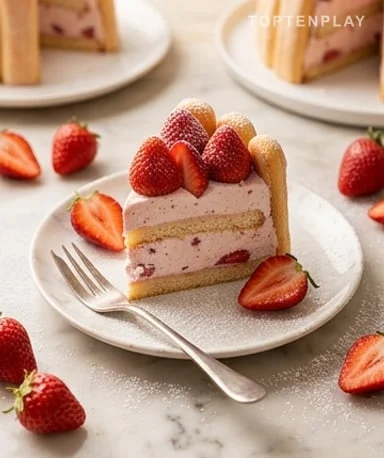
Once unmolded, the charlotte has that slightly precious look that few homemade desserts can claim: golden ladyfingers tight like a fence, the top crowned with shiny strawberries that still smell of the sun. Inside, the mousse is a pale, almost pastel pink, light yet dense, with that sweet-tartness from Gariguette coulis mixed into the cream. You take it out of the fridge after six hours of waiting, and it holds perfectly, without wobbling or sinking. It’s the reward for patient people.
Why you’ll love this recipe
Ingredient Notes
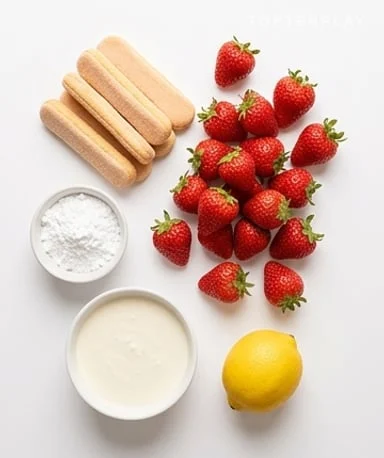
Gariguette strawberries, cold whole cream, and ladyfingers: three ingredients that do it all.
- Ladyfingers (20 pieces) : They serve as both structure and sponge. Once soaked in syrup, they gradually soften with contact from the mousse and fridge humidity — that transition from crisp to melting is what gives the charlotte its character. Use good quality ladyfingers, not too thin, otherwise they collapse as soon as you dip them. Also avoid soaking the sugar side: the domed side absorbs better without disintegrating.
- Gariguette strawberries (500 g) : Gariguette isn’t just a name on a label: it’s an elongated variety, slightly tart, with a fragrance that holds up to cooking. In peak season (April to June), it has no equal for a coulis. If you can’t find them, Charlotte or Ciflorette strawberries do the job well — avoid out-of-season Spanish greenhouse strawberries, their coulis will be bland and watery.
- Cold whole liquid cream (40 cl) : The important word here is cold. The fat in the cream must be almost solid to trap air when whipping. If your cream is at room temperature, it won’t whip or will collapse within hours. Put it in the fridge the day before, along with the bowl and beaters if possible — especially in summer. Minimum 30% fat: below that, forget about holding.
- Granulated sugar + powdered sugar : Granulated sugar (50 g) goes into the whipped cream while it’s whipping — not at the beginning, otherwise it weighs it down. Powdered sugar (20 g) is used to sweeten without graininess: it dissolves instantly and gives a smoother texture to the mousse. The two do different jobs and are not interchangeable here.
- Lemon juice (2 tsp) : Two teaspoons is little, but enough to enhance the strawberry coulis without identifying the lemon. Its acidity balances the sugar and reinforces the natural flavor of Gariguette. Without it, the mousse tends to taste a bit flat, especially if the strawberries aren’t at peak ripeness.
- Syrup (water + sugar, 15 cl / 80 g) : The syrup isn’t just to randomly hydrate the ladyfingers — it conditions them to absorb moisture evenly without falling apart. Syrup that’s too hot softens them too quickly and the ladyfingers break; too cold, it doesn’t penetrate enough. Let it cool until warm to the touch but bearable before starting.
Make the syrup first — while it cools, you save time
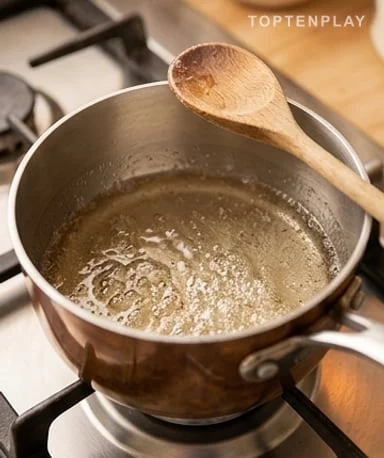
Always start with the syrup, not the cream. The reason is simple: it needs to cool before use, and that cooling takes ten to fifteen minutes. Pour the water and sugar into a small saucepan, heat over medium heat without a lid. After two to three minutes, the mixture starts to simmer — small bubbles rise at the edges, the sugar is dissolved, and the consistency is slightly syrupy. We’re not looking for a caramel or a thick syrup: just sweetened water with a bit of body. Remove from heat and set the pan on a cold towel to speed up cooling. Meanwhile, prepare your charlotte mold or a round bowl of similar size, and start sorting your strawberries.
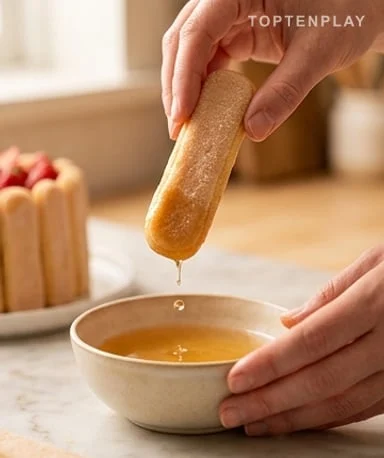
Dip the ladyfingers with measure, neither too much nor too little
This is the step that scares people unnecessarily. We imagine the ladyfingers collapsing into mush as soon as they touch the syrup — that happens, but only if you leave them to soak. The right technique: a quick dip, one to two seconds maximum, domed side up. The ladyfinger should be moist on the surface but not soaked. When held between two fingers, it should still offer slight resistance. Then place them on the edges of the mold, sugar side against the wall for a cleaner look when unmolding, pressing them tightly together. Line the bottom the same way, cutting a few ladyfingers if needed to fill gaps. The smell of warm syrup on the ladyfinger is sweet, almost vanilla-like — it signals that the soaking is going well.
For the strawberry whipped cream, add the coulis slowly and by hand
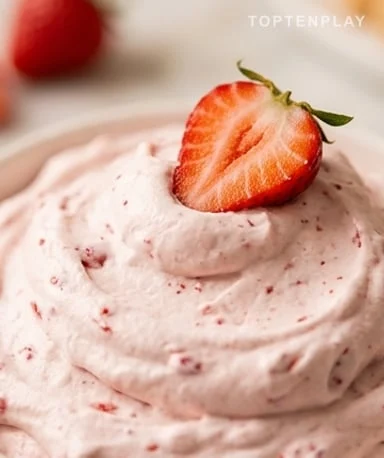
Hull 300 g of strawberries and blend them until smooth. Strain through a fine sieve, pressing with the back of a spoon — this removes seeds and small bits that would break the mousse texture. Reserve this coulis. Now whip the well-chilled heavy cream in a large bowl. With an electric mixer, start at medium speed to gradually incorporate air, then increase. Add the granulated sugar when the cream begins to thicken, not before. It’s ready when it holds a soft peak on the whisk — firm but not grainy. This is where it gets delicate: incorporate the strawberry coulis in a stream, folding gently with a spatula rather than whisking. If you whisk, you’ll tighten the cream and make it curdle. The result should be a uniform pink, airy, with that smell of fresh strawberries rising directly from the bowl.
Assemble the charlotte layer by layer, without rushing
Hull the remaining strawberries and cut them in halves or quarters depending on size. Spread a first generous layer of mousse over the bottom ladyfingers — about a third of the preparation. Distribute a layer of strawberry pieces, spacing them slightly so they are well enrobed in the surrounding cream. Add a new layer of soaked ladyfingers flat, then repeat with mousse and strawberries. Finish with a layer of mousse, roughly smoothed with a spatula. No need for perfection here: the surface will be flipped at unmolding. Cover with plastic wrap directly on the mousse to prevent a skin from forming, then place a plate with a light weight on top — this slight pressure helps the layers consolidate during resting.
Unmold cold, with a thin knife and without rushing
After at least six hours in the refrigerator — overnight is even better — the charlotte is firm, the layers have fused, and the ladyfingers have that half-melting texture we’re after. Run a thin knife blade between the ladyfingers and the mold in a continuous motion to release the sides. Place your serving plate upside down on top of the mold, then flip decisively. Lift the mold slowly — it should detach without force. If you feel resistance, an extra knife cut usually does it. Arrange the remaining strawberries on top and serve immediately: once unmolded, the charlotte begins to soften at room temperature.
Tips & Tricks
- Never whip cream in a warm bowl or with cream at room temperature: the fat only traps air when cold, otherwise the mousse falls within minutes and can’t be saved.
- Always strain the strawberry coulis before incorporating it into the cream, even if it seems tedious: small pulp bits create weak points in the whipped cream and prevent it from holding uniformly.
- If your mold is wide and the ladyfingers won’t stand on their own, hold them in place with a strip of parchment paper along the wall during assembly — remove it just before unmolding.
- The charlotte benefits from a full night’s rest rather than the minimum six hours: flavors meld better, ladyfinger texture is more uniform, and unmolding is cleaner.
Can the charlotte be prepared the day before?
It’s even recommended. A full night in the fridge gives a far superior result to the minimum six hours: the ladyfingers reach their ideal half-melting texture, the layers consolidate, and unmolding is cleaner. Cover it with plastic wrap placed directly on the surface to prevent it from picking up fridge odors.
Can frozen strawberries be used instead of fresh?
For the coulis, yes, provided they are fully thawed and drained of excess juice before blending — frozen strawberries release a lot of water, which would liquefy the whipped cream. For decoration and interior layers, however, fresh strawberries are indispensable: frozen ones become mushy and release water upon contact with the cream.
My whipped cream won’t whip, what do I do?
The cause is almost always temperature: cream not cold enough, warm bowl, or a hot kitchen in summer. Put cream and bowl in the freezer for ten minutes, then start again. If the cream has already been overworked and starts to grain, there’s no going back — better to buy more and start fresh with all equipment well chilled.
How to avoid ladyfingers being too soggy?
The dip must be quick: one to two seconds maximum, no more. The ladyfinger should be moist on the surface but still slightly resistant between your fingers. Syrup that’s too hot instantly softens the ladyfingers, which is why we wait until it’s lukewarm before starting. If despite this a ladyfinger breaks, reposition the pieces in the mold — it won’t show when cut.
How long does the charlotte keep in the refrigerator?
Maximum two days after assembly, covered with plastic wrap. Beyond that, the ladyfingers soften too much and the cream starts to separate slightly. Do not freeze it: whipped cream does not handle freezing and would release water upon thawing, collapsing the structure.
Can ladyfingers be replaced with something else?
Pink Reims biscuits work well and give a natural pink color to the wall — they are also a bit firmer, making them easier to dip without risk. Pavesini (similar Italian biscuits but thinner) also work but require an even shorter dip. Avoid very thin industrial boudoir biscuits that collapse upon contact with the syrup.
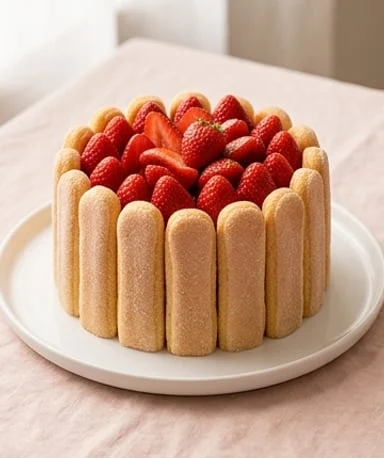
Strawberry Charlotte with Whipped Cream
French
Desserts
A classic charlotte with Gariguette strawberries and homemade whipped cream, layered and rested overnight in the fridge. No baking, no intimidating technique — just time and good fruit.
Ingredients
- 20 ladyfingers
- 500 g Gariguette strawberries
- 40 cl cold whole liquid cream (min. 30% fat)
- 50 g granulated sugar
- 20 g powdered sugar
- 2 tsp lemon juice
- 15 cl water (for syrup)
- 80 g granulated sugar (for syrup)
Instructions
- 1In a small saucepan, bring water and 80 g sugar to a simmer over medium heat. Stir until sugar is fully dissolved, then remove from heat and let cool for 10 to 15 minutes.
- 2Hull 300 g strawberries and blend until smooth. Strain through a fine sieve, pressing with the back of a spoon to obtain a coulis without pieces. Add lemon juice and set aside.
- 3Quickly dip ladyfingers into the warm syrup (1 to 2 seconds, no more) domed side up. Line the sides of the charlotte mold, pressing them tightly together, then line the bottom, cutting ladyfingers if necessary.
- 4In a large well-chilled bowl, whip the heavy cream at medium then high speed. When it begins to thicken, add the granulated sugar. Continue until stiff peaks form, with a soft peak on the whisk.
- 5Add the strawberry coulis in a stream, gently folding with a spatula. Do not whisk. The mousse should be uniform and pale pink.
- 6Hull the remaining strawberries and cut into halves or quarters. Spread one-third of the mousse over the bottom ladyfingers, distribute a layer of strawberries, add a layer of soaked ladyfingers, then repeat. Finish with a layer of mousse smoothed with a spatula.
- 7Cover with plastic wrap directly on the surface, place a plate with a light weight on top, and refrigerate for at least 6 hours, ideally overnight.
- 8To unmold, run a thin knife blade between ladyfingers and mold. Place serving plate upside down on the mold and flip decisively. Decorate with remaining strawberries and serve immediately.
Notes
• The cream must be very cold before whipping — also place the bowl and beaters in the refrigerator 15 minutes before starting, especially in summer.
• Always strain the coulis before adding to the whipped cream: small pulp pieces prevent the cream from holding uniformly.
• If you don’t have a charlotte mold, a round bowl of similar size works well — line it with plastic wrap before filling to facilitate unmolding.
• The charlotte keeps for 2 days in the refrigerator, covered with plastic. It does not freeze well.
Nutrition Facts (per serving, estimated)
| 468 kcalCalories | 5 gProtein | 53 gCarbs | 26 gFat |