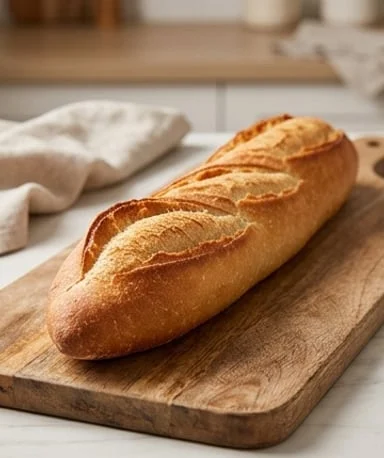
There is a distinct sound when you place a homemade baguette on the rack just out of the oven — a dry, almost fragile crackling that announces the crust has done its job. The smell follows a second later: warm wheat, slightly caramelized, with that subtle yeasty undertone that only real bread has. Five ingredients, a few hours of patience, and that sound is yours.

Ingredients :
- T55 flour (490 g) — T55 is the standard flour of French bakeries for baguettes: its gluten content is balanced, neither too elastic like T45 pastry flour nor too rustic like T80. It gives a light crumb with good structure. If you don’t have it, T65 works very well and adds a slightly more pronounced flavor, closer to a traditional baguette.
- Instant dry yeast (1 packet) — Yeast is what transforms flour and water into something alive. Instant dry yeast (like Briochin) can be incorporated directly into the dough without prior rehydration, but reactivating it in warm water with sugar remains a good habit: it lets you check that it’s still active before investing two hours of rising. If you have fresh yeast, use about 10 g to replace a 7 g packet.
- Warm water (300 g) — Water temperature is more important than you might think. Too cold, the yeast remains dormant and the dough takes forever to rise. Too hot — above 40°C — and you kill the ferments, the dough won’t rise at all. The sweet spot is between 25 and 30°C: barely warm to the touch, never hot. A kitchen thermometer removes all doubt.
- Fine salt (2 teaspoons) — Salt isn’t just for flavor. It regulates fermentation by controlling yeast activity, and it strengthens the gluten network for a more structured crumb. That’s why you never mix it directly with yeast: salt kills the ferments on contact. First, mix the salt into the dry flour, the yeast into the water, then combine.