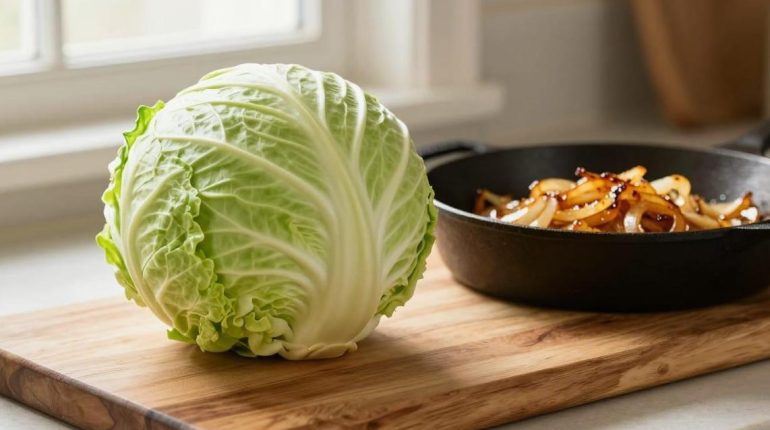
📌 Steamed cabbage and caramelized onions: the budget recipe that transforms a humble vegetable into a flavorful side dish
Posted 16 March 2026 by: Admin
A Budget Recipe That Transforms A Humble Vegetable
Green cabbage has a mediocre reputation in our kitchens. However, when it meets the right technique, this economical vegetable reveals an unsuspected nature: tender, silky, slightly sweet. This metamorphosis is not a culinary miracle, but the result of controlled cooking that releases its buried qualities.
On the wallet side, the equation is attractive. A head of cabbage costs a few dollars and can feed two people for four meals. This remarkable longevity is accompanied by flawless storage in the refrigerator, sometimes for several weeks without losing its freshness. In an era where food budgets are tightening, this yield is impressive.
Preparation requires neither virtuosity nor a full set of cookware. A single pot is enough, a few basic cuts, and you’re done. No obscure techniques or specialized equipment. The cabbage undergoes gentle steaming in a mixture of caramelized onions, garlic, and butter, gradually absorbing these gourmet flavors.
This financial and technical accessibility makes steamed cabbage with caramelized onions much more than a simple emergency side dish. It is a concrete demonstration that budget cooking can spark desire, and even create an unexpected addiction to a vegetable long relegated to the background.
The Cooking Technique That Makes All The Difference
This transformation of the cabbage is not by chance. It relies on a precise technical sequence that extracts the best from each ingredient. It all starts with the onions, caramelized for 8 to 10 minutes until they reach that light golden brown that concentrates their natural sugars. This initial step builds the aromatic foundation of the dish.
Then comes the decisive choice: replacing water with broth. Chicken or vegetable, it doesn’t matter, as long as this liquid brings its flavor profile. Because the steam generated doesn’t just cook the cabbage, it literally infuses it. Every fiber of the vegetable absorbs these aromas during the 10 to 15 minutes of covered cooking, reaching that sought-after tender-crisp texture.
Timing matters. Too short, and the cabbage remains firm and bitter. Too long, and it becomes soft and bland. The 10 to 15-minute window offers reasonable leeway, with one or two stirs to ensure even cooking. If the vegetables stick, a few spoonfuls of water are enough to deglaze the bottom without drowning the flavors.
The finishing touch happens off the heat: two spoonfuls of apple cider vinegar. This final acidity balances the richness of the butter and wakes up the whole dish. Without it, the dish would remain one-dimensional, too round. With it, every bite gains depth and relief.
Strategic Ingredients For A Perfect Alliance
This technical success is not enough without the right components. At the heart of the equation is butter, three spoonfuls that melt in the pot and that the cabbage absorbs like a sponge. This fat and this vegetable form a natural duo, one providing richness, the other the structure that captures and diffuses it.
Sliced yellow onion and minced garlic build the aromatic base. No fancy stuff here, just two staples that deliver exactly what is expected of them: depth and character. The first brings its sweet mildness after caramelization, the second its fleeting pungency that fades with heat.
Celery salt remains optional but deserves attention. This optional pinch injects a discreet savory note, almost umami, which highlights the vegetable without masking it. Those who omit it will simply need to slightly increase the amount of regular salt to maintain the balance.
To finish, fresh chopped herbs transform the visual and the taste. Parsley, dill, chives, or tarragon—each brings its signature. Parsley remains neutral and bright, dill evokes Eastern Europe, chives soften, tarragon sophisticates. The choice of herb will subtly guide the final identity of the dish, from rustic to refined depending on the mood of the moment.
This calculated simplicity proves that with few well-chosen elements, you get a result that far exceeds the sum of its parts.
A Versatile Side Dish For All Occasions
This mastery of ingredients and cooking gives steamed cabbage a rare adaptability. It pairs with practically any protein, like its cousins roasted cabbage and cabbage steaks which show the same flexibility of use.
Chicken finds a natural partner in it, especially Chicken Francese whose lemony sauce resonates with the apple cider vinegar. Sausages and kielbasa offer an even more direct path: just slice them and integrate them directly with the cabbage during cooking, transforming the side dish into a complete meal.
For St. Patrick’s Day, corned beef brisket traditionally calls for this type of preparation. The cabbage absorbs the salty juices of the braised meat, creating that rustic harmony that guests expect every March 17th. Pork, in the form of oven-baked chops, completes this panorama by bringing its melting fat that dialogues with the butter already present in the preparation.
This versatility explains why this dish returns frequently to the rotation. In the refrigerator, it keeps for up to four days in an airtight container. Reheating is done gently in a pan over medium heat or in the microwave until the desired temperature is reached. Freezing is not recommended: the cabbage becomes mushy after thawing, losing that tender-crisp texture that makes it interesting.
A reliable side dish is recognized by its ability to disappear from plates without ever stealing the spotlight. This one masters that delicate balance.