📌 Slimming lunch: how to transform your tuna sandwich into a breadless dish ready in 15 minutes
Posted 10 March 2026 by: Admin
A Classic Revisited: The Breadless Tuna Sub
Inspired by Jersey Mike’s counters, this “sub-in-a-tub” version reproduces the experience of an authentic Italian sandwich by eliminating the bread. The principle? All the signature ingredients of a deli sub—creamy tuna, crunchy vegetables, tangy vinaigrette—served in a bowl on a bed of lettuce. This transformation saves 265 calories per serving compared to 600 to 800 for a traditional sandwich, while preserving the flavors that make Italian subs famous.
The nutritional equation leans resolutely in favor of this variation: low in carbs with only 9g per serving, it boasts 16.5g of protein which maintains satiety for several hours. Ready in 15 minutes flat, it meets the demands of busy lunches without sacrificing taste quality. The secret lies in the architecture of flavors: each ingredient plays its precise role to recreate the characteristic balance of subs—the acidity of red wine vinegar counterbalances the richness of the mayonnaise, banana peppers bring that signature spicy touch, and chopped broccoli integrates fiber and nutrition without compromising texture.
This formula fits perfectly into a meal prep logic: double or triple the quantities, store the components separately, and you have a week of protein-packed lunches ready to assemble. The craving for a sub without the calories of bread finds its most convincing answer here.
The Winning Formula: Two Complementary Components
The architecture of this lunch rests on a precise duality: a creamy tuna salad that contrasts with an ultra-crunchy vegetable base. The first component combines drained canned tuna, chopped celery, red onion, small broccoli pieces, three spoons of Hellmann’s mayonnaise, and a teaspoon of red wine vinegar. This formula is not arbitrary: the broccoli injects fiber without weighing it down, the acidity of the vinegar cuts through the richness of the mayo, and the celery and onion provide that characteristic crunch of real deli tuna salads.
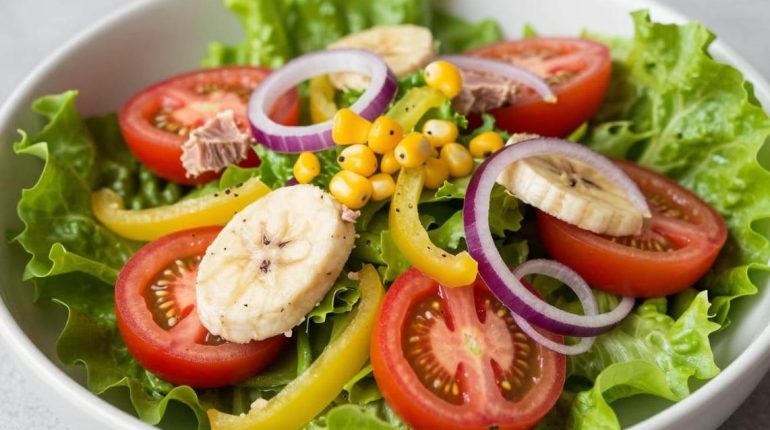
The second layer transforms the bowl into a true sensory experience. On three cups of finely shredded romaine or butter lettuce, sliced vine-ripened tomatoes, drained banana peppers or pepperoncini, thin red onion rings, and dill pickles are aligned. This combination faithfully reproduces the flavor profile of an Italian sub: the acidity of the pickled peppers, the crunch of the fresh lettuce, the juiciness of the ripe tomatoes. The minimalist vinaigrette—one spoon of olive oil, one of red wine vinegar, dried oregano—seals the whole without masking individual flavors.
Each ingredient dialogues with the others to reconstitute the signature balance: the vegetable freshness tempers the protein richness, the acidity wakes up the taste buds between each bite. This flavor mechanic explains why the concept works without bread—all the sensory markers of an authentic sub are present, redistributed in a lighter but equally satisfying formula.
Infinite Customization and Creative Alternatives
This architecture tolerates practically all modifications without losing its identity. Protein is the first lever for adaptation: canned salmon, cooked shrimp, deli turkey or ham, shredded chicken replace tuna without altering the balance of the bowl. Vegetarians can substitute a mashed chickpea salad that mimics the texture of tuna while offering the same protein intake.
Eliminating mayonnaise opens other paths: mashed avocado for vegetable creaminess, Greek yogurt to lighten calories, or simply olive oil and vinegar for a pure Mediterranean version. Tuna preserved in olive oil then becomes self-sufficient, without adding extra fat.
Vegetable variations multiply the possibilities: diced cucumbers for more freshness, raw peppers for colorful crunch, marinated artichoke hearts, giardiniera for an explosion of acidity, marinated jalapeños if you’re looking for heat. Adding shredded mozzarella or provolone injects extra protein while bringing the flavor profile closer to a real Italian sub.
Even the seasoning allows for improvisation: white balsamic vinegar, apple cider vinegar, or the brine from marinated peppers as an alternative source of acidity. Fresh basil advantageously replaces dried oregano for a summery herbal touch. This plasticity transforms the recipe into a personal canvas rather than a rigid formula, adapting to refrigerator contents as well as dietary restrictions.
Strategic Meal Prep for the Week
This versatility takes on its full meaning in a preparatory approach. The tuna salad keeps for three days in the refrigerator, allowing several portions to be prepared in a single session. Double or triple the quantities according to your weekly needs: five extra minutes produce four to six ready-to-go lunches.
The storage technique determines the final quality. Divide the ingredients into three distinct categories: a first container groups the tuna salad, sliced tomatoes, banana peppers, and red onions. A second, smaller one, holds the olive oil, vinegar, and oregano. The third, larger one, houses the shredded lettuce with an absorbent paper at the bottom and on top.
This paper plays a decisive role: it captures the residual moisture that softens the leaves, preserving their crunch until the third day. Without this precaution, the lettuce wilts within twenty-four hours, compromising the texture contrast that defines the dish.
Assembly takes place exclusively at the time of consumption. Transfer the lettuce to a bowl, add the tuna preparation and toppings, then pour the vinaigrette. Mix immediately. This sequence guarantees that each bite retains the freshness and crunch of an instant preparation, transforming fifteen minutes of Sunday work into a week of balanced lunches without extra daily effort.