Follow us
7 June 2026

Sauce Filetto di Pomodoro

Prep Time
5 minutes
Cook Time
1 hour
Total Time
1 hour 5 minutes
Servings
8 portions

The best Italian sauces are also the simplest — and filetto di pomodoro is absolute proof. Six ingredients, one hour of patience, and you get something that puts any jarred sauce to shame. No special skills needed, just good ingredients and not being too lazy to let it simmer.
Advertisement
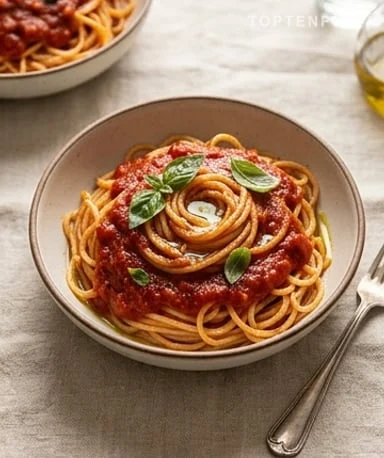
Final result
A generous bowl of spaghetti topped with homemade filetto di pomodoro sauce — the kind of dish that alone can make everything right.

What strikes you first is the color — a deep red, almost orange at the edges, with green flecks of basil that have infused into it. Then the smell: that combination of concentrated tomato and melted garlic escaping from the lid is enough to make the whole room salivate. The texture is neither smooth nor chunky — it has that rustic consistency that clings to pasta without weighing it down. A sauce that smells like home, not a factory.

Why you’ll love this recipe

90% Hands-off : The simmering time is almost entirely hands-free. You start the sauce, do something else, and it concentrates on its own for 45 minutes.
Six ingredients, not one more : No powdered herbs, no gimmicks. Every ingredient has a precise purpose — nothing is there just for show.
Freezes perfectly : Make a double batch on Sunday. The following week, you have a tomato base ready for pasta, chicken parmigiana, or a gratin — straight from the freezer to the pan.
Adaptable to anything : On spaghetti, in lasagna, as a base for vegetarian Bolognese — this filetto is a culinary tool, not just another recipe.

Ingredient Notes

Ingredients

Only six ingredients, but each plays a precise role: carrots soften, fresh basil perfumes, and good imported tomatoes do the rest.

  • Imported crushed tomatoes : This is the backbone of the sauce. Quality Italian tomatoes — look for San Marzano, DOP, or IGP on the label — have naturally sweeter acidity and denser flesh than low-end cans. A bad can will give a dull, overly acidic sauce that simmering won’t fix. In summer, if you have access to real ripe fresh tomatoes, peel them in boiling water and crush them by hand.
  • Carrots : They play a role few anticipate: balancing the acidity of the tomatoes with their natural sugar, without adding white sugar. Cut them into very small dice — they must melt completely into the sauce during simmering, not remain as identifiable chunks that betray their presence.
  • Crushed garlic : Here, we use whole cloves flattened with the flat side of a knife, not minced. Crushed garlic releases its aromas more slowly and infuses the sauce with a sweet, round flavor rather than a sharp one. If you don’t want to find the pieces in your mouth, remove them just before adding the tomatoes.
  • Light chicken broth : It serves to thin the sauce during simmering and add a slight umami depth without weighing it down. For a vegetarian version, a quality vegetable broth works very well — the result is slightly different but equally valid. Avoid overly salty bouillon cubes that overpower the sauce.
  • Fresh basil : Added only in the last ten minutes, never at the beginning. Basil cooked too long loses its essential aromatic oils and becomes bitter — you turn a fresh note into an unpleasant aftertaste. Do not replace it with dried basil; the result is incomparable.
  • Olive oil : Cooking base for the soffritto. Regular olive oil is fine here — no need to sacrifice a bottle of extra virgin for medium-heat cooking. Save the good oil for finishing or salads.

The soffritto, the real beginning

It all starts with a wide pot — not a small pan — with olive oil heated over medium-low heat. Add the crushed garlic first and let it just turn golden for a minute: as soon as it starts to color, that slightly sweet and pungent smell fills the kitchen. Then add the onion and carrots, both finely chopped. The goal is not to brown them but to soften them — you’re looking for that stage where they are translucent, almost melting, and their sweetness is fully developed. This takes two to three minutes. If it starts to stick or brown on the edges, lower the heat immediately: a burnt soffritto gives a bitter undertone that permeates the whole sauce and cannot be corrected.

The soffritto, the real beginning
The aromatic base — onion, garlic, carrot — gently cooked in olive oil until it fills the whole kitchen with fragrance.

Adding the tomatoes

Pour the crushed tomatoes and broth directly into the pot. The cold mass will degas upon contact with the heat — a vigorous bubbling that quickly calms down. Stir to incorporate the vegetables and bring to a simmer. At this stage, the sauce is still watery, slightly acidic, almost raw in taste. This is normal, and this is exactly where time does its work. Partially cover — with the lid askew — to let moisture evaporate gradually, reduce heat to minimum, and let the sauce find its rhythm. It will start to visibly thicken after about twenty minutes.

45 minutes that change everything

Slow simmering is the step many sabotage by turning up the heat to speed things up. Over high heat, the sauce reduces too quickly on the surface, burns on the bottom, and develops a bitterness that nothing can fix. Over low heat, the natural sugars in the carrots and tomatoes have time to concentrate peacefully. You’ll see the color evolve: from that initial bright red to a darker, denser, almost jammy red. The smell also changes — it loses its raw edge and becomes round, warm, enveloping. Stir every ten minutes to prevent sticking. If the sauce thickens too quickly before the end, add a little broth.

The basil and final adjustment

In the last ten minutes, add the fresh basil, roughly torn by hand — not cut with a knife, which oxidizes the leaves. It will soften and release its aromas into the sauce without dissolving them in the steam. After turning off the heat, taste. If the sauce seems too acidic — it always depends on the tomatoes — two options: a tablespoon of sugar, which balances directly, or half a teaspoon of baking soda, which chemically neutralizes acidity without adding sweetness. Baking soda gives a more neutral result, sugar a slightly rounder mouthfeel. The difference is subtle but real — your palate decides.

The basil and final adjustment
45 minutes of slow simmering, and the sauce concentrates, thickens, and develops that depth you never find in jarred sauce.

Tips & Tricks
  • Choose quality canned tomatoes, not the cheapest on the shelf — with so few ingredients, every product directly impacts the final taste. San Marzano or DOP on the label guarantees a naturally sweet acidity that simmering will further enhance.
  • Do not cover the pot completely during simmering — moisture needs to escape for the sauce to concentrate. A lid placed askew is sufficient. If you cover tightly, you’ll steam the sauce and it will remain watery.
  • Make a double batch and freeze half in 250g portions in flat bags. The sauce keeps three months in the freezer and thaws directly in a pan over low heat — it’s a quick meal stash that’s worth its weight in gold on weekdays.
  • If you want to blend the sauce for a smooth texture, do so with an immersion blender directly in the pot off the heat. Blending hot sauce in a closed blender creates dangerous pressure that can blow the lid off — the experience is unpleasant and messy.
Close-up
That rustic, slightly thick consistency that clings perfectly to pasta — not too smooth, not too chunky, just right.
FAQs

Can I use fresh tomatoes instead of canned?

Yes, and it’s even recommended in summer when tomatoes are at their best. Choose ripe tomatoes, peel them after a quick dip in boiling water, then crush them by hand. Use about 1.5 kg of fresh tomatoes to replace the two 800g cans.

How long does this sauce keep?

In the refrigerator in an airtight container, it keeps 5 to 7 days without issue. In the freezer, it keeps up to 3 months — freeze in 250-300g portions so you only thaw what you need, directly in a pan over low heat.

My sauce is too acidic, how can I fix it?

Two options depending on the desired effect: a tablespoon of sugar to round the taste with slight sweetness, or half a teaspoon of baking soda to neutralize acidity without adding flavor. The baking soda will briefly foam the sauce — that’s normal, stir and taste.

Can I make it ahead?

It’s even recommended. Like many simmered sauces, filetto is better the next day once flavors have melded. Make it the day before, let it cool completely before refrigerating, and reheat over low heat with a splash of water if it has thickened too much.

Can I blend it for a smooth texture?

Yes, it’s a matter of personal preference. The traditional version is rustic, but a quick blend with an immersion blender at the end gives a pleasant velvety texture. Let the sauce cool slightly before using a closed blender to avoid splatters.

Sauce Filetto di Pomodoro

Sauce Filetto di Pomodoro

Easy
Italian
Sauce

Prep Time
5 minutes
Cook Time
1 hour
Total Time
1 hour 5 minutes
Servings
8 portions

An authentic Italian tomato sauce slowly simmered with imported crushed tomatoes, carrots, garlic, and fresh basil. Simple to prepare, versatile, and far superior to any jarred sauce.

Ingredients

  • 2 cans (800g each) imported crushed tomatoes (San Marzano, DOP, or IGP)
  • 3 garlic cloves, crushed with flat side of knife
  • 1 tablespoon olive oil
  • 1/2 large onion, finely minced
  • 120g carrots, finely minced
  • 120ml light chicken broth (or vegetable broth for vegetarian)
  • 1 bunch fresh basil

Instructions

  1. 1Heat olive oil in a large pot over medium-low heat. Add crushed garlic cloves and let them turn golden for 1 minute, stirring, until the smell is slightly sweet.
  2. 2Add finely minced onion and carrots. Sauté for 2 to 3 minutes over medium-low heat until translucent and melting, without browning.
  3. 3Pour in the crushed tomatoes and broth. Stir well to incorporate the vegetables and bring to a simmer.
  4. 4Place a lid askew on the pot to let steam escape, reduce heat to minimum, and let simmer for 45 minutes, stirring every ten minutes.
  5. 5In the last 10 minutes of cooking, add the fresh basil, roughly torn by hand.
  6. 6Taste and adjust acidity if needed with 1 tablespoon of sugar or 1/2 teaspoon of baking soda. Serve hot or let cool before storing.

Notes

• The quality of the tomatoes directly determines the final result: look for San Marzano, DOP, or IGP on the label, even for such a simple sauce.

• Do not cover tightly during simmering — steam must escape for the sauce to concentrate properly.

• Keeps 5 to 7 days in the refrigerator and 3 months in the freezer in portions. Thaws directly in a pan over low heat.

• For a vegetarian version, replace chicken broth with a quality vegetable broth.

Nutrition Facts (per serving, estimated)

91 kcalCalories 0.5gProtein 15.5gCarbs 2gFat
Advertisement
Share on Facebook