Follow us
7 June 2026

Salmon Terrine with Fresh Herbs

Prep Time
20 minutes
Cook Time
45 minutes
Total Time
1 hour 5 minutes
Servings
6 servings

Looking for a starter that makes an impression without keeping you stuck in the kitchen for hours? Salmon terrine is exactly that: a dish that looks like you went all out, when in reality you just had the good idea to prepare it the day before. It’s the kind of recipe that reconciles busy cooks with festive meals.
Advertisement
Final result
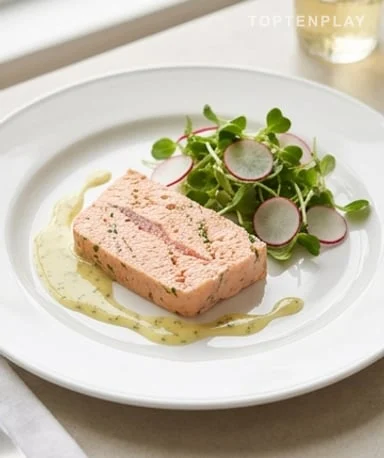
The terrine unmolded and sliced, served with its homemade dill-lemon sauce.

Upon unmolding, the slice reveals a pearly pink marbled with smoked salmon, dotted with small green flecks of dill and chives. The aroma is light, briny, with that lemon undertone that leans towards freshness. The texture always surprises the first time — tender but firm, somewhere between a dense mousse and a rustic terrine. Placed on a plate with a spoonful of dill-lemon sauce, it holds itself, cleanly, without collapsing.

Why you’ll love this recipe

Ready the night before, stress-free : The terrine is not served hot — it needs at least four hours in the fridge after baking. In other words, the next day you have nothing left to do for the starter. Just take it out, slice, and plate.
Light and just filling enough : No heaviness as a starter, which matters when there’s a main course to follow. The salmon and cream provide flavor and structure without weighing down the stomach.
The visual does the work : A beautiful pink slice on a white plate with a few sprigs of dill is already elegant. You don’t need to be a chef to plate this starter properly.
Adaptable based on what you have : Dill can be replaced with tarragon or flat-leaf parsley. You can add capers, some pieces of red bell pepper, or a spoonful of whole-grain mustard to the base to change the flavor profile without betraying the recipe.

Ingredient Notes

Ingredients

Fresh salmon, smoked salmon, heavy cream, and herbs: everything you need for an elegant terrine.

  • Fresh salmon (500 g) : This is the base of the terrine, which will be blended to form the mixture. Choose a skinless, boneless fillet, fresh rather than frozen: the texture will be cleaner after cooking, less watery. If using frozen, thaw it completely in the fridge the day before and pat it dry thoroughly with paper towels before blending.
  • Smoked salmon (200 g) : It plays two roles: providing the smoky intensity that fresh salmon alone cannot, and creating visual marbling in the slice. Cut it into irregular pieces rather than small dice — larger pieces hold up better during cooking and give that beautiful marbled effect when cut. Avoid very thin slices that melt entirely into the mixture.
  • Heavy cream (20 cl) : It brings tenderness and binds everything without weighing down. Full-fat heavy cream is ideal — the liquid version makes the terrine less firm and harder to slice cleanly. If you want to lighten it slightly, replace one third with 20% fat cottage cheese, but no more: below a certain fat content, the texture becomes elastic.
  • Eggs (3) : They ensure the terrine sets during cooking — without them, it would collapse upon unmolding. Three eggs for 500 g of salmon is the balance that gives a firm texture without turning the terrine into an omelet. Room-temperature eggs blend better into the mixture.
  • Lemon juice : It doesn’t just ‘add freshness’ in a vague sense: it cuts the fattiness of the cream and balances the sometimes overly smoky taste of the salmon. Half a lemon is usually enough — taste the mixture before cooking and adjust. Finely grated zest in the mixture amplifies the lemon effect without adding liquid.
  • Dill and chives : Dill is the classic herb for salmon — its slightly aniseed flavor naturally complements the brininess of the fish. Chives add a milder, almost vegetal note. If you don’t have both, dill alone works very well. Avoid flat-leaf parsley, which gives an unappetizing greenish color to the mixture once blended.

Blend the base: the step that makes all the difference

The quality of the terrine is largely decided here. Put the fresh salmon cut into pieces in the blender bowl with the eggs, heavy cream, lemon juice, and herbs. Blend in short pulses rather than continuously — the goal is a homogeneous paste but not perfectly smooth. A bit of texture in the mixture shows and feels in the mouth. If you blend too long, the motor heat starts to slightly precook the salmon proteins and the final texture will be less tender. Taste before seasoning: the smoked salmon to be added already brings salt, so be moderate with the salt shaker. White pepper is more discreet than black and avoids little dark specks in the pink mixture.

Blend the base: the step that makes all the difference
The key step: gently folding the smoked salmon pieces into the blended mixture.

The smoked salmon: don’t drown it in the mass

Once the mixture is ready, incorporate the smoked salmon pieces with a spoon, not the blender. This is a detail that matters. If you blend them with the rest, they disappear into the mass and you lose both the marbling and the smoky flavor points that you want to find in every bite. Fold them gently into the mixture, like incorporating whipped cream — the goal is to distribute them without crushing them. Some pieces will break down slightly, others will remain almost intact: that’s exactly what we want.

Baking in a water bath: patience, not haste

Pour the mixture into a terrine lined with parchment paper (or lightly greased) and smooth the surface. Place the terrine in a larger baking dish, then pour boiling water into the dish until it reaches halfway up the terrine. This indirect cooking is what gives a tender texture without holes or overcooking on the surface — the heat envelops the terrine gently, without thermal shock. Oven at 170°C, static heat preferably, because convection dries out. After 45 minutes, the terrine should be set on the edges but still slightly wobbly in the center when you gently shake the dish. It will finish setting as it cools. A knife blade inserted in the center that comes out clean confirms it’s done — if it still comes out moist after 50 minutes, give it another 5 to 10 minutes.

Resting in the cold: the step you can’t shortcut

Remove the terrine from the oven, let it cool to room temperature for at least one hour, then cover with plastic wrap directly on the surface and refrigerate for a minimum of four hours — overnight is even better. During this rest, the terrine firms up, the flavors meld, and the whole thing gains cohesion. If you cut into it too early, it will collapse at the slice. The plastic wrap prevents a dry skin from forming on the surface and preserves the pink color. When serving, dip a thin knife in hot water before each slice — the cut will be clean and unmolding neat.

What to serve with it, and why it works

Salmon terrine doesn’t need an elaborate accompaniment — it’s already complete. A simple sauce made from cottage cheese, lemon juice, and chopped dill is enough to create the freshness contrast that lightens each bite. For greens, a few lightly dressed young shoots and thinly sliced radishes add the crunch that the terrine lacks. Toasted country bread is the obvious choice — the slight bitterness of the crust stands up to the cream’s richness and calls for a second slice. Serve the terrine cold, never at room temperature: the flavor is cleaner, the texture better, and it holds perfectly.

What to serve with it, and why it works
The terrine bakes gently in a water bath — the method that guarantees a tender texture.

Tips & Tricks
  • Never blend the mixture too long — 30 seconds in two or three pulses is enough. An over-blended mixture heats up slightly and gives a more compact, almost elastic texture after cooking.
  • Add salt after incorporating the smoked salmon, not before. Smoked salmon is already quite salty: if you salt the base mixture without accounting for that, you risk an overly salty terrine that masks the delicacy of the fresh salmon.
  • Let the terrine rest at least overnight in the fridge if possible. After four hours, it holds properly. But after twelve hours, the flavors have truly melded and the slice holds without any tendency to crumble.
  • Dip the knife in hot water between each slice. The cold terrine sticks slightly to cold blades — a hot, wiped blade cuts cleanly and keeps the slice neat for plating.
Close-up
The cut reveals a pearly interior, dotted with herbs and marbling of smoked salmon.
FAQs

Can you prepare the terrine several days in advance?

Yes, and it’s even recommended. The terrine keeps for up to 3 days in the fridge, well covered with plastic wrap — the flavors deepen over time. Beyond 3 days, the texture starts to change slightly and the taste of smoked salmon becomes too dominant.

How do you know if the terrine is cooked properly?

Gently shake the dish: the edges should be firm and the center still slightly wobbly. Insert a knife blade in the center — if it comes out clean and warm, it’s done. An overcooked terrine becomes dry and grainy; it’s better to stop a bit early because it finishes setting as it cools.

Can you freeze salmon terrine?

Technically yes, but the result is disappointing. Freezing alters the texture of the cream and releases water upon thawing, making the terrine more crumbly and less tender. If you need to prepare far in advance, it’s better to stick to the 3 days in the fridge.

The terrine crumbled when sliced — what went wrong?

There are two possible reasons: either the terrine didn’t rest long enough in the cold and wasn’t firm enough, or it was overcooked and lost its binder. The solution in both cases is preventive: respect the minimum refrigeration time and stop cooking as soon as the center wobbles slightly. A knife dipped in hot water between slices also helps a lot.

Which fresh salmon should I choose for a successful terrine?

A skinless, boneless salmon fillet, as fresh as possible — ask for it at the fishmonger rather than the supermarket if you can. Frozen salmon works but you need to thaw it completely in the fridge the day before and pat it dry thoroughly: excess water in the mixture makes the terrine softer and harder to slice neatly.

Can I replace the heavy cream with something else?

Yes, partially. You can replace up to one third of the heavy cream with 20% fat cottage cheese to lighten it slightly without sacrificing too much texture. However, do not try with soy cream or a plant-based substitute: the terrine won’t set properly and slicing becomes impossible.

Salmon Terrine with Fresh Herbs

Salmon Terrine with Fresh Herbs

Easy
French
Starter

Prep Time
20 minutes
Cook Time
45 minutes
Total Time
1 hour 5 minutes
Servings
6 servings

A tender and flavorful terrine combining blended fresh salmon and chunks of smoked salmon, seasoned with dill, chives, and lemon. Prepare entirely the day before — on the day, just take it out, slice, and serve.

Ingredients

  • 500 g fresh salmon, skinless and boneless
  • 200 g smoked salmon slices
  • 3 eggs
  • 20 cl full-fat heavy cream
  • 1 lemon (juice + zest)
  • ½ bunch fresh dill
  • ½ bunch fresh chives
  • 1 pinch salt
  • 1 pinch ground white pepper

Instructions

  1. 1Preheat the oven to 170°C (static heat). Line a terrine or loaf pan with lightly oiled parchment paper.
  2. 2Cut the fresh salmon into pieces and place in a blender bowl with the eggs, heavy cream, lemon juice and zest, and chopped dill and chives. Blend in short pulses until you get a homogeneous but slightly textured mixture — do not aim for a perfectly smooth paste.
  3. 3Taste and season lightly with salt (smoked salmon is already salty) and white pepper.
  4. 4Cut the smoked salmon into irregular pieces and gently fold them into the mixture with a spoon, folding without crushing to preserve the marbling.
  5. 5Pour into the terrine and smooth the surface with a spatula. Place the terrine in a larger baking dish and pour boiling water halfway up the terrine for the water bath.
  6. 6Bake for 45 minutes. The terrine is done when the edges are firm and the center wobbles slightly when you gently shake the dish. A knife inserted in the center should come out clean.
  7. 7Remove from the oven and let cool to room temperature for about 1 hour. Cover with plastic wrap directly on the surface to prevent oxidation, then refrigerate for at least 4 hours — overnight gives the best results.
  8. 8When serving, dip the knife in hot water and wipe between each slice. Serve cold with a cottage cheese-dill-lemon sauce, young shoots, and slices of toasted country bread.

Notes

• Do not over-blend the mixture: 2 to 3 pulses of 10 seconds are enough. An over-blended mixture heats the salmon proteins and gives a more compact texture after cooking.

• Salt only after incorporating the smoked salmon — it is already quite salty and can make the terrine too salty if you season the base mixture without accounting for it.

• The terrine keeps for 3 days in the fridge, well covered with plastic wrap. The flavors are even better the next day.

• To lighten slightly, replace up to one third of the heavy cream with 20% fat cottage cheese. Do not go beyond that, or the texture will suffer.

Nutrition Facts (per serving, estimated)

310 kcalCalories 27 gProtein 1 gCarbs 22 gFat
Advertisement
Share on Facebook