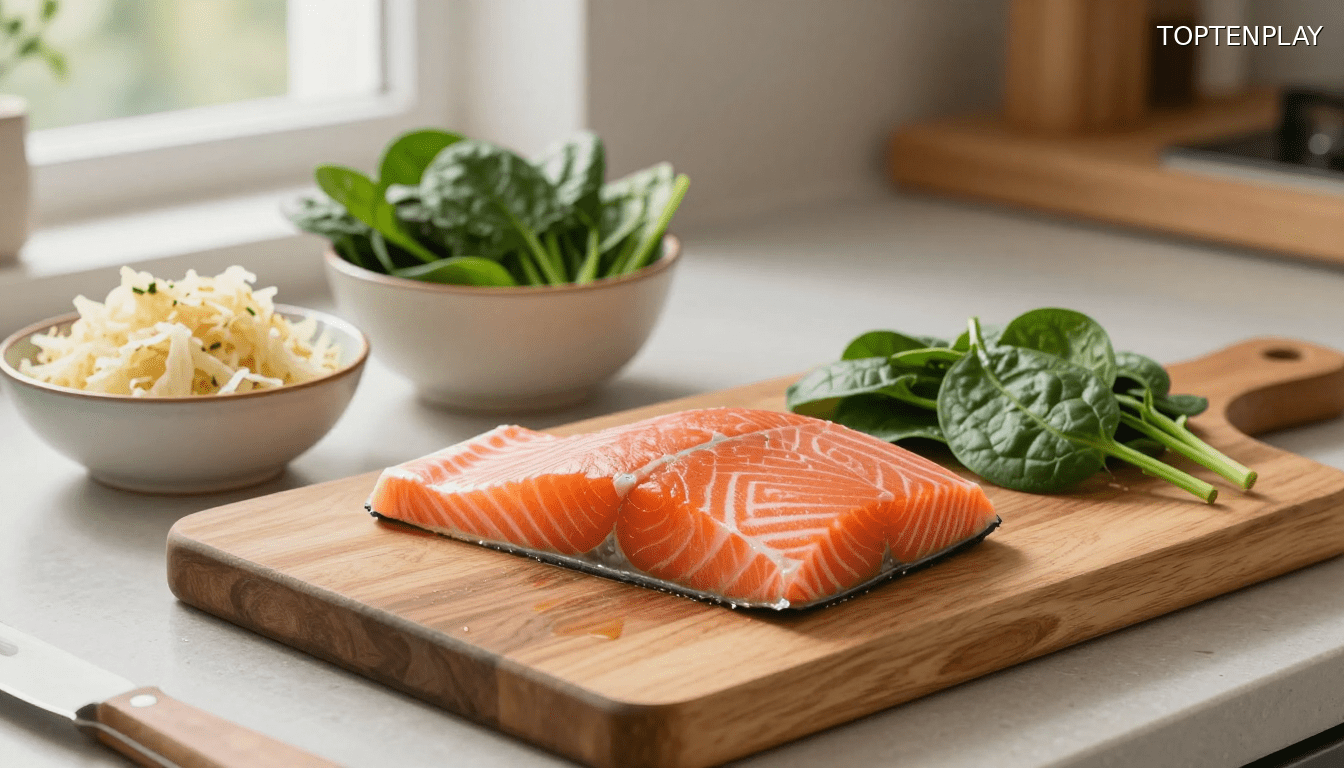
Preparation Of Savory Fillings
The success of this puff pastry relies on an often overlooked step: the rigorous preparation of the fillings. In a pan heated over high heat, the cooked sauerkraut is transformed under the action of a tablespoon of oil. The objective: to obtain a slight caramelization that concentrates the aromas and creates roasted notes. The addition of cumin amplifies this depth of flavor before complete cooling.
Spinach requires a similar but distinct technique. Sautéed in a very hot pan with oil and a crushed garlic clove, they must lose all their vegetation water. This complete evaporation is the secret of a crispy puff pastry: wet fillings would inevitably soften the dough during cooking.
The prior cooling of both preparations is not optional. Lukewarm fillings would cause premature melting of the puff pastry butter, compromising the characteristic layered structure. This double step of cooking then cooling separates professional achievements from approximate attempts. The patience invested here determines the final quality of the turnover, guaranteeing contrasting textures between the golden shell and the melting fillings.

Strategic Assembly Of The Puff Pastry
Once the fillings have cooled, spreading the puff pastry marks the beginning of a precision-timed assembly sequence. The salmon, seasoned with salt and pepper, is positioned 2 cm from the edge of the dough — this precise distance is not accidental. It constitutes the essential safety margin for folding the envelope without causing the fillings to overflow.
The layering follows a strategic order: the fish as a base, the spinach as an intermediate layer, the cooked sauerkraut on top. This vertical distribution ensures a harmonious diffusion of flavors during cooking, with each layer retaining its taste identity while participating in the overall balance.
Folding the dough requires method and precision. By closing the turnover, the ends are folded under the pastry, creating a hermetic seal that traps juices and aromas. This professional closing technique transforms a simple recipe into a creation worthy of a gourmet restaurant.
The final browning — a mixture of egg yolk and milk applied with a brush — prepares the visual metamorphosis. A few decorative incisions made with the tip of a knife complete this meticulous preparation, announcing the golden coloration that will soon reveal the invested expertise.

Closing Technique And Finishes
The critical moment occurs when the turnover takes shape under the cook’s hands. Folding the dough requires a firm and precise gesture: folding the puff pastry envelope over the composite filling without creating air pockets. Each end is then tucked under the pastry, a technique that guarantees a hermetic seal while hiding the joints for a visually impeccable result.
The preparation of the egg wash marks the transition to the finishing phase. The egg yolk-milk mixture is applied with a brush in a regular layer, without excess that might burn during cooking. This emulsion will transform the pale surface of the dough into a golden and lustrous envelope, the visual signature of professional achievements.
The decorative incisions traced with the tip of a knife are not mere ornament. These controlled cuts facilitate the expansion of steam during cooking and create lines that visually structure the turnover. Geometric patterns or arabesques follow the shape of the pastry, revealing the chef’s creative intention.