📌 Salmon frittata in 20 minutes: the complete recipe with soy sauce to boost umami
Posted 4 March 2026 by: Admin
Salmon Frittata: A Complete Dish Reinvented
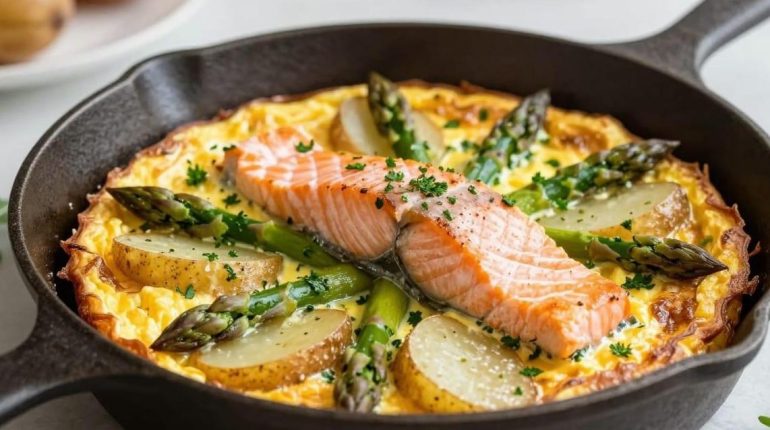
Twenty minutes is all it takes to transform simple ingredients into a refined culinary creation. This salmon frittata subverts the codes of the traditional Italian omelet by integrating an unexpected Asian touch: naturally fermented Kikkoman soy sauce. It is precisely this ingredient that gives the dish its “inimitable” umami, that fifth flavor so sought after by chefs.
The marriage between oven-baked salmon and this reduced-salt Japanese sauce creates a rare aromatic depth for such an accessible recipe. Potatoes provide their comforting texture, while green asparagus injects freshness and crunch. Four eggs beaten with a tablespoon of soy sauce are enough to bind everything together.
Designed for lunch on the go, this frittata is easily portable. It combines the efficiency of express preparations with the nutritional balance of a complete dish: noble salmon proteins, starches, green vegetables, and that umami signature that instantly elevates the result. The recipe is suitable even for novice cooks, classified as easy difficulty with only eight main components. An effort-to-result ratio that makes all the difference between a mundane lunch and a mastered gourmet break.
An Accessible Recipe For All Levels
This simplicity of execution is the true asset of the salmon frittata. Ten minutes of preparation, ten minutes of cooking: the math is quickly done. No complex technique hinders the realization, even for a beginner cook facing their first kitchen experiences.
The ingredient list consists of eight main components, all available in classic supermarkets. Four eggs, a tablespoon of naturally fermented soy sauce, a teaspoon of pepper, sixty grams of cooked potatoes, a quarter bunch of asparagus, one hundred and fifty grams of already cooked salmon, a spoonful of olive oil, parsley, and arugula. Nothing exotic, nothing inaccessible.
The easy difficulty level displayed is not editorial marketing: it reflects a tangible reality. Beating eggs with a fork, slicing potatoes, chopping asparagus, dicing salmon – these elementary gestures are enough. Cooking covered in a simple pan eliminates any risk of drying out or failure.
For two people, twenty minutes from start to finish guarantees a balanced complete dish. This exceptional effort-to-result ratio appeals as much to busy professionals as to novice cooks looking to impress without stress. The frittata requires no particular skill or sophisticated equipment, just a pan and a fork. Efficiency in its purest form.
Detailed Preparation Technique
Execution relies on an unstoppable logic: first create the aromatic base, then integrate the solid elements. The four eggs beaten with a fork mix intimately with the Kikkoman soy sauce and pepper, forming the flavor foundation of the dish. This first step ensures the homogeneous distribution of umami in every bite.
The sliced potatoes, chopped asparagus, and diced salmon then join the liquid preparation. The uniformity of the cutting guarantees a balanced distribution of textures and flavors. No ingredient dominates; each contributes to the overall picture.
Cooking in heated olive oil marks the decisive turning point. The trick lies in the lid kept on during the entire setting phase: this technique captures steam, allowing the eggs to cook uniformly from the bottom to the surface. No more runny tops or burnt bottoms that ruin so many improvised frittatas.
The finish brings the essential touch of freshness. Chopped parsley sprinkled on top, combined with a bed of crunchy arugula, contrasts with the melting texture of the warm preparation. This hot-cold, cooked-raw association awakens the taste buds and balances the whole. Portable in an airtight container, this frittata can be enjoyed warm or cold, at the office or outdoors.
Nutritional Composition And Practical Tips
The 150 grams of cooked salmon constitute the protein pillar of this frittata, simultaneously providing essential omega-3 fatty acids for good cardiovascular function. This generous amount transforms the dish into a complete solution for an autonomous lunch, without the need for additional accompaniment.
Cooked potatoes provide the necessary carbohydrate energy, while green asparagus adds fiber and vitamins. The major tip lies in the explicit permission to use frozen asparagus out of season: this pragmatic flexibility eliminates seasonal constraints without sacrificing nutritional quality. Frozen food preserves most nutrients while simplifying sourcing.
Reduced-salt soy sauce meets contemporary dietary concerns. This precision is not trivial: it allows you to enjoy the characteristic umami while controlling sodium intake, particularly relevant for those monitoring their diet. One tablespoon is enough to permeate the whole without saturating the taste buds.
The final bed of arugula is not just for decoration. Its twenty grams provide a peppery bite that wakes up the whole, while adding a dose of vitamin K and antioxidants. Eaten cold or warm, this frittata travels without problem in an airtight container, lasting several hours at room temperature before being enjoyed at the office, on a picnic, or while traveling.