📌 Russian tuna salad: the 30-minute resting tip that changes everything
Posted 27 March 2026 by: Admin
Olivier Salad: A Universal Classic with Many Faces
Born in 19th-century Imperial Russia under the leadership of chef Lucien Olivier, this cold salad has conquered tables worldwide, from Moscow to Casablanca. Known today by different names depending on the region, it remains a staple of cold starters thanks to its generous composition: melting potatoes, crunchy vegetables, hard-boiled eggs, and creamy mayonnaise form a perfect balance between texture and flavor.
The tuna-enriched version transforms this classic into a complete and nourishing dish, perfect for a quick meal without sacrificing nutritional quality. Unlike ephemeral salads that lose their freshness in a few hours, this one reveals its potential after several hours in the refrigerator, when the flavors truly fuse.
Its main asset lies in its advance preparation: ideal for picnics, buffets, or family meals, it frees the cook from the pressure of service. Economical, it makes the most of simple ingredients available year-round. Adaptable to all diets and enjoyed by children and adults alike, it spans generations without aging a day.
This versatility explains its permanent presence in Mediterranean refrigerators, where it waits patiently to be served as a refreshing starter or a generous side dish. A success based on precise technical execution, where many fail by neglecting essential details.
Step-by-Step Recipe: Mastering Cooking for Perfect Texture
This precise technical execution begins with cooking each ingredient separately, a crucial step that too many cooks neglect. Potatoes, cut into uniform cubes, require exactly 15 minutes in boiling salted water: too short, and they remain hard; too long, and they turn into mash under the spatula. Carrots follow with 10 minutes of cooking, while eggs harden during the same period.
The fatal trap occurs during assembly: mixing still-warm ingredients with mayonnaise causes a disastrous reaction where the emulsion breaks, producing an oily and separated texture. Complete cooling, though time-consuming, is the absolute safeguard against this failure. Allow 30 to 60 minutes of rest at room temperature before any handling.
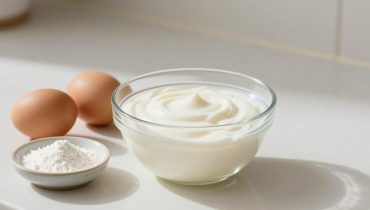
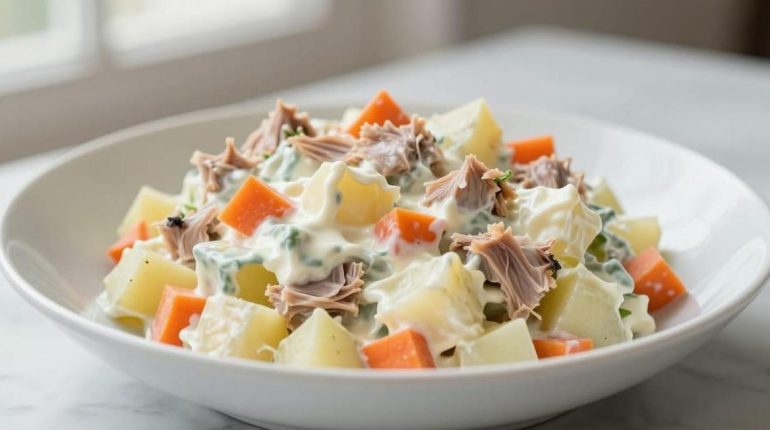
Assembly requires delicate movements: crumble the drained tuna into the bowl, add the cooled vegetables, then incorporate the 350 ml of mayonnaise mixed with 50 ml of olive oil. Here, the fork gives way to a wide spatula that coats without crushing, preserving the integrity of the potato cubes.
The final rest in the refrigerator, minimum 30 minutes, completes the metamorphosis: flavors fuse, the texture firms up, and the salad reaches its optimal balance. Many serve it too early, ignoring that this patience transforms an ordinary preparation into a refined taste experience.
Secrets of a Successful Russian Salad: Expert Advice
Beyond this methodical process lie subtleties that only experience reveals. Cooking potatoes perfectly illustrates this culinary paradox: they must be tender at the core but firm enough to withstand mixing. A simple test consists of pricking a cube with a knife: the blade should enter effortlessly, but the piece should not crumble on contact.
The quality of the mayonnaise determines 70% of the final result. Low-end industrial versions, rich in stabilizers, produce an artificial texture that masks flavors instead of revealing them. The 350 ml required deserve an investment in a premium brand, or better yet, a homemade preparation where the olive oil already present in the recipe finds its full expression.
Seasoning is the third technical trap. Canned tuna, even when drained, retains a significant salt load. Mayonnaise also contains salt in its composition. Tasting before adding a single grain avoids the disaster of a definitively too salty salad, an irreversible error that even adding extra potatoes only imperfectly corrects.
The mixing tool makes all the difference: a wide silicone spatula slides between ingredients without damaging them, whereas a spoon crushes and fragments. This gentle gesture preserves the visual structure of the salad, where each element remains identifiable rather than melting into a characterless homogeneous mass.
Customization and Variations: Adapting the Recipe to All Diets
This technical plasticity opens the way to countless variations that respect dietary constraints and cultural preferences. The classic version includes 100g of peas and three diced pickles, providing a vinegary acidity that balances the richness of the mayonnaise. Adding diced ham transforms the starter into a main dish with enough protein for a complete meal.
Vegetarian diets are fully satisfied by simply removing the tuna, as the egg-vegetable-mayonnaise combination already offers a satisfying nutritional density. Conversely, shredded cooked chicken advantageously replaces fish for those seeking a meatier texture, while maintaining the 10 to 15g of protein per serving.
The light version substitutes plain yogurt for half of the mayonnaise, reducing the caloric load from 400 to 250 kcal without completely sacrificing the dish’s characteristic creaminess. This modification suits people monitoring their lipid intake, although the texture becomes slightly more fluid.
The Moroccan interpretation introduces the juice of half a lemon, fresh chopped parsley, and a pinch of cumin, creating a Mediterranean aromatic profile that contrasts with the original neutrality. This variant keeps remarkably well for 24 hours in the refrigerator, during which the flavors fuse to reach their taste optimum.
The final presentation deserves as much attention as the preparation: a plating ring creates an elegant structure, topped with hard-boiled egg slices, parsley sprigs, or black olives that visually signal the generosity of the content.