The smell coming from the oven when a rhubarb clafoutis is baking is something between sweet vanilla and the slightly caramelized acidity of the fruit—a combination you wouldn’t expect to be so pleasant. Everyone knows the classic cherry version. This one plays in a different register: fresher, with a character all its own.
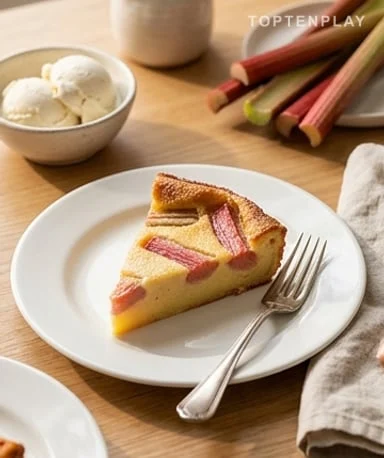
The surface takes on an irregular golden hue, slightly puffed at the edges and still soft in the center. When you dip the spoon in, it slides in without effort, into a texture close to flan—but lighter, less dense. The rhubarb pieces are melting, almost candied, and their natural acidity holds its own against the sweet creaminess of the vanilla custard. The fruit color turns pink-beige during baking: less visually spectacular, but that’s where all the flavor is concentrated.
Why you’ll love this recipe
Ingredient Notes

Simple ingredients and well-chosen fresh rhubarb—that’s all you need for this dessert.
- Rhubarb : It’s the fruit of the recipe, but also the one that sets the pace. Its role is not to be neutral: it adds acidity, it flavors, it balances the sweetness of the custard. Choose firm stalks, bright red or vivid pink—overly green stalks are more stringy and significantly more aggressive in acidity. Before baking, a quick maceration with sugar removes some of the fruit’s water and slightly softens its bite without completely erasing it.
- Eggs : They ensure the custard sets during baking. Three eggs for 500g of rhubarb is the right balance for a soft result without being rubbery. Room temperature eggs incorporate better and give a more homogeneous batter—taken out of the fridge an hour ahead is sufficient.
- Heavy cream : It provides creaminess and roundness on the palate. Without it, a milk-only base gives a lighter but also drier clafoutis. If you want to lighten the recipe, plain yogurt can replace it: the result is less rich but retains a fresh quality that pairs well with the rhubarb’s acidity.
- Flour : It gives structure to the batter—but the amount matters. 100g for this quantity of liquid is the threshold beyond which the clafoutis loses its softness and becomes a dense cake. Mix gently after adding to avoid lumps without overworking the batter, which would make it elastic.
- Vanilla sugar : It subtly flavors without weighing down. One packet is enough here because the batter doesn’t need too much vanilla—the rhubarb already occupies the aromatic space. For a more intense and natural flavor, half a vanilla bean scraped into warm milk does the job much better than artificial flavor.
- Melted butter : It enriches the texture and prevents the clafoutis from sticking to the mold. 40g is small, but it changes the mouthfeel—a slight creaminess that binds the other ingredients. Let it cool for a few minutes before incorporating, to avoid cooking the eggs when mixing.
Prepare the rhubarb
It all starts with the stalks. Wash them, remove the outer strings if they are thick—a knife works, like with green beans—and cut into pieces about two centimeters. Not too short, otherwise they melt completely and disappear into the batter; not too long, otherwise they remain hard at the core. Once in the bowl, add two tablespoons of sugar, mix well, and let it rest for about thirty minutes. This maceration time is not just for show: the rhubarb releases some of its water, which lightens the clafoutis during baking and prevents excess moisture from softening the bottom of the batter. Drain the pieces lightly before putting them in the mold—the pink juice released by the fruit doesn’t need to join the batter.

The batter in three steps
The oven is preheating to 180°C while you prepare the batter. In the bowl, first the eggs, whisked with the sugar and vanilla sugar until the mixture slightly whitens and becomes a little frothy—two minutes by hand, three if the eggs are from the fridge. Then the flour, added all at once and mixed just enough to absorb the liquid without creating lumps. Then the milk, poured gradually—not all at once—to loosen the batter gently. The cream follows, then the melted cooled butter and the pinch of salt. The final texture should be fluid, smooth, flowing, slightly thicker than pancake batter. If lumps remain, an extra whisk stroke fixes the problem without overworking.
Assemble the dish
A buttered gratin dish, not too high on the sides—ceramic or enameled cast iron molds retain heat better and give a more evenly cooked base. The drained rhubarb pieces are arranged in a uniform layer, without piling up, so that the heat reaches them evenly. The batter is poured over gently, so as not to displace the fruits. For the finish, some slivered almonds are optional but they brown well during baking and add a slight crunch against the soft texture of the clafoutis. As soon as the dish is in the oven, the smell begins: first warm vanilla, then after about twenty minutes, a light caramelized note rising from the cooking rhubarb.
Monitor the baking
Forty minutes at 180°C is the benchmark, but ovens vary and color guides you. The top should take on a nice uniform golden hue, without darkening at the edges. The center test is done with a light finger pressure or the tip of a knife—the batter should still tremble slightly, not be liquid. This soft center will set as it cools: if you wait until it is completely set in the oven, you’ll get an overcooked clafoutis, dry and slightly rubbery. Five to ten minutes of rest out of the oven is enough for it to stabilize, firm up just enough, and become easier to cut cleanly.

Tips & Tricks
- Don’t skip the rhubarb maceration: without this step, the pieces release their water directly into the batter during baking, which wets the bottom and prevents the batter from setting correctly in the center.
- Don’t fill the mold to the brim—the batter rises slightly with heat, especially at the sides. A good centimeter of margin prevents overflow and allows more even baking across the surface.
- Remove the clafoutis when the center still trembles slightly under light pressure: residual heat finishes the job out of the oven. A fully set batter before removing is an already overbaked clafoutis.
- Serve warm rather than piping hot: powdered sugar stays better, flavors are clearer, and the texture finds its balance about ten minutes after leaving the oven.

Can I use frozen rhubarb?
Yes, but with a precaution: frozen rhubarb releases much more water than fresh. You need to thaw it completely, drain it well, and even press it lightly in a towel before using. Maceration with sugar is still useful to adjust acidity, even if the fruit is already softened.
How do I know when the clafoutis is done?
The top should be golden and the edges slightly set, but the center should still tremble slightly when you gently shake the dish. This trembling disappears as it cools—if you wait until it is completely set in the oven, you overbake it. A light finger press in the center that resists a little without being hard is the best indicator.
Why macerate the rhubarb in sugar before adding it?
Maceration allows the rhubarb to release some of its water before going into the dish. If you skip this step, that liquid releases during baking and makes the bottom of the batter moist, preventing it from setting properly. It also slightly softens the natural acidity of the fruit without removing it completely.
Can I make this clafoutis the day before?
No problem. It keeps for 2 to 3 days in the refrigerator, covered with plastic wrap. To serve warm, a few minutes in the oven at 150°C or half an hour at room temperature is enough. Its texture firms up slightly as it cools, making it also enjoyable cold.
The rhubarb is too acidic for me, how can I sweeten it further?
Slightly increasing the maceration sugar—using 3 or 4 tablespoons instead of 2—helps neutralize more acidity. Mixing the rhubarb with a few chopped strawberries is another option: their natural sugar balances the overall flavor without changing the clafoutis texture.
Can I replace the heavy cream with something else?
Plain yogurt in the same amount works well and lightens the result while adding a slight acidity that complements the rhubarb. Additional whole milk is also possible, but the clafoutis will be less rich and slightly drier. Avoid overly liquid plant-based substitutes that could unbalance the texture.
Rhubarb Clafoutis
French
Dessert
A soft and melting clafoutis, enhanced by the natural acidity of seasonal rhubarb. Vanilla custard, flan-like texture, and that slightly tart taste that changes up the classic cherry clafoutis.
Ingredients
- 500g fresh rhubarb
- 3 eggs
- 100g granulated sugar
- 2 tbsp sugar (for maceration)
- 100g flour
- 30cl whole milk
- 10cl heavy cream
- 1 packet vanilla sugar
- 40g melted butter
- 1 pinch salt
- to taste powdered sugar for finishing (optional)
- to taste slivered almonds (optional)
Instructions
- 1Wash the rhubarb stalks, remove the outer strings if necessary, and cut into pieces about 2 cm. Place in a bowl, sprinkle with 2 tablespoons of sugar, mix, and let macerate for 30 minutes. Drain lightly before using.
- 2Preheat the oven to 180°C. Butter a gratin dish or a round mold.
- 3In a bowl, whisk the eggs with the granulated sugar and vanilla sugar until the mixture slightly whitens.
- 4Add the flour and mix until absorbed. Then gradually pour in the milk, then the heavy cream, continuing to whisk to obtain a smooth batter.
- 5Add the cooled melted butter and the pinch of salt. Mix until you have a fluid, smooth batter without lumps.
- 6Arrange the drained rhubarb pieces evenly in the dish. Pour the batter over gently. Sprinkle with slivered almonds if desired.
- 7Bake for 40 to 45 minutes at 180°C, until the top is golden and the center still trembles slightly.
- 8Let rest 10 minutes out of the oven before serving. Dust with powdered sugar before serving.
Notes
• Do not skip the rhubarb maceration: it removes excess water from the fruit and prevents a moist bottom that would prevent the batter from setting properly.
• Remove the clafoutis when the center still trembles slightly—it finishes setting as it cools. An overbaked clafoutis loses its softness.
• Keeps 2 to 3 days in the refrigerator. Delicious cold or reheated a few minutes in the oven at 150°C.
Nutrition Facts (per serving, estimated)
| 310 kcalCalories | 7gProtein | 36gCarbs | 14gFat |