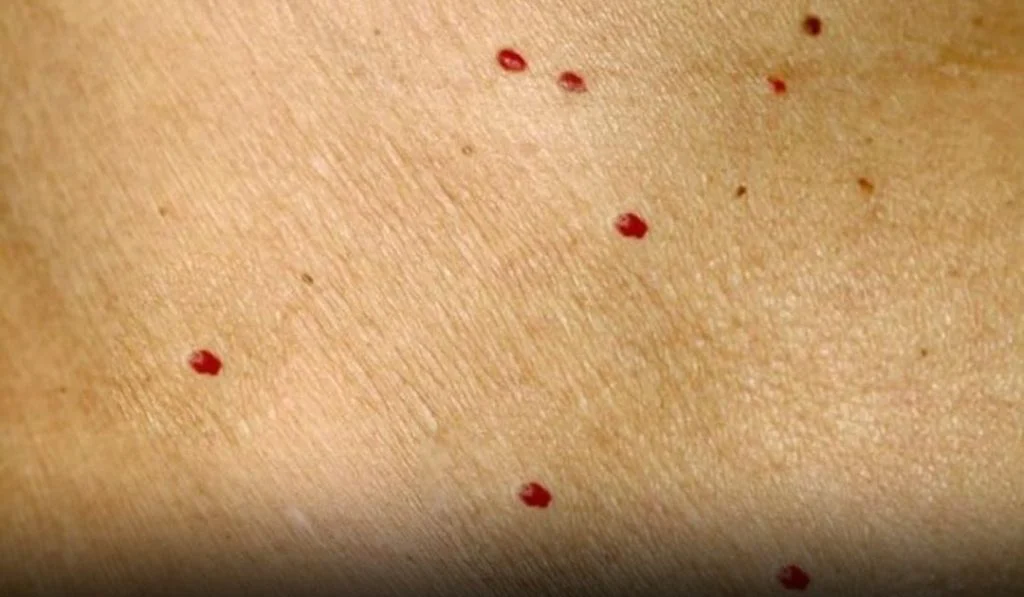
Those small red dots that appear on the skin—flat or raised, isolated or clustered—are one of the most common reasons people consult a dermatologist or search for answers online. Their causes range from entirely benign to conditions requiring prompt medical attention. Here is what the science says about the most frequent explanations.
En bref
- —At least 11 distinct conditions can cause red dots on skin
- —Cherry angiomas are harmless and linked to aging after 30
- —Petechiae may signal low platelets or infection if widespread
Cherry angiomas: the most common red dot after age 30
Cherry angiomas are among the most frequently encountered red spots on adult skin. They appear as bright red, round marks measuring between 1 and 5 millimetres, either flat against the skin or very slightly raised. Their distinctive colour comes from clusters of dilated capillaries just beneath the surface.

These spots are directly linked to the natural aging process and become increasingly common from the age of 30 onward. They can appear anywhere on the body and tend to multiply over time, though they cause no pain or discomfort.
From a medical standpoint, cherry angiomas are entirely benign. No treatment is required unless the patient chooses to have them removed for cosmetic reasons, in which case laser therapy or electrocautery are standard dermatological options.
Petechiae: when tiny dots signal something deeper
Petechiae are flat, pinpoint-sized red or purple dots that share one defining characteristic: they do not blanch—that is, they do not turn white when pressed. This distinguishes them immediately from other red marks caused by surface irritation or allergic reactions.

They form when small capillaries beneath the skin rupture and leak blood into the surrounding tissue. In many cases, the trigger is mechanical and temporary: intense coughing, vomiting, heavy lifting, or physical straining can all produce petechiae in localised areas, particularly around the face and neck.
However, petechiae warrant closer attention when they appear in large numbers, spread rapidly, or are accompanied by other symptoms such as fever, unusual bruising, or fatigue. These combinations can indicate a low platelet count—a condition known as thrombocytopenia—or an underlying infection, including in some cases sepsis. Anyone presenting with widespread petechiae alongside systemic symptoms should seek medical consultation without delay.
Why skin dots are so often misidentified
The skin is the body’s largest organ and one of the most visible indicators of internal health. Red dots in particular are frequently self-diagnosed incorrectly because dozens of conditions share similar visual characteristics. Dermatologists use a combination of visual inspection, the blanch test, patient history, and in some cases a biopsy to reach an accurate diagnosis.
Suggested Posts
Why US public restrooms are legally required to have U-shaped toilets
Walk into almost any public restroom in the United States and you'll notice the same thing: a toilet seat with an open front, shaped…