📌 Purple spots on thawed chicken: should you really throw it away?
Posted 17 February 2026 by: Admin
Those Purple Spots on Your Thawed Chicken: Understanding the Phenomenon
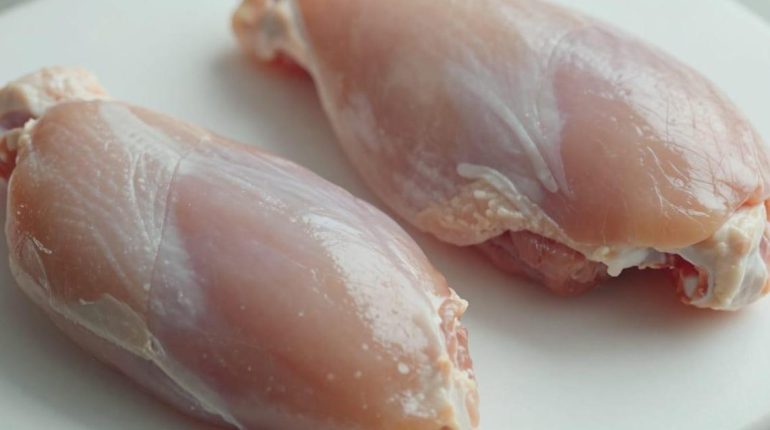
Opening a pack of thawed chicken breasts to discover purplish spots under the skin invariably triggers a reflex of concern. However, in the majority of cases, this visual reaction is nothing to be alarmed about.
These dark colorations are mainly due to myoglobin, a protein present in muscle tissue whose role is to store oxygen. During the freezing/thawing cycle, this protein undergoes structural changes that alter its pigmentation — a phenomenon comparable to the natural browning of beef exposed to air.
The intensity of the hue varies according to several factors: the age of the animal, its diet, and the muscle group concerned. Thighs, naturally richer in myoglobin than fillets, thus present more pronounced colorations. These variations are biologically normal and do not indicate the sanitary quality of the meat.
It is therefore advisable to dissociate the appearance of a food from its actual safety. A visually surprising chicken is not necessarily a dangerous chicken. What the eye perceives as an anomaly is often only the visible trace of a perfectly mundane chemical process.
Understanding the origin of these spots is the first step in an informed assessment — but myoglobin is not always the only cause of these colorations.
Bone Marrow Leakage: The Most Frequent Culprit
While myoglobin explains a large part of the observed colorations, another mechanism frequently occurs: bone marrow leakage.
During freezing, ice crystals form inside the cells and mechanically perforate them. This cellular rupture releases the marrow contained in the bones, whose blood pigments then diffuse into the surrounding tissues during thawing. The result: purplish or reddish streaks extending around bone areas, particularly visible near the breastbone or joints.
This phenomenon affects young chickens more, whose bones, still porous and little calcified, offer less resistance to these micro-perforations. This is why poultry raised quickly — a common practice in the modern poultry industry — is more likely to show this type of coloration after freezing.
Visually unpleasant, this marrow diffusion remains biologically harmless. It alters neither the safety nor the taste qualities of the meat, provided that the cold chain has been correctly respected and the poultry has been handled under adequate hygienic conditions.
These two mechanisms — myoglobin and bone marrow — produce colorations of similar appearance, but the difference between a benign discoloration and a true sign of spoilage rests on precise sensory criteria that it is essential to master.
Benign Discoloration or True Sign of Spoilage: How to Tell the Difference
Once these two mechanisms are identified, it is still necessary to know how to distinguish a harmless coloration from a real alarm signal — because the boundary, although clear, is read more with the senses than with the eyes.
Purple spots due to myoglobin or bone marrow share a common characteristic: they remain localized and circumscribed, generally around bone areas or specific muscles. To the eye, the flesh retains a firm and slightly moist appearance, without a dull or generalized grayish reflection. To the touch, the surface remains supple without being sticky. And above all, the smell remains neutral — that of fresh raw meat, without any sour or rancid notes.
Spoiled meat, on the other hand, sends signals that are impossible to ignore. A pungent or putrid odor, even slight, is the first indicator. The texture becomes slimy or sticky under the fingers — a sensation distinct from simple natural moisture. The color, finally, turns to a dull and uniform gray, well beyond the localized spots.
If even one of these signals appears — suspicious odor, slimy film, degraded general appearance — the decision is clear: the poultry must be thrown away. No cooking, even at high temperatures, neutralizes the bacterial toxins already present in deteriorated meat.
By mastering these sensory criteria, the consumer has a reliable framework to decide quickly — and in complete safety.
Final Verdict: Cook or Toss Your Thawed Chicken?
Once these sensory criteria are mastered, the decision becomes much simpler than it appears at first glance.
Isolated purple spots, without a suspicious odor or abnormal texture, in no way compromise food safety. Whether they result from a modification of myoglobin or a bone marrow leak, these colorations are biologically harmless. The chicken remains fit for consumption, provided that storage was correct — temperature below 4°C before freezing, thawing in the refrigerator rather than at room temperature, and hygienic handling throughout the process.
The most frequent error is to rely exclusively on visual appearance. Impeccable-looking meat can be contaminated, while a chicken with purplish hues can be perfectly healthy. The global sensory approach — sight, touch, smell — remains the only reliable tool for assessing the freshness of poultry.
In practice: if the flesh smells good, retains a firm texture, and the spots remain localized, put it in the oven without fear. Conversely, as soon as a doubt remains on one of the three criteria, the benefit of the doubt always belongs to caution. No saving is worth the risk of food poisoning.
Knowing the mechanisms behind these colorations also means better understanding how to optimize the preparation of your poultry for a result that is both safe and tasty.