📌 Prime rib: why marbled fat is the key to perfectly juicy and tender meat
Posted 2 March 2026 by: Admin
Selecting The King Of Roasts: Deciphering Grades And Cuts
The success of a prime rib begins at the butcher’s counter. The USDA classification system distinguishes three determining grades: Prime, the absolute pinnacle with its intensive marbling guaranteeing maximum flavor and juiciness, reserved for exceptional occasions. Choice offers slightly less marbling but remains excellent, simply requiring increased monitoring during cooking. Select, leaner and more economical, suits tight budgets but requires rigorous technical mastery to avoid drying out.
The bone-in or boneless dilemma reveals two philosophies. The standing rib roast with bone, featuring 2 to 7 ribs, enriches the meat with deep flavors, preserves natural moisture, and impresses visually. The boneless version facilitates cutting and storage but cooks faster, demanding constant attention to maintain tenderness.
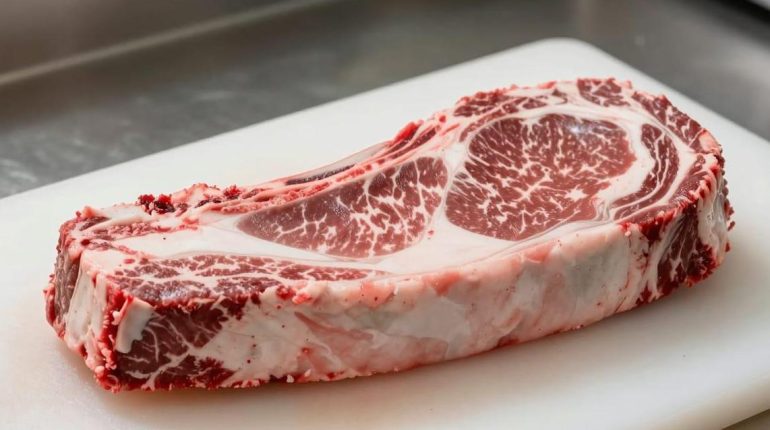
“Look for the white veins interlaced in the red meat,” professionals advise. This visible marbling constitutes the ultimate quality indicator, promising tenderness and intense aromas. The portion rule remains simple: 450 grams per person for a generous service. A 4 to 5-rib roast comfortably feeds 6 to 8 guests, transforming your table into a gastronomic theater.
This meticulous selection lays the foundation. But even the noblest meat will fail without mastered thermal preparation.
Preparation Fundamentals: Temperature And Strategic Trimming
This meticulous selection now requires rigorous thermal preparation. If your roast is frozen, thaw it completely in the refrigerator for 24 to 48 hours depending on its mass. Banish any thawing at room temperature: this practice promotes bacterial proliferation and creates catastrophic thermal gradients for cooking.
Two hours before putting it in the oven, take the roast out of the cold. This temperature rise is the step most underestimated by amateurs. Meat seared directly out of the refrigerator develops a charred exterior while the core remains stubbornly cold. Thermal uniformity guarantees homogeneous cooking from edge to center, transforming every slice into pink perfection rather than a grayish gradient.
Trimming requires precision and restraint. Use a sharp knife and reduce the fat layer to 6 millimeters thick. Too generous, it prevents seasoning from penetrating the meat. Too frugal, it deprives the roast of that golden, caramelized crust that marks great successes. This thin lipid film will naturally baste the meat during cooking, creating a protective barrier against drying out.
These technical gestures, seemingly simple, separate the amateur from the connoisseur. What remains is to compose the aromatic crust that will sublimate this meticulous preparation.
The Signature Seasoning: The Crust Of A Thousand Flavors
This meticulous preparation now calls for its aromatic consecration. The purist doctrine prevails here: only three ingredients compose the legendary crust of the prime rib. Two to three tablespoons of kosher salt, one to two spoons of freshly ground black pepper, one to two teaspoons of garlic powder. Nothing more, nothing less.
Kosher salt stands out over fine salt for a specific reason: its irregular crystals adhere superbly to the fatty surface, creating a textured crust that concentrates flavors without dissolving prematurely. Pepper requires immediate grinding: volatile aromas evaporate as soon as the seed is fragmented. Garlic powder, often despised by purists, reveals its relevance here: unlike fresh garlic which burns under high temperature, the dehydrated form caramelizes harmoniously.
Massage this trio of spices over the entire surface of the roast, paying particular attention to the carefully preserved 6-millimeter fat layer. Some chefs add herbs de Provence, rosemary, or mustard. Resist this temptation. The prime rib possesses an intrinsic nobility that requires no artifice. Complexity is born from the meat itself, its generous marbling, and its aging.
This calculated sobriety sets the stage for the ultimate test: the mastery of fire that will transform this seasoned block into a culinary masterpiece.
Towards Perfection: Anticipating The Rest Of The Transformation
This minimalist crust, applied with conviction, now seals the promise of a future success. But seasoning is only an intermediate step in this culinary quest. The true alchemy will take place in the following phases, when heat and time metamorphose this prepared roast into an unforgettable centerpiece.
The balance achieved between the 6-millimeter fat layer and the spice coating creates the ideal conditions for the formation of a golden and crispy crust. This protective barrier will trap internal juices while developing the Maillard reactions that produce that much-sought-after caramelized flavor. Without this meticulous preparation, no cooking technique, however sophisticated, can compensate.
Timing now becomes a critical factor. Every minute counts in the upcoming thermal orchestration. The ambient temperature of the roast, its perfectly seasoned surface, its strategic trimming: all these elements converge toward a single goal. The mention “see more on the next page” in the original guide reveals that this culinary journey unfolds methodically, transforming a simple recipe into a true narrative arc.
The hour approaches when oven, thermometer, and patience will reveal their decisive importance in the conquest of the absolute prime rib.