📌 Potato and spinach balls: the 30-minute recipe to transform your leftovers into a complete dish
Posted 3 January 2026 by: Admin
Homemade Potato Base And Preparation Of Fresh Ingredients
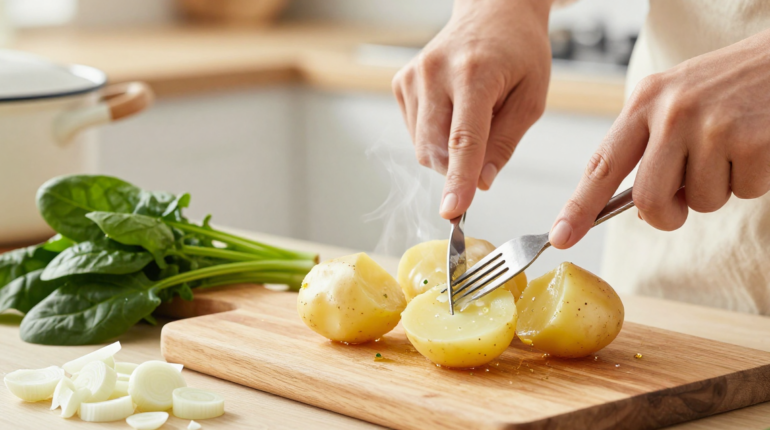
The success of these balls relies on a simple but precise technical base. The 400 g of potatoes, peeled and washed, start their cooking in cold salted water. This detail matters: if plunged directly into boiling water, they would cook unevenly. Twenty minutes are enough to obtain tender flesh, which is then mashed with a fork after cooling completely. This slightly rustic texture, far from a smooth puree, guarantees the hold of the balls during shaping.
During this cooking time, the shallot is peeled and goes under the knife for a fine mince. The fresh parsley, meticulously washed and dried, joins the cutting board for a thorough chopping. These simultaneous actions optimize the announced twenty minutes of preparation, without haste or downtime.
Mashing with a fork, intentionally imperfect, creates a base that will accommodate the spinach and meat without falling apart. This traditional method avoids the blender, preserving a structure that will withstand frying. The complete cooling of the potatoes before this step prevents any premature cooking of the other ingredients during the final mixing, guaranteeing freshness and control of textures.
Treatment Of Fresh Spinach And Gourmet Assembly
The 400 g of fresh spinach require special attention. Each leaf is stripped of its stem and, if necessary, its too thick central vein. A double wash in two successive waters eliminates soil and impurities, an essential gesture for these often sandy vegetables. Meticulous drying precedes a regular shredding that will facilitate their harmonious incorporation.
The pan receives this prepared spinach with a tablespoon of olive oil and a few basil leaves. The quick cooking preserves their vibrant color and nutritional qualities. This pass in the pan concentrates the flavors while reducing the volume, avoiding excess water that would dilute the final mixture.
The bowl becomes the stage for assembly: cooled mashed potatoes, sautéed spinach, minced shallot, 300 g of minced veal, and 150 g of mozzarella cut into tiny cubes. The latter, coarsely grated if preferred, will melt delicately during cooking, creating creamy pockets contrasting with the crispy exterior. Fresh basil scents the whole while salt and pepper adjust the seasoning according to personal preferences.
This meat-vegetable-cheese combination balances proteins, fibers, and calcium in a comforting bite. The resulting homogeneous mixture already reveals the desired final texture: compact enough to be shaped, flexible enough to remain soft at the core.
Shaping And Breading Of The Balls
The resulting homogeneous mixture is now ready for manual shaping. Slightly moistened hands take a generous portion and roll it into a regular ball, a gesture repeated until the preparation is exhausted. The size of the balls remains at your discretion: larger for a hearty main course, smaller for a presentation as an appetizer or tapas.
The professional triple breading is organized in successive stations: a first container contains the flour, the second holds the lightly beaten egg white, the third contains the breadcrumbs. Each ball follows this methodical path, first coated in flour which dries the surface, then dipped in the egg white which acts as a natural glue, and finally rolled in the breadcrumbs which will form that much-sought-after golden crust. This technique guarantees perfect adhesion and prevents any peeling during cooking.
The salt-pepper seasoning integrated into the base mixture is adjusted according to personal taste. Some will prefer a touch of grated nutmeg which harmonizes remarkably with the spinach, others will dare a hint of dried chili to wake up the whole. This three-step breading method, borrowed from professional kitchens, remains accessible to amateur cooks who will discover how to obtain this characteristic textural contrast.
The breaded balls wait patiently on a plate, ready to join the heat of the pan that will complete their transformation into crispy bites.
Golden Cooking And Immediate Service
A sauté pan or a thick-bottomed frying pan receives the four tablespoons of olive oil which will rise in temperature over medium-high heat. The breaded balls join this hot oil bath without haste, arranged with enough space to allow easy rotation. Constant monitoring is required: each side demands its uniform cooking time, obtained by regular movements that avoid any pale or, on the contrary, burnt areas.
The golden coloring progresses over the entire surface in about seven to eight minutes. A wooden spatula or a spoon delicately accompanies these successive rotations, preserving the integrity of the crispy crust that gradually forms. The characteristic smell of grilled veal and toasted breadcrumbs signals the approach of perfect cooking, that precise moment when the exterior reaches the desired crunch while the core retains its melting softness.
Paper towels spread on a plate receive the finished balls, eliminating any superfluous excess oil in a few seconds. This degreasing step preserves the lightness of the final dish without compromising the taste.
Service is immediate, the generous portions for four people revealing this characteristic textural contrast at the first bite. The thirty minutes of total cooking result in this recipe by Amélie Roche for Interfel/CNIPT, a perfect illustration of accessible home cooking that transforms simple ingredients into refined bites.