📌 Palmistry and the “Wealth Cross”: What Ancient Hand Reading Reveals About Financial Destiny (and Why Science Disagrees)
Posted 11 December 2025 by: Admin
The Ancient Origins And Cultural Foundations Of Palm Reading
Palmistry’s story begins not with fortune tellers in dimly lit tents, but in the ancient civilizations of India, where practitioners first began mapping the human hand as a landscape of destiny. From there, this cross-cultural phenomenon spread methodically through China, Persia, Egypt, and eventually Europe, each region absorbing and reshaping the practice to fit its own worldview. What emerged was far more than a party trick—it became a sophisticated system for interpreting character, fate, and the invisible forces believed to shape human lives.
To early palm readers, hands were never merely body parts. They were intricate maps written in flesh, where every detail held meaning. A practitioner would study the life line tracing the edge of the thumb, the head line revealing intellect, the heart line exposing emotional tendencies, and the fate line suggesting destiny’s trajectory. Beyond the lines themselves lay the mounts—fleshy areas of the palm each associated with distinct traits and energies. Finger shapes, palm proportions, and symbolic marks like crosses, islands, forks, and stars all contributed to a larger narrative.
This holistic approach distinguished traditional palmistry from mere superstition. Readers never interpreted a single line in isolation; they viewed the hand as a complete text, where patterns and symbols combined to reveal a coherent story. A cross here, a fork there, a broad mount, a tapering finger—together they painted a portrait of the person seeking answers. Across diverse civilizations, this fundamental principle remained constant: the hand was a canvas where life expressed itself symbolically, and understanding those symbols meant understanding oneself. Over centuries, palmistry became woven into cultural identity, blending ancient wisdom with evolving beliefs.
Decoding The Wealth Cross: Symbol, Meaning, And Interpretation
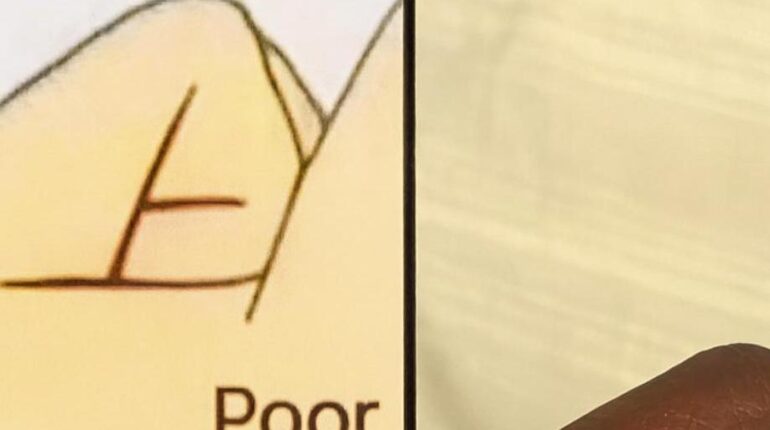
The transition from understanding how hands were read as maps of destiny to exploring specific symbols reveals why certain markings became cultural touchstones. Among the most enduring interpretations in palmistry stands a deceptively simple marking: the wealth cross. Picture two contrasting palms side by side. In one, near the base of the thumb, a faint, almost imperceptible cross barely marks the surface—traditionally labeled “Poor.” In the other, a deep, clearly defined cross appears unmistakably etched into the flesh—marked “Rich.” The visual distinction is stark, and the implication seems obvious. Yet the reality behind this symbol proves far more nuanced than folklore suggests.
According to traditional palmistry, this cross near the thumb intersects with an area associated with resourcefulness and ambition. A strong, well-defined cross is believed to indicate financial competence in handling money, good fortune in seizing opportunities, and a natural knack for converting ideas into tangible success. Conversely, a faint or fragmented cross has been interpreted as suggesting that financial ease may require greater effort or that resources might not flow as naturally.
But here lies palmistry’s essential paradox: the interpretation was never meant as literal prophecy. The cross functions as a metaphor, representing mindset rather than inevitable fate. Someone studying their palm and discovering a strong wealth cross might internalize confidence and determination simply because they believe the symbol validates their potential. In this sense, palmistry becomes less about prediction and more about self-perception. The symbol works not because it predicts the future, but because it encourages the seeker to view themselves as capable of achieving financial stability. This psychological dimension explains much of palmistry’s persistent appeal across centuries—it offers not answers, but mirrors reflecting our ambitions back to us.
Global Perspectives: How Different Cultures Read Prosperity In Palms
The symbolism embedded in palmistry’s wealth cross reveals something profound: humans across continents and centuries have sought the same answers in their hands. This universal impulse to decode prosperity through palm markings takes strikingly different forms depending on cultural context, yet the underlying belief remains constant—hands are canvases where destiny expresses itself.
In Indian palmistry, the area near the thumb connects to the Mount of Venus, traditionally associated with vitality, passion, and worldly enjoyment. Crosses appearing here are interpreted as major life events or significant opportunities, with practitioners viewing them as markers of life-altering potential rather than simple financial indicators. The focus extends beyond mere money to encompass the broader concept of living fully and experiencing abundance.
Chinese traditions approach the same region through a different lens. Intersecting lines in palm reading are read as indicators of luck cycles and fortune fluctuations—not fixed destinies but flowing changes in circumstance. This interpretation reflects a philosophical view where fortune ebbs and flows naturally through life’s seasons, making certain markings signs of transitional periods rather than permanent conditions.
Middle Eastern practices ground their analysis in more concrete territory: signs near the thumb are historically linked to family resources, inheritance patterns, and long-term stability. Here, the wealth cross speaks less to personal ambition and more to familial circumstances and generational wealth transmission.
Despite these variations, a striking consistency emerges across continents. Whether viewed through Indian, Chinese, or Middle Eastern frameworks, the hand—particularly areas near the thumb—has consistently symbolized prosperity and potential. This convergence suggests that palmistry’s appeal transcends individual cultures; it reflects a fundamental human need to find meaning in the physical markers we carry. Rather than predicting financial futures, these diverse interpretations offer cultural reflections of how different societies understand abundance, opportunity, and the forces shaping human fortune.
The Modern Reality: Science, Self-Reflection, And The True Power Of Palm Symbols
The cultural consistency uncovered across continents reveals palmistry’s enduring appeal—yet science tells a starkly different story. Modern research has found no measurable connection between palm markings and financial outcomes, wealth accumulation, or personal destiny. Neuroscientists, economists, and statisticians agree: palmistry belongs firmly in the category of pseudoscience, lacking empirical evidence to support its predictive claims.
Your actual wealth depends on education, environment, hard work, opportunity, and circumstantial luck—variables palmists cannot read in skin and lines. A fortune 500 executive and a struggling entrepreneur may share identical crosses near their thumbs. The difference lies not in their palms but in their circumstances, choices, and timing.
Yet dismissing palmistry entirely misses something important. Psychologists increasingly recognize symbolic systems as valuable tools for self-reflection rather than prediction. When someone examines their palm and contemplates what a “wealth cross” might represent—ambition, competence, determination—they’re engaging in meaningful introspection. That conversation about goals, fears, and aspirations holds genuine psychological value, regardless of literal truth.
Think of palmistry as a mirror rather than a prophecy. It doesn’t predict your future; it reflects your current mindset back to you. Someone viewing themselves as capable and determined—because they believe a bold cross empowers them—may indeed pursue opportunities with greater confidence. That confidence alone could shape outcomes, creating a self-fulfilling prophecy built on psychology rather than mysticism.
The real magic of palm reading, ultimately, lies not in decoding destiny but in sparking the self-awareness that drives people toward their ambitions.