📌 Kama-Asa in Paris: how this boutique directly connects Japanese artisans and French cooks with over 1,000 traditional utensils
Posted 22 January 2026 by: Admin
Kama-Asa, The Parisian Sanctuary Of Japanese Tools
On Rue Jacob, a few steps from Boulevard Saint-Germain, a sober storefront conceals one of the capital’s best-kept secrets. Behind the Kama-Asa window, more than 1,000 Japanese kitchen utensils are lined up, including several hundred knife models selected with surgical standards. Here, there are no gadgets or superfluous tools: each piece corresponds to a precise gesture, designed for performance and exceptional longevity.
The address is gradually establishing itself as the haunt of Michelin-starred chefs and enlightened amateurs, attracted by a rare promise: direct access to the expertise of Japanese artisans without commercial intermediaries. The Parisian boutique extends the history of a house born in Japan, entirely dedicated to tools forged to last. Far from the classic distribution model, Kama-Asa positions itself as a true cultural relay, explaining the origin, function, and maintenance of each utensil with goldsmith-like precision.
Personalized support is the house signature: from choosing the knife adapted to one’s morphology and use to the perpetual sharpening service, each acquisition becomes a transmissible investment. This philosophy attracts a clientele that rejects planned obsolescence and seeks tools that develop a patina over time, gaining character with each use. In a neighborhood saturated with ephemeral boutiques, Kama-Asa cultivates an opposite approach: that of the rare object, chosen to last through the decades.
Amane, Excellence Forged In Seki By The Hōchō No Fujitake Workshop
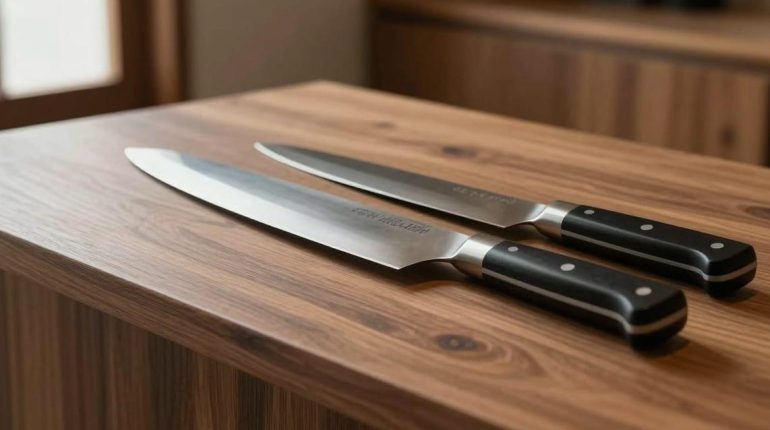
This demand for excellence finds its quintessence in the Amane collection, born from an exclusive collaboration with the Hōchō no Fujitake workshop. Located in Seki, the emblematic city of Japanese cutlery in Gifu Prefecture, this family workshop perpetuates a know-how that has become extremely rare: complete in-house mastery of the key manufacturing stages. From initial grinding to sharpening, finishing, and handle fitting, each knife passes through the same expert hands, guaranteeing consistency and precision that place these blades in the big leagues.
The choice of VG10 steel reveals this obsession with excellence. Developed specifically for Japanese kitchen cutlery, this high-end stainless steel concentrates three qualities rarely found together: high hardness, durable sharpness, and remarkable corrosion resistance. After cutting the steel plate and heat treatment, artisans shape each blade on a whetstone, manually correcting deformations one by one to obtain a profile of irreproachable regularity.
This manic attention to detail explains why Amane knives appeal to both professionals and enthusiasts. No step is automated, no shortcut is tolerated. The result: blades that retain their initial sharpness for years, provided they are given the maintenance they deserve. In Seki, excellence is still forged the old-fashioned way, with absolute respect for the artisanal gesture.
The Hamaguri Technique, Secret Of A Legendary Sharpness
This artisanal rigor culminates in the very geometry of the blade. Amane knives adopt the Hamaguri profile, an ancestral technique that shapes the surface into a convex form, gradually thinning towards the edge. This subtle curvature transforms each cut into a surgical gesture: the blade penetrates food with minimal resistance, while maintaining a structural robustness that defies the test of time.
The Hamaguri profile excels on all terrains. The most delicate vegetables – ripe tomatoes, fresh herbs – are sliced without crushing, while dense pieces of meat or fleshy fish yield with the same disconcerting fluidity. This versatility explains the range of the collection: the small utility knife reigns over peeling and meticulous finishes, the multi-purpose Santoku is essential for daily vertical cutting, and the Gyuto, a true chef’s knife, exploits its pronounced curvature for a rocking motion of formidable precision.
Kama-Asa’s most daring innovation lies in the knife for children. Designed for small hands, it incorporates a durable and reversible sharpening that accompanies young cooks into adulthood. An approach that embodies the Japanese philosophy: the tool is not replaced, it evolves with its user, develops a patina, and becomes a natural extension of the gesture.
The Complete Ecosystem Of Authentic Japanese Cuisine
Beyond exceptional blades, Kama-Asa deploys a complete arsenal for those who want to master the codes of Japanese gastronomy. The rectangular pans for tamagoyaki embody this requirement: their specific shape allows the Japanese omelet to be rolled in perfectly neat successive layers, impossible to reproduce in a classic Western utensil. Each tool corresponds to a precise gesture, codified by centuries of practice.
Traditional copper graters reveal all their subtlety on fresh ginger, crunchy daikon, or authentic wasabi. Their unique texture extracts the juices without tearing the fibers, transforming preparation into a moment of pure concentration. Japanese cypress steam baskets complete this picture: their noble wood diffuses a homogeneous heat while delicately scenting the food with a subtle woody note.
This philosophy of sustainable investment extends into the support service. Kama-Asa offers sharpening and repair to restore the original edge to the blades, but above all personalized maintenance advice that guarantees the longevity of each piece. Washing, drying, storing: every gesture counts for copper or carbon steel utensils. The tool develops a patina over time, becomes the cook’s accomplice, and passes through the years as a living heritage. An address open from Monday to Saturday, 12 rue Jacob in Paris VI, where Japanese craftsmanship is permanently installed in Parisian kitchens.