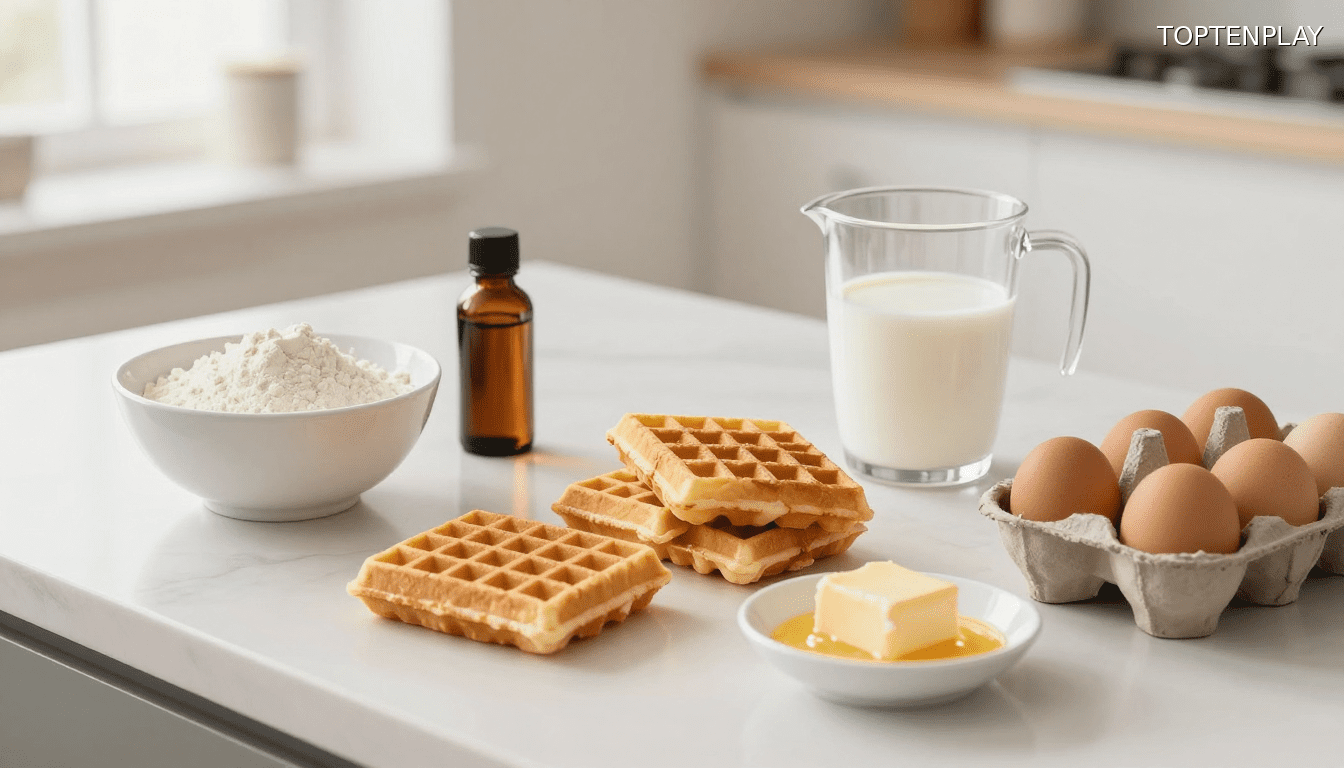
Essential Ingredients For Perfect Waffles
The success of a homemade waffle relies on a precise combination of ingredients whose proportions are not left to chance. The base starts with 250g of flour combined with 50g of sugar, a balance that guarantees structure while providing the right dose of sweetness. This dry foundation then welcomes 11g of baking powder, the leavening agent responsible for that much-sought-after airy texture.
The liquid part requires special attention: 2 beaten eggs are combined with 400ml of milk, but beware, the latter must imperatively be at room temperature. This technical detail, often neglected, determines the homogeneity of the batter and avoids stubborn lumps. Cold milk would cause premature solidification of the melted butter, compromising the final texture.
Precisely, those 50g of melted butter constitute the element of richness that transforms a simple batter into a golden treat. Combined with a large tablespoon of liquid vanilla or a sachet of vanilla sugar, it develops those characteristic aromas that fill the kitchen. A pinch of salt balances the whole, subtly revealing sweet flavors without dominating them.
This apparently basic list of ingredients actually hides a measured alchemy where every gram counts to achieve that outer crispness and inner softness that define the perfect waffle.

The Preparation Technique Decoded
These carefully measured ingredients only reveal their potential through a rigorous incorporation methodology. The first step consists of mixing the dry components: flour, sugar, salt, and baking powder, thus creating a homogeneous base that will receive the liquids without forming lumps.
In a separate container, beat the eggs before gradually incorporating the room-temperature milk. This emulsion constitutes the vehicle that will unite all elements. Then pour this liquid mixture into the center of the well formed in the dry ingredients, whisking from the center outwards in a circular motion. This technique avoids excessive air incorporation which would make the waffles too spongy.
The critical moment occurs with the integration of the melted butter. This should only be added at the very end of preparation, once the batter is perfectly smooth. If it were incorporated too early or with cold ingredients, it would solidify into small particles compromising the final smoothness. Liquid vanilla or vanilla sugar are added simultaneously, diffusing their aromas throughout the preparation.
The resulting batter should have a fluid but coating consistency, similar to a thick cream. This texture will guarantee uniform distribution in the waffle maker and that characteristic crispy-soft contrast, provided however that the cooking is mastered.

Keys To Mastered Cooking
This carefully prepared batter now requires a properly preheated waffle maker. Contrary to popular belief, the temperature should never be at maximum from the start: progressive preheating on a medium setting allows for uniform heat distribution, avoiding overcooked areas that would char the outside while the inside remains raw.
The moment to pour the batter occurs when the waffle maker reaches its optimal temperature, generally signaled by an indicator light. Pour a generous ladleful into the center of the plates, without trying to cover the entire surface: the batter will spread naturally under the pressure of the lid. Closing it too abruptly would expel the excess, while a delicate closure guarantees uniform distribution.