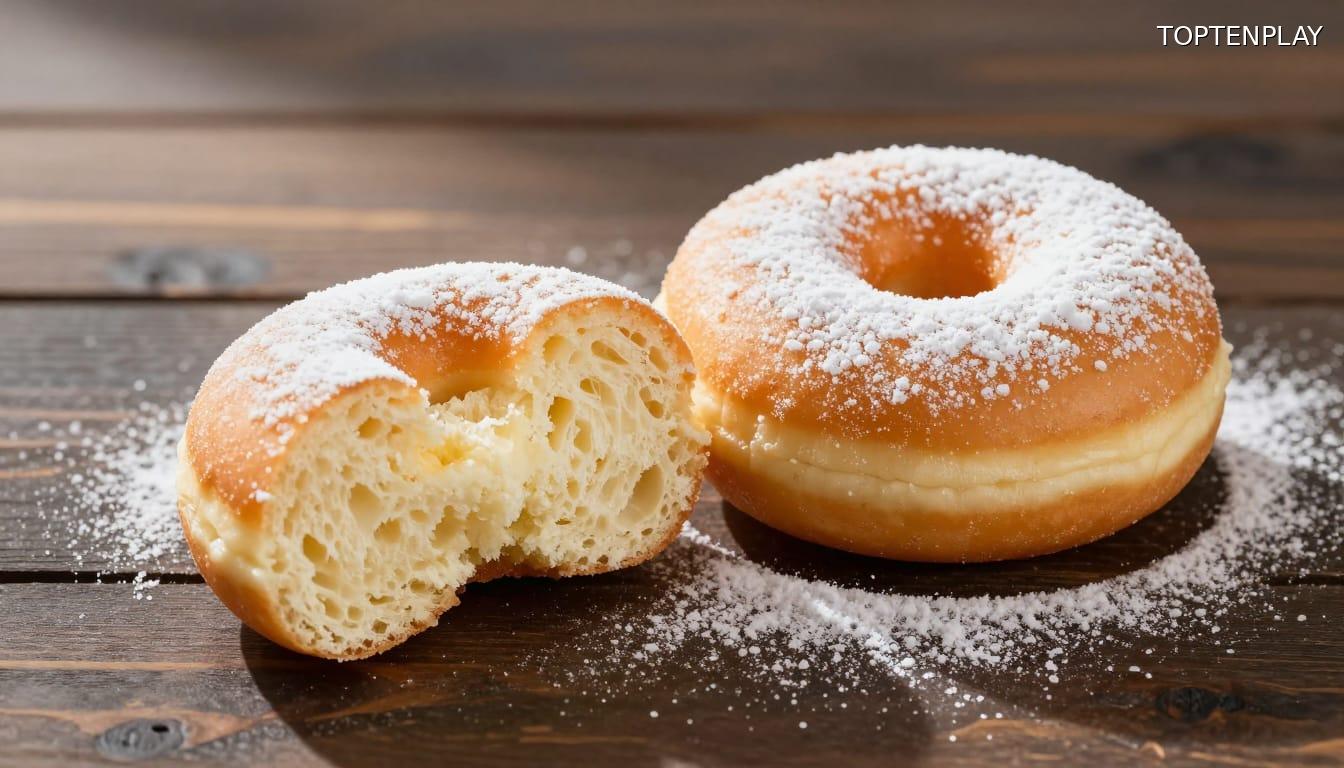
The Basic Recipe For Filled Donuts
Only five ingredients separate the amateur from the perfect donut. This recipe reveals a truth little known to pastry chefs: simplicity takes precedence over complexity when proportions are mastered.
The liquid base relies on 1 cup of milk, the anchor point that determines the optimal hydration of the dough. This precise ratio guarantees a texture that is neither too dry nor too sticky. Next come 3 tablespoons of icing sugar and 2 tablespoons of vegetable oil, a strategic duo that sculpts the characteristic softness of professional donuts.
Fermentation is activated thanks to 1 tablespoon of dry yeast, an essential chemical agent to obtain that much-sought-after airy structure. The 2 1/4 cups of flour constitute the structural framework, just enough to maintain the shape without weighing down the dough.
This precise dosage is not the result of chance. The milk/flour ratio of this recipe ensures a balance between elasticity and lightness, while vegetable oil advantageously replaces butter for prolonged freshness. Each measurement plays a precise role in the final alchemy.
With the list of ingredients complete, it remains to understand how these components interact to transform a simple dough into a gourmet delight.
The Secrets Of A Perfectly Risen Dough
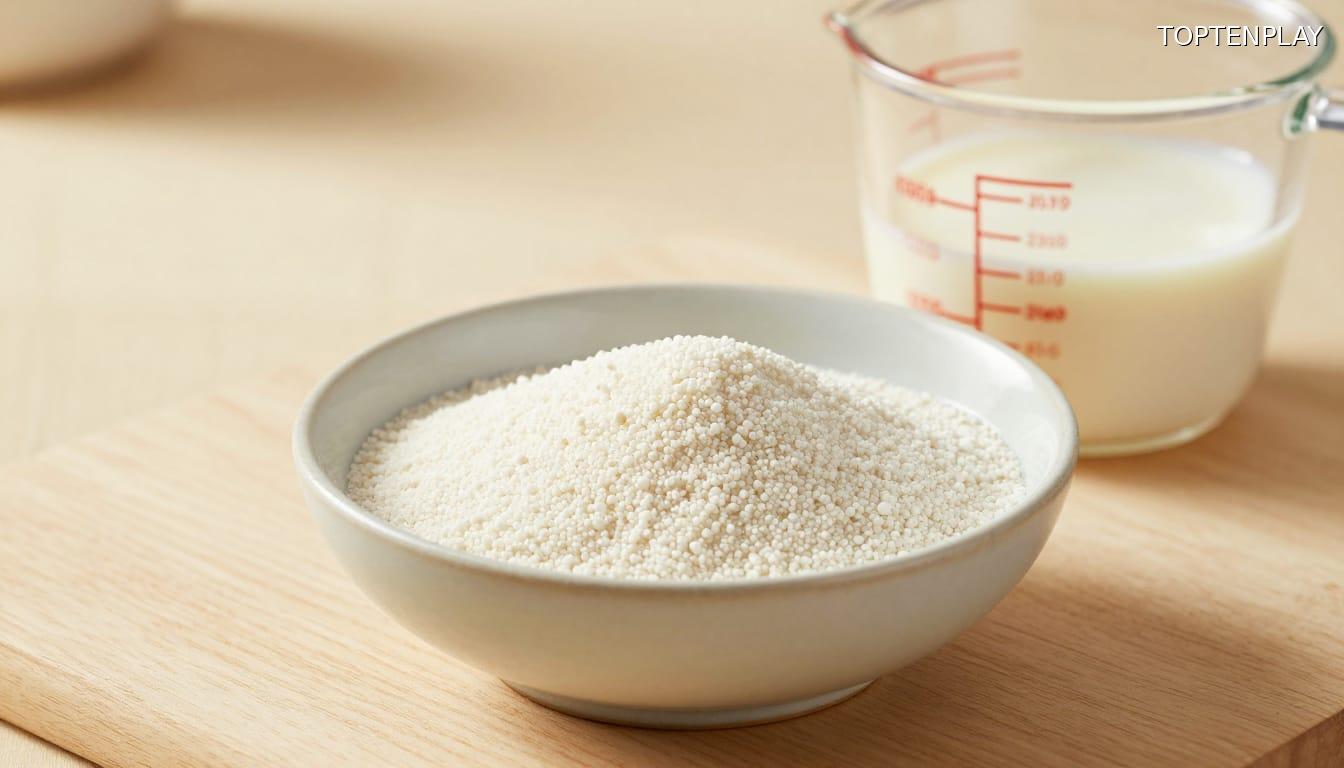
Dry yeast holds the power to transform a dense mixture into an edible cloud. Its activation determines everything: milk temperature too high, and the microorganisms die; too cold, and fermentation stagnates. The ideal zone is between 37 and 43°C, body temperature that wakes up the fermentation agents without destroying them.
Icing sugar doesn’t just serve to sweeten. It directly feeds the yeast, accelerating the production of carbon dioxide responsible for the rising. This chemical reaction creates the thousands of microscopic bubbles that give donuts their characteristic airy texture. Without this yeast-sugar alliance, the dough would remain flat and compact.
Vegetable oil acts as a moisture regulator. It coats the gluten molecules, limiting their excessive development which would make the dough rubbery. This lipid film also preserves softness for several days after cooking, unlike butter recipes which harden quickly.
Fermentation requires patience: 45 minutes minimum in a warm environment allow the dough to double in volume. This visible expansion confirms that the yeasts are working effectively, creating the honeycomb structure that differentiates a professional donut from an ordinary flatcake.
With these biochemical reactions mastered, it becomes possible to assemble the ingredients according to a proven method that guarantees the perfect cohesion of the whole.

Step-By-Step Preparation
Pouring the warm milk into a bowl starts the process. Immediately dissolving the dry yeast and icing sugar in it creates the activator mixture: a light foam appears after 5 minutes, a visual signal that the microorganisms are waking up. Vegetable oil is then incorporated, forming a cloudy emulsion that will unify the final texture.
Flour is added gradually, never all at once. Three successive additions of three-quarters of a cup allow for observing the evolution of the consistency: first liquid, then creamy, finally elastic. This gradual incorporation avoids lumps that are impossible to eliminate later and allows for adjusting the exact quantity according to the ambient humidity which varies absorption.
Kneading develops the essential gluten network. Eight minutes by hand or five with a mixer transform the sticky mass into a supple ball that pulls away from the sides. The windowpane test: gently stretching a piece of dough should form a translucent membrane without tearing immediately. This elasticity guarantees that the donuts will keep their shape during shaping and cooking.
Technique counts as much as proportions. Lightly flouring the hands facilitates handling without drying out the dough. A repeated folding-rotation movement creates the honeycomb structure that will capture the carbon dioxide produced during fermentation.
This mastered base now opens the way to the final transformations that will metamorphose the raw dough into golden and crispy delights.
Towards Cooking And Filling
The structured dough now requires rest and heat. Covering the bowl with a damp cloth and placing it in an environment at 25-30°C triggers slow fermentation: the volume doubles in 60 to 90 minutes depending on the ambient temperature. This invisible phase builds the complex aromas and the characteristic airy texture of professional donuts.
Shaping takes place after this first rise. Gently rolling out the dough on a floured surface without completely degassing it preserves some of the air bubbles. Form disks 8 centimeters in diameter then let them rest for an additional 20 minutes allows for a crucial second rise: the donuts swell again before diving into oil heated to exactly 175°C.
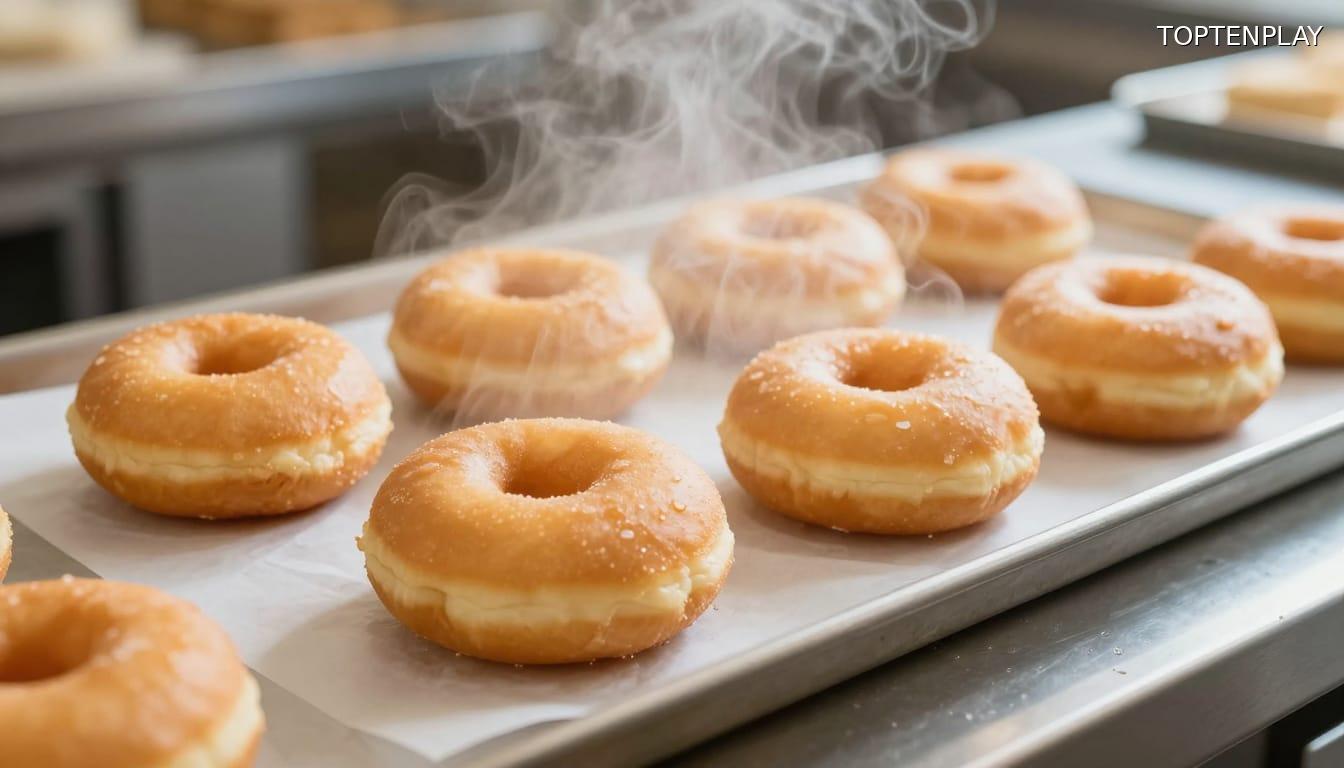
Frying instantly seals the surface while cooking the interior. Two minutes on each side are enough to obtain a uniform golden color. Draining on paper towels removes excess fat without compromising the outer crispness or the inner softness.
Filling transforms the plain donut into a gourmet creation. Piercing laterally with a nozzle allows for injecting pastry cream, jam, or ganache into the heart of the warm brioche. The cooled filling contrasts with the residual heat of the freshly fried dough.
These ultimate transformations reveal the full potential of the initial recipe, where five simple ingredients become vectors of multiple gustatory pleasure, customizable according to creative desires.