The smell hits you first. Even before you open the oven, the roasting garlic and melting parmesan start to drift through the entire kitchen — a round, warm, slightly pungent aroma that signals something good is coming. These oven-baked fries are exactly that: simple, effective, and no-nonsense.
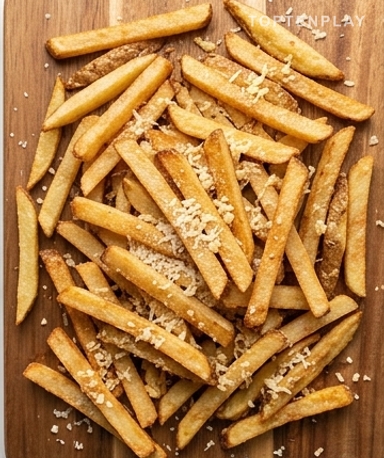
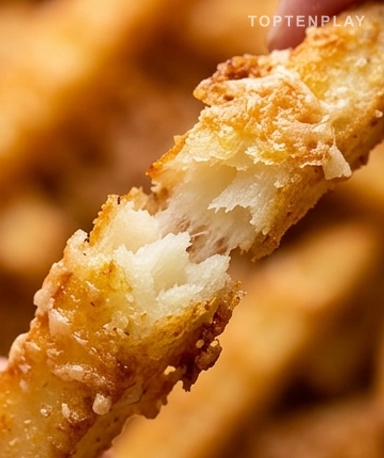
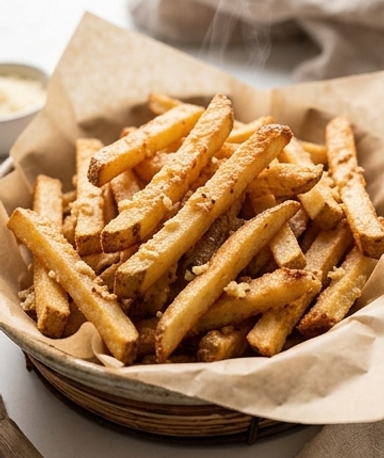
In front of you is a tray covered in light caramel-colored sticks, some edges slightly darker, almost amber. The parmesan crust has hardened and dried under the dry heat of the oven — on the surface, small grainy fragments that crunch under your teeth. Underneath, the potato flesh remains tender, almost creamy. And the garlic is everywhere, without being overpowering.
Why you’ll love this recipe
Ingredient Notes
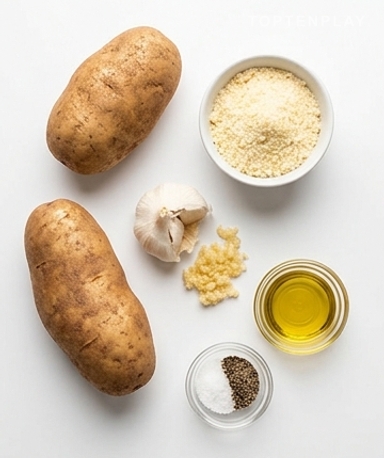
Two Russet potatoes, parmesan, fresh garlic, and a drizzle of olive oil: that’s all you need.
- Russet potatoes : The Russet is the quintessential American potato for fries: starchy flesh, thick skin, low moisture. If you can’t find them, opt for Monalisa or Bintje. Avoid waxy varieties like Charlotte; they stay soft in the oven no matter what you do.
- Freshly grated parmesan : Forget the pre-grated parmesan in a bag. It’s too dry and too fine; it burns before it browns properly. Buy a wedge and grate it yourself with a fine grater — you’ll get a slightly moist texture that sticks better to the fries and melts more evenly.
- Fresh garlic : Two cloves finely minced or crushed with a press. Garlic powder works, but gives a milder result without the bite. With fresh garlic, be careful: it can burn quickly. That’s why we mix it with olive oil, which acts as protection during cooking.
- Olive oil : No need for expensive oil. Its role here is purely technical: to conduct heat, allow the crust to form, and coat each fry evenly. Two tablespoons for an entire tray is enough — any more, and your fries will be greasy rather than crispy.
Dry your potatoes before doing anything else
This is the step everyone skips and no one should. Once your potatoes are cut into sticks — about one centimeter thick, no thinner — lay them on a clean kitchen towel and pat them firmly. Surface moisture is the direct enemy of the crust. Wet potatoes in a hot oven don’t roast: they steam. The result is soft fries with no bite. A few minutes of drying really changes everything.
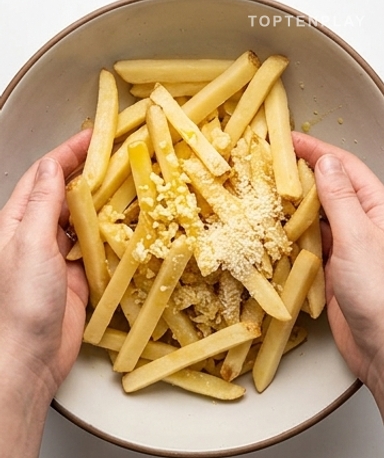
Coat them with your hands — it’s the only honest way to do it
In a large bowl, pour in the olive oil, minced garlic, parmesan, salt, and pepper. Add the fries and mix with your hands. Not with a spatula, not by shaking the bowl. It’s the only way to feel if every fry is well-coated, to spot areas where the parmesan is sticking or sliding off. You should feel the slightly grainy parmesan and the damp garlic clinging to the potato skin under your fingers. It takes thirty seconds and is truly worth it.
Don’t touch a thing for 25 minutes
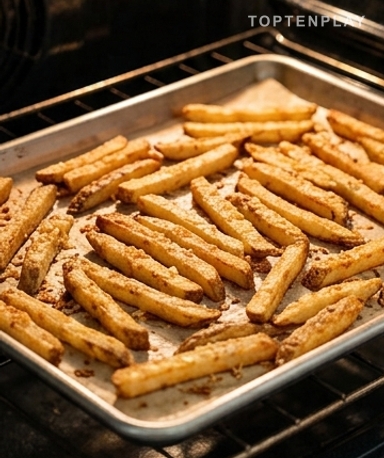
Spread the fries on a parchment-lined baking sheet in a single layer without overlapping. Preheat the oven to 220°C. Slide them in and don’t touch them. No flipping every five minutes — let the contact between the fry and the hot tray do its work. After twenty-five minutes, flip them just once and leave for another five to eight minutes. The bottom should be a deep golden brown, like light caramel — that’s where all the crispiness is concentrated.
Serve immediately, no exceptions
Oven fries lose their crispiness within minutes of leaving the oven. This isn’t an opinion; it’s physical reality. Time it so they go straight to the table. If you wait ten minutes, you’ll be eating soggy fries with a rubbery parmesan crust — technically edible, but not what we were going for. A little extra parmesan grated over them as they come out of the oven melts gently in the residual heat. That’s all the finishing they need.
Tips & Tricks
- Never overcrowd the tray: if the fries touch, they steam rather than roast in the dry heat. Better to do two batches than to sacrifice the texture of the first.
- Keep the skin on the potatoes if it’s thin and well-washed. It adds a slight earthy bitterness that contrasts well with the parmesan and protects the flesh during cooking.
- If your oven heats unevenly, place the tray on the bottom rack for the first twenty minutes, then move it up for the last five — the top browns, the bottom crisps, and the two meet in the middle.
Why do my fries stay soft even with a high oven temperature?
The most common cause: the potatoes weren’t dried before being coated. Surface moisture creates steam in the oven and prevents the crust from forming. Pat them well with a towel, and also make sure not to overcrowd the tray — fries that touch steam rather than roast.
Which potato should I use if I can’t find Russets?
Look for Monalisa or Bintje: starchy flesh, low moisture, they hold up well during cooking. Avoid waxy varieties like Charlotte or Ratte — they stay soft in the oven and won’t form a satisfying crust.
Can I prepare these fries in advance?
Partially. You can cut and dry the potatoes a few hours early, keep them in a dry towel in the fridge, then coat and bake them at the last minute. Full cooking in advance is not recommended: oven fries lose their crunch in less than ten minutes after coming out.
Can I use pre-grated bagged parmesan?
It’s possible, but the result will be less satisfying. Pre-grated parmesan is too fine and dry: it tends to burn before forming a real golden crust. Grating a piece of fresh parmesan takes thirty seconds and makes a huge difference in the final texture.
How do I reheat leftovers without making them soggy?
In the oven at 200°C for 8 to 10 minutes on a dry tray — never in the microwave, which turns them permanently soft. They won’t regain the full crispiness of the first bake, but the dry heat of the oven recovers them reasonably well.
What can I substitute for parmesan for a lactose-free version?
Grated nutritional yeast gives a similar result in terms of texture and umami, with a slightly different but very pleasant flavor. Use about two tablespoons to replace the three of parmesan.
Garlic and Parmesan Oven Fries
American
Side Dish
Golden and crispy oven-baked fries, coated in fresh garlic and grated parmesan. Ready in 40 minutes, no deep fryer required.
Ingredients
- 2 large (about 800g) Russet potatoes (or Monalisa / Bintje)
- 25g (3 tbsp) freshly grated parmesan
- 2 cloves (2 tsp) fresh garlic, finely minced
- 30ml (2 tbsp) olive oil
- ½ tsp salt
- ¼ tsp ground black pepper
Instructions
- 1Preheat the oven to 220°C (convection/fan if possible). Line a large baking sheet with parchment paper.
- 2Wash the potatoes and cut them into sticks about 1 cm thick. Do not peel if the skin is thin.
- 3Dry the sticks thoroughly with a clean towel by patting firmly — this step is essential for crispiness.
- 4In a large bowl, mix the olive oil, minced garlic, grated parmesan, salt, and pepper.
- 5Add the fries to the bowl and mix with your hands until every stick is well coated.
- 6Spread the fries in a single layer on the tray without overlapping. Use two trays if necessary.
- 7Bake for 25 minutes without touching them. Flip the fries using a spatula and cook for another 5 to 8 minutes until uniformly golden.
- 8Serve immediately, with extra grated parmesan after taking them out of the oven if desired.
Notes
• Storage: These fries do not keep well once cooked. To prepare in advance, cut and dry the potatoes and keep them wrapped in a dry towel in the fridge for up to 4 hours before cooking.
• Spicy variation: Add ½ tsp of smoked paprika or a pinch of cayenne pepper to the oil-garlic-parmesan mixture.
• Lactose-free: Replace the parmesan with 2 tbsp of nutritional yeast for a similar flavor and texture.
Nutrition Facts (per serving, estimated)
| 245 kcalCalories | 6gProtein | 35gCarbs | 9gFat |