📌 Fried tofu and simmered eggs: the Japanese secret to a complete meal in 15 minutes
Posted 19 March 2026 by: Admin
The Vegetarian Alternative To Traditional Oyakodon
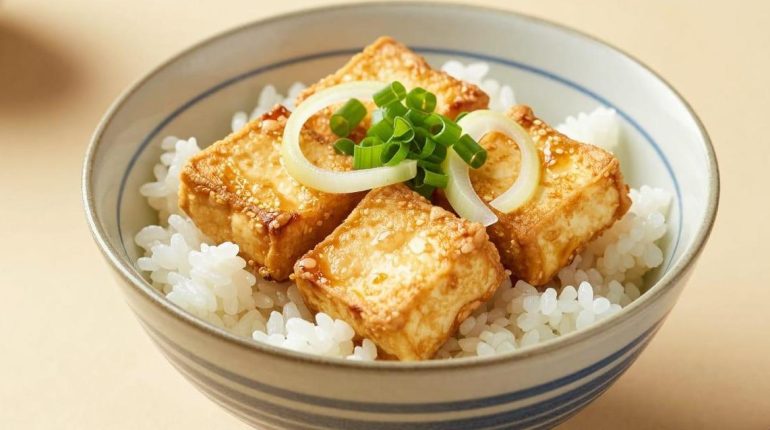
The oyakodon reigns among Japan’s comforting rice bowls, but its main ingredient – chicken – excludes some fans of Japanese cuisine. Atsuage tamagotoji don (厚揚げ卵とじ丼) overcomes this limitation by applying the same proven formula, simply substituting the meat with thick fried tofu. This transposition fully preserves the structure of the dish: onions simmered in an umami broth, beaten eggs poured in a spiral, all topped over steaming rice.
This vegetarian version goes even further. Combined with a vegetable dashi and an egg substitute like JUST Egg, it becomes entirely vegan compatible, opening the door of a Japanese classic to an even wider audience. The texture of the fried tofu – a golden crust surrounding a soft heart – absorbs the broth with remarkable efficiency, creating bites bursting with flavor.
The most attractive aspect remains its speed of execution. Fifteen minutes are enough to compose this family-style dish, with a single pot and basic ingredients. The result offers that savory depth characteristic of Japanese donburi, without compromising on authenticity or taste satisfaction.
A Preparation Technique In Exactly 15 Minutes
The efficiency of this recipe relies on a precise sequence that Japanese cooks master perfectly. The first step contradicts intuition: place the onion slices and tofu cubes in the broth while it is still cold, without turning on the heat. During these 1-2 minutes of waiting, the atsuage slowly soaks up the dashi-soy sauce-mirin mixture, absorbing the flavors even before the heat kicks in. Turning each piece once ensures uniform impregnation.
Medium heat then triggers a quick 3-minute cooking under a lid, creating a steam environment that softens the onions without dissolving them. Then comes the delicate moment: pouring the egg. Beat the eggs at room temperature, then pour them in a slow spiral over the simmering liquid – never a rolling boil – producing those characteristic silky ribbons and avoiding unsightly clumps of coagulated egg.
The final subtlety separates amateurs from experts: remove the pan 30-60 seconds before the egg is fully cooked. The white should be just set, the yolk still slightly shiny. The residual heat finishes the job during plating, preserving that creamy texture that makes all the difference between an ordinary donburi and an authentically successful version.
Simple Ingredients For A Perfect Balance
This harmony of flavors relies on a star ingredient often overlooked: atsuage, this thick fried tofu that is radically different from ordinary tofu. Its double texture – crispy golden crust on the outside, soft heart on the inside – gives it an exceptional ability to absorb liquids while maintaining its structure. It can be found in the refrigerated section of Asian grocery stores, usually pre-packaged in 200-gram blocks.
The broth that transforms these simple cubes into a comforting dish combines only four elements: dashi (Japanese broth), soy sauce, mirin, and sugar. This deep umami base permeates every bite without masking the natural sweetness of the tofu. Thinly sliced onions bring their sweet melt-in-the-mouth quality, while the white parts of the green onions cook in the broth and the green parts, added raw as a final garnish, create a texture contrast.
Eggs, taken out of the refrigerator 15 minutes before use, cook more evenly at room temperature. Japanese short-grain rice serves as a neutral canvas, absorbing the fragrant broth poured generously over it. For those looking for that characteristic spicy touch, shichimi togarashi – a blend of seven Japanese spices – wakes up the whole dish with an optional but traditional vibrant note.
Customization And Optimal Storage
Beyond its basic recipe, this Japanese bowl welcomes a multitude of vegetable variations that enrich its texture and nutritional profile. Sliced carrots, shiitake mushrooms, delicate turnips, melting potatoes, crunchy bean sprouts, grated daikon, or bamboo shoots add color and fiber without distorting the balance of the broth. These additions cook directly in the sauce during the three minutes of simmering.
For a different comforting version, Japanese cooks sometimes pour this preparation directly over a bowl of hot udon noodles rather than rice. The tofu and eggs then float in a steaming liquid, creating a complete soup-meal in a single bowl. This adaptation totally transforms the taste experience while keeping the same ingredients.
Regarding storage, the dish keeps for 2 to 3 days in the refrigerator in an airtight container. Reheat it gently over low heat, adding a few spoons of dashi if the broth has thickened. Freezing presents an important technical peculiarity: eggs become rubbery after thawing. The solution is to freeze only the tofu-vegetable-broth mixture, then beat fresh eggs during reheating, poured in a spiral as in the original recipe. This method perfectly preserves the characteristic silky texture.