📌 Florida: flamingos find their original habitat after a century of disappearance thanks to the restoration of the Everglades
Posted 17 January 2026 by: Admin
The Forgotten Extinction — When Flamingos Disappeared From Florida
At the beginning of the 20th century, American flamingos (Phoenicopterus ruber) still populated the southern coasts of Florida and the Everglades. Naturalists of the time documented their movements, their colonies, and their familiar presence in the wetlands. But this reality was about to come to a brutal end.
The fashion industry signed their death warrant. Starting in the 1910s, plume hunters tracked these birds to supply the growing demand for ornamental accessories. Women’s hats, adorned with brilliant pink feathers, were worth a fortune. The flamingos, already few in number, were systematically slaughtered. The Migratory Bird Treaty Act of 1918 attempted to stem the massacre, but it arrived too late: the local extinction was complete.
The massive drainage of the Everglades during the 20th century finished condemning any prospect of a natural return. Canals, water diversions, and rapid urbanization transformed the brackish lagoons into land conquered by concrete. Flamingos then became what they remained for nearly a century: a cultural symbol frozen in the pink plastic of Florida gardens, more famous dead than alive. A cruel irony for a bird once native to these lands.
September 2023 — The Hurricane That Changed Everything
On September 30, 2023, Hurricane Idalia swept across Florida. With it came an unexpected phenomenon: dozens of flamingos, torn from their Caribbean refuges by violent winds, were literally deposited on the Florida coasts. Marco Island, Pine Island, the Everglades, Merritt Island — everywhere, these pink silhouettes reappeared in landscapes that had forgotten them.
Scientists spoke of a “gift” from nature. Cyclonic winds, blowing from Cuba and Mexico, had involuntarily redistributed entire populations. What initially seemed anecdotal quickly turned into a revelation: in early 2024, Audubon Florida launched an unprecedented census that counted 101 wild flamingos across the state. A staggering figure for ornithologists, accustomed to seeing these birds only in zoos or on yellowed postcards.
These observations were not scattered anomalies. The flamingos were once again occupying natural wetlands, forming small “flamboyances” — their collective name — in estuaries and coastal marshes. For the first time in a century, Florida was finding its pink residents again, no longer as frozen symbols, but as living, fragile, real presences. The hurricane had opened a breach in history — it remained to be seen if this breach would become a permanent door.
Pinky, The Solitary Pioneer — The Bird That Rekindled Hope
Long before Idalia reshuffled the cards, a solitary flamingo had already blazed the trail. In 2018, at the St. Marks National Wildlife Refuge in northern Florida, a pink bird named “Pinky” made its appearance. Alone. Improbable. Magnificent.
For five years, Pinky became a local celebrity. Birdwatchers made pilgrimages to see him, children asked questions about him, photographers immortalized his slender silhouette in the shallow waters. During the pandemic, when isolation weighed on everyone, this solitary flamingo embodied a silent resilience — a reminder that nature never gives up.
His presence defied all logic. Flamingos were not supposed to return to Florida. Yet there, in a northern state refuge, Pinky subsisted, a living symbol of a possible reconnection between the land and its erased past. Then came September 2023. When Idalia’s winds brought dozens of his kind, Pinky took flight and joined a group. His trail was lost afterward, but his legacy persisted: he had embodied hope before science confirmed the return.
A single bird. Five years of solitude. And a promise kept by the hurricane.
Permanent Return Or Just Passing Through? — What Science Says
Pinky had led the way. Idalia had redistributed the populations. The crucial question remained: will these flamingos stay?
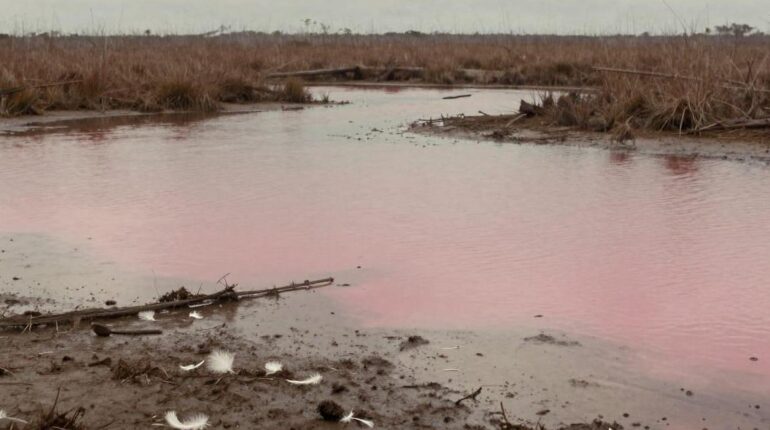
Scientists no longer speak of chance appearances, but of a possible sustainable re-establishment. Julie Wraithmell, executive director of Audubon Florida, states it plainly: with the ongoing restoration of the Everglades, the region could become a “flamingo paradise.” The shallow, brackish waters, rich in algae, brine shrimp, and microscopic invertebrates, are gradually recreating the ecosystem that American flamingos frequented before their local extinction.
It is no coincidence that observations persist. Since 2023, reports continue to pour in from central and southern Florida — precisely in the areas where, before the massive drainage of the 20th century, immense colonies of wading birds thrived. The ongoing hydrological restoration corrects the mistakes of the past: water is finding its old paths, quality is improving, and habitats are being reconstituted.
But the debate remains. Some researchers consider these flamingos as mere climate refugees, displaced by storms and likely to leave. Pressures persist: rapid urbanization, complex water management, and the growing climate threat. The definitive answer will come in the years to follow — and from Florida’s ability to protect what it restores.