📌 Emmental Potato Gratin: the milk cooking technique that changes everything
Posted 22 January 2026 by: Admin
Ingredient Preparation: The Foundations of a Successful Gratin
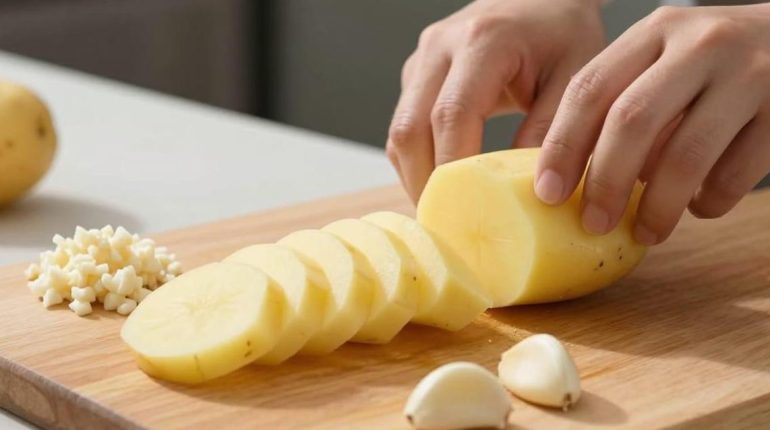
Every exceptional gratin begins with a simple but decisive technical gesture: the cut. Once peeled and washed, the potatoes must be sliced into thin rounds of regular thickness. This precision is not anecdotal: it directly determines the uniform cooking and the melting texture of the final dish. A slice that is too thick will remain firm at the core, while an irregular cut will create overcooked areas.
At the same time, the peeled and finely chopped garlic prepares to diffuse its fragrance throughout the preparation. This aromatic, far from being a simple accompaniment, will constitute the gustatory thread that links each layer of the gratin. The fineness of the chopping guarantees a homogeneous distribution of flavors, without aggressive pieces in the mouth.
These preparatory steps, often neglected by hurried cooks, nevertheless determine 50% of the final success. The regularity of the cut allows the potatoes to uniformly absorb liquids during cooking, creating that creamy consistency characteristic of successful gratins. The sharp knife then becomes the indispensable ally for an irreproachable texture, transforming an ordinary tuber into a gourmet promise.
Pre-Cooking in Milk: The Secret to a Creamy Texture
This little-known step distinguishes mediocre gratins from memorable creations. In a saucepan brought to a boil, the milk welcomes the chopped garlic, salt, and pepper before the potato slices are plunged in for 15 to 20 minutes of cooking. This immersion radically transforms the structure of the tuber: the pores open, progressively absorbing the flavored liquid that penetrates to the heart of each slice.
The milk bath fulfills a double strategic function. First, it infuses flavors deeply, creating a gustatory base that simple oven cooking could never achieve. Second, it softens the potatoes while preserving their hold, avoiding the collapse into mush that threatens poorly mastered gratins. The cooking time is adjusted according to the desired firmness: 15 minutes to maintain a slight resistance, 20 minutes for maximum melt.
This preliminary technique explains why some gratins possess that incomparable smoothness from the first bite. The potatoes, soaked in flavored milk, arrive in the oven already imbued with aromas, ready to receive the cream and cheese that will complete their metamorphosis. The cooking liquid, now enriched with released starches, could even serve as a base for other preparations, proving that nothing is lost in this mastered alchemy.
Strategic Assembly: Cream and Emmental in the Spotlight
The drained potatoes, soaked in their milk bath, now require a setting worthy of their preparation. The oven preheated to 180°C waits while a paper towel soaked in butter meticulously lines the gratin dish, creating an anti-stick barrier while adding a first layer of fat that will contribute to the final browning.
The arrangement of the slices in the dish follows a precise logic: the layers overlap without too much crowding, allowing the fresh cream to infiltrate every gap. This creamy coating uniformly covers the surface, forming a smooth binder that will coat every piece. Then comes the grated Emmental, generously distributed to guarantee that golden crust characteristic of exceptional gratins.
The detail that makes the difference: small knobs of butter scattered on top. These fragments will gradually melt, enriching the cream while promoting the caramelization of the cheese. This layered construction – infused potatoes, enveloping cream, protective Emmental, caramelizing butter – creates a gustatory architecture where each element fulfills a specific function. The balance between a melting interior and a crispy surface is played out precisely in this mastered superposition, ready to reveal its potential under the effect of heat.
Oven Cooking: 30 Minutes for Golden Perfection
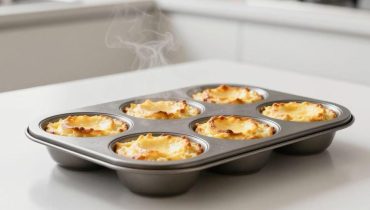
The assembled dish crosses the threshold of the preheated oven, initiating a silent but decisive transformation. At 180°C, the heat uniformly envelops the preparation for exactly 30 minutes, a period during which the magic of gratining takes place. The first few minutes see the cream simmer gently, infiltrating further between the slices while the butter begins its slow caramelization.
Halfway through cooking, the Emmental begins its metamorphosis: its proteins melt, create golden bubbles on the surface, then gradually set into a crunchy crust. The potatoes, already softened by their milk bath, complete their cooking in this creamy cocoon, reaching that melting texture characteristic of exceptional gratins. The garlic diffuses its aromas throughout the dish, amplified by the heat.
The final minutes crystallize the result: the surface develops those sought-after amber nuances, signs of a successful gratin. Upon leaving the oven, the dish exhales scents of caramelized cheese and infused cream. This precise timing – neither too short to obtain the crust, nor too long to preserve the melt – constitutes the final arbitration between exterior crispness and interior smoothness. The gratin then reaches its gustatory peak, ready to reveal the perfect balance of textures and flavors from the first bite.