📌 Da Lu Mian: how this traditional Chinese birthday dish symbolizes longevity through its noodles and thickened sauce
Posted 9 March 2026 by: Admin
Da Lu Mian: The Essence Of A Northern Chinese Classic
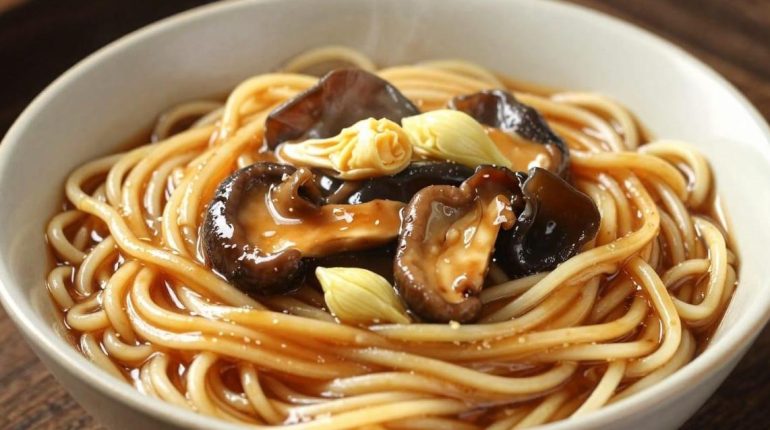
Behind the name Da Lu Mian (打卤面) lies much more than a simple noodle dish. This Northern Chinese specialty, literally “thick sauce noodles,” embodies an ancestral culinary tradition deeply rooted in Beijing culture. The principle? A velvety and generous sauce, thickened with cornstarch, which generously coats wheat noodles. Its composition reveals the richness of the land: pork belly, shiitake mushrooms, wood ears, dried lily flowers, and ribbons of beaten eggs intertwine in a fragrant broth.
But what truly distinguishes this dish from its noodle cousins is its symbolic weight. In Beijing and surrounding regions, Da Lu Mian transcends its status as an affordable daily meal to become the ritual food for birthdays, representing longevity. The noodles, through their uninterrupted length, embody the promise of a long and prosperous life – a symbolism so powerful that the tradition dates back to the Tang Dynasty (618-907). This cultural dimension transforms every bowl into a silent celebration of life, where each bite metaphorically extends existence. A popular dish that carries within it centuries of family beliefs and hopes.
The Michelin Inspiration Reinventing Tradition
It was in an unexpected setting that this popular dish revealed its capacity for adaptation: a two-star Michelin vegetarian restaurant, nestled near the Lama Temple in Beijing. The establishment served a refined version of Da Lu Mian, presented with the characteristic elegance of haute gastronomy. A revelation that challenges the image of a recipe confined to family tables and neighborhood stalls.
This experience illustrates the unsuspected versatility of the dish. Far from being frozen in a single formula, the recipe comes in multiple variations: a tomato-egg version for lovers of acidic freshness, a shrimp adaptation for coastal tables, or even entirely vegetarian interpretations like the one discovered in this starred restaurant. The structure of the dish tolerates these metamorphoses while preserving its identity: that thick and comforting sauce that coats the noodles.
A technical detail further illuminates its apparent familiarity to connoisseurs: the preparation is surprisingly similar to that of hot and sour soup, but in a more concentrated version. Same base of rehydrated mushrooms, same thickening with cornstarch, same delicate incorporation of beaten eggs. The classic recipe favors pork belly but readily accepts dark chicken meat as a substitute. A flexibility that explains how an everyday dish can cross the doors of starred tables without denying its popular essence.
Secrets Of Preparation And Possible Adaptations
Mastering Da Lu Mian relies on a technical peculiarity often overlooked: thickening with cornstarch. Unlike Western sauces thickened with flour, this gravy loses its consistency as it cools. A chemical phenomenon that imposes a golden rule: adjust quantities to the number of guests. For two or three people, it is imperative to halve the recipe to avoid wasting a sauce that will never regain its initial velvety texture.
The choice of noodles directly influences the tasting experience. Fresh noodles absorb more sauce, creating an optimal fusion between pasta and gravy. Alternatively, dried ribbon-shaped noodles are the ideal alternative: their curves capture the thick liquid, ensuring even distribution with every bite. A little-known tip further expands the possibilities: this generous sauce works perfectly over rice, transforming the dish into a Chinese-style risotto.
The classic pork belly version is just a starting point. Dark chicken meat easily replaces pork, while vegetarian adaptations prove the robustness of the aromatic structure. The sauce draws its richness from rehydrated shiitake mushrooms, crunchy wood ears, and slightly sweet lily flowers. These dried ingredients constitute the true DNA of the dish, surviving protein variations without fail.
Culinary Process In Three Stages
Preparation begins long before cooking: shiitake mushrooms require several hours of immersion in 1½ cups of water, ideally an entire night for complete rehydration. Simultaneously, wood ears and lily flowers soak in separate bowls. This preparatory phase, often neglected by hurried cooks, determines the final aromatic depth. The shiitake soaking water, loaded with umami, will be reintegrated later – not a single drop should be lost.
The pork belly cooks whole in an aromatic broth composed of ginger, scallion, star anise, and Shaoxing wine. Thirty minutes over medium-high heat is enough: a fork should sink in without resistance. This broth will not end up in the sink – it will form the liquid base of the final sauce. In parallel, oil infused with Sichuan pepper simmers for ten minutes over low heat, releasing its lemony and slightly numbing notes. This oil, drizzled at service, transforms the dish.
Final assembly requires technical precision. Once the pork is browned and the mushrooms sautéed, the reserved broth joins the wok with the rehydrated ingredients. Fifteen minutes of simmering precedes the addition of diluted cornstarch, which instantly thickens the boiling liquid. Beaten eggs are poured in a wide circle without stirring – a few seconds of patience allows them to set into silky ribbons. Raw garlic and chopped scallion finalize the sauce, which must have a pronounced saltiness: it will season the neutral noodles waiting for it, ready to absorb this liquid generosity.