There is a distinct sound when you place a homemade baguette on the rack just out of the oven — a dry, almost fragile crackling that announces the crust has done its job. The smell follows a second later: warm wheat, slightly caramelized, with that subtle yeasty undertone that only real bread has. Five ingredients, a few hours of patience, and that sound is yours.
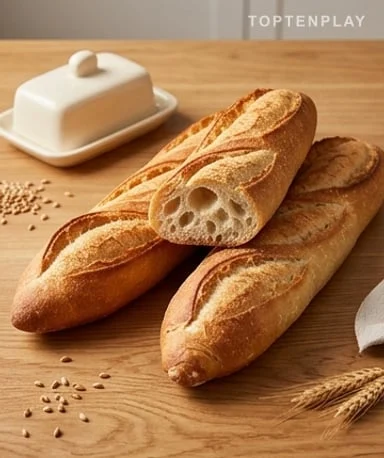
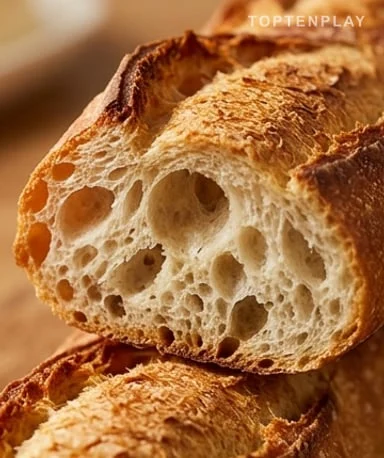
Cutting it while still warm, the crumb reveals irregular air pockets — some large, others tiny, a sign that fermentation had time to do its work. The crust resists for a fraction of a second under the knife before giving way with that characteristic crunch. The crumb is soft without being cottony, with a slight elasticity that holds the bite without crumbling. With a bit of butter melting on the warm slice, it’s hard to get simpler and more satisfying.
Why you’ll love this recipe
Ingredient Notes
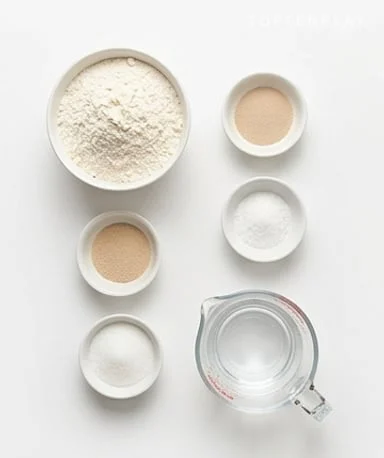
Just five ingredients: T55 flour, warm water, salt, sugar, and dry yeast. No more is needed for real French bread.
- T55 flour (490 g) : T55 is the standard flour of French bakeries for baguettes: its gluten content is balanced, neither too elastic like T45 pastry flour nor too rustic like T80. It gives a light crumb with good structure. If you don’t have it, T65 works very well and adds a slightly more pronounced flavor, closer to a traditional baguette.
- Instant dry yeast (1 packet) : Yeast is what transforms flour and water into something alive. Instant dry yeast (like Briochin) can be incorporated directly into the dough without prior rehydration, but reactivating it in warm water with sugar remains a good habit: it lets you check that it’s still active before investing two hours of rising. If you have fresh yeast, use about 10 g to replace a 7 g packet.
- Warm water (300 g) : Water temperature is more important than you might think. Too cold, the yeast remains dormant and the dough takes forever to rise. Too hot — above 40°C — and you kill the ferments, the dough won’t rise at all. The sweet spot is between 25 and 30°C: barely warm to the touch, never hot. A kitchen thermometer removes all doubt.
- Fine salt (2 teaspoons) : Salt isn’t just for flavor. It regulates fermentation by controlling yeast activity, and it strengthens the gluten network for a more structured crumb. That’s why you never mix it directly with yeast: salt kills the ferments on contact. First, mix the salt into the dry flour, the yeast into the water, then combine.
- Sugar (1 teaspoon) : A small amount, but a precise role: sugar feeds the yeast to accelerate initial activation. It also contributes very slightly to the golden color of the crust via the Maillard reaction. Don’t put in more, or the baguette would take on a brioche profile that doesn’t belong here.
Activate the yeast first
Before even touching the flour, prepare the yeast. In a bowl, pour the warm water, add the sugar, then the yeast, and let it sit for ten minutes without disturbing. After that time, the surface should be foamy, slightly puffed, with a fresh fermentation smell. If nothing happens, the yeast is dead — better to know now than to waste two hours of rising on dough that will never rise. This activation test is the only real verification step in the recipe, and it costs nothing.
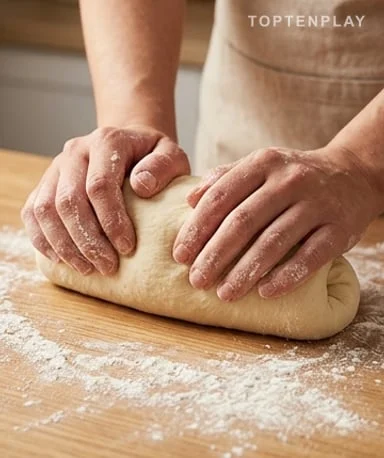
Knead until you feel the difference
In a large bowl, mix the flour and salt dry, then gradually incorporate the water-yeast mixture. At first, the dough is sticky, lumpy, somewhat unruly. Turn it out onto a floured work surface and start kneading: push with the palm, fold, rotate a quarter turn, repeat. After five minutes, the change becomes noticeable — the dough starts to smooth out, losing its rough texture. After ten to twelve minutes, it’s supple, slightly elastic under finger pressure, and cleanly releases from the work surface. This gluten development gives the airy structure of the crumb. You cannot shorten this step without paying the price in the final result.
Two rises, two transformations
The kneaded dough goes into a lightly oiled bowl, covered with a clean cloth. It should double in volume in one and a half to two hours in a warm place — near a radiator, or in an off oven with just the light on. At this stage, the dough has a slightly acidic, almost fermented smell, indicating the ferments are working well. Gently punch it down with your fist, divide into three portions, shape the baguettes, and let them rise a second time for thirty to forty-five minutes on the baking sheet. This second rise is crucial for the lightness of the final crumb — skipping it gives a dense, compact baguette.
Shape without tearing
To form each baguette, lightly flatten the dough portion with your palm, fold one third toward the center like a letter, then the other side, and gently roll while elongating. The motion should be firm but not aggressive: if you force it, you tear the gluten network built during kneading. Pinch the ends to seal. The resulting baguette doesn’t need to be perfect — slight irregularity is normal and preferable to an overly molded shape. Before baking, score three or four diagonal slashes with a sharp blade: these scarifications allow the dough to expand in a controlled way in the oven rather than bursting randomly on the sides.
Steam makes the crust
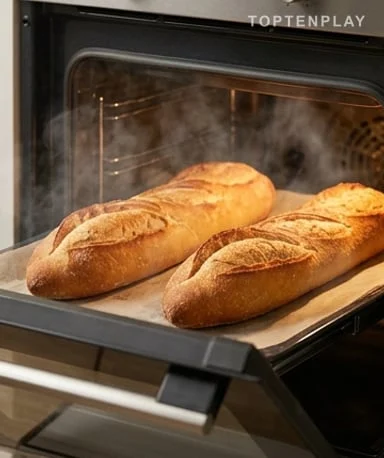
The oven preheated to 240°C is essential — a baguette placed in a cold oven won’t develop properly. Before baking, place a small container of hot water in the bottom of the oven, or spray a few bursts of water onto the walls with a spray bottle. This steam at the start of baking slows down crust formation, allowing the dough to expand freely before the surface sets. Without steam, the crust forms too quickly, blocks the rise, and you get a compact loaf with a dull surface. After twenty to twenty-five minutes, the baguettes should be well golden, with a skin that sounds hollow when tapped on the bottom. Transfer them to a wire rack — never directly on a flat surface — so air circulates under the base and preserves the crispness.
Tips & Tricks
- Do not exceed 30°C for the activation water: above 40°C, heat destroys the ferments. A kitchen thermometer costs two euros and completely removes this uncertainty.
- Always score with a dry, well-sharpened blade, with a quick, decisive motion: a wet or hesitant blade tears the dough instead of slicing it, and the baguettes will open unevenly during baking.
- Let cool for at least fifteen minutes on a wire rack before slicing: internal steam continues to redistribute moisture in the crumb during this time. Cutting too early gives a gummy crumb that compresses under the knife.
- If the dough sticks to your hands during kneading, resist the temptation to add a lot of flour: slight stickiness is normal and gives a more open crumb. Just flour the work surface and your hands, not the dough itself.
Why doesn’t my baguette rise during proofing?
The most common cause is water that is too hot during activation: above 40°C, the yeast is killed and the dough will never ferment. Also check that your yeast isn’t expired — the activation test in warm sweetened water is there for that: if it doesn’t foam within ten minutes, you need to buy new yeast.
Can you make baguettes without kneading?
Yes, with a high-hydration method and a very long rest (12 to 14 hours in the fridge), gluten develops without kneading. The result is different: a more open crumb, a less taut crust. But for a first classic homemade baguette, manual kneading remains the most reliable and straightforward path.
How to store homemade baguettes?
Homemade baguettes lack the industrial improvers that extend freshness. Store them at room temperature wrapped in a clean cloth; they are truly best within six to eight hours of baking. To reheat the next day, put them in a 180°C oven for two minutes — the crust regains almost all its crunch.
Can you freeze the dough or baked baguettes?
Both options work. Freeze the dough after the first rise and shaping: place the raw baguettes on a tray, freeze flat, then bag them. Take them out the night before for a slow thaw in the fridge, then let the second rise happen at room temperature before baking. Baked baguettes also freeze very well and reheat directly from the freezer in a 200°C oven for ten minutes.
T55 or T65 flour, what’s the real difference?
T55 gives a lighter crumb and a more delicate texture, close to a white bakery baguette. T65 has a higher ash content, giving it a slightly more pronounced flavor and a creamier crumb — closer to a traditional baguette. Both work perfectly in this recipe; it’s a matter of taste.
Is steam really necessary?
Yes, if you want a true thin, shiny crust. Without steam, the dough surface dries too quickly in contact with heat, forms a thick crust that blocks expansion, and results in a compact loaf with a dull appearance. Steam delays this crust formation for the first few minutes, allowing the bread to expand freely. A simple bowl of boiling water in the bottom of the oven suffices.
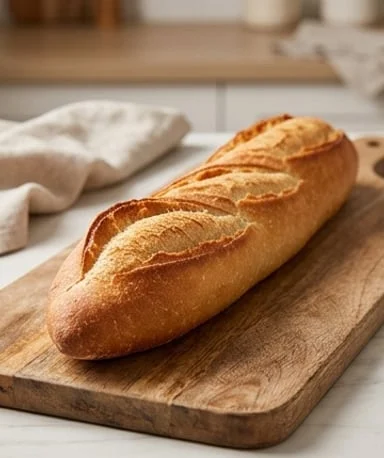
Crispy Homemade Baguettes
French
Bakery
Baguettes with a thin, crackling crust and airy crumb, made with five basic ingredients. The method follows the fundamentals of traditional French baking — two rises, steam baking — without special equipment.
Ingredients
- 490 g T55 wheat flour
- 300 g warm water (25-30°C)
- 1 packet (7 g) instant dry baker’s yeast
- 2 tsp fine salt
- 1 tsp granulated sugar
Instructions
- 1Pour warm water into a bowl, add sugar then yeast. Stir briefly and let rest for 10 minutes at room temperature. The surface should become foamy and slightly puffed — this is the sign that the yeast is active.
- 2In a large bowl, mix the flour and salt dry. Gradually incorporate the water-yeast mixture, stirring with a spatula until a roughly homogeneous dough forms.
- 3Turn the dough onto a lightly floured work surface and knead by hand for 10 to 12 minutes, pushing the dough with your palm, folding, and rotating a quarter turn each time. The dough should become smooth, supple, and slightly elastic to the touch.
- 4Shape into a ball, place in a lightly oiled bowl, and cover with a clean cloth. Let rise in a warm place for 1.5 to 2 hours, until doubled in volume.
- 5Gently punch down the dough with your fist to deflate, then divide into 3 equal portions on a floured work surface.
- 6For each portion, lightly flatten with your palm, fold one third toward the center, then the other side, and gently roll to form an elongated cylinder about 35 to 40 cm long. Pinch the ends to seal. Place the shaped baguettes on a baking sheet lined with parchment paper.
- 7Cover with a cloth and let rest for 30 to 45 minutes at room temperature for the second rise.
- 8Preheat the oven to 240°C. Place a small container of hot water in the bottom of the oven. Using a baker’s lame or very sharp knife, make 3 to 4 diagonal slashes on each baguette with a quick, decisive motion.
- 9Bake the baguettes for 20 to 25 minutes until well golden. They sound hollow when tapped on the bottom — that’s the sign that baking is complete.
- 10Let cool for at least 15 minutes on a wire rack before slicing, to allow internal steam to redistribute through the crumb.
Notes
• Water must never exceed 35°C during yeast activation. Above 40°C, the ferments are destroyed and the dough won’t rise.
• For the second rise, baguettes can be left in the refrigerator overnight (up to 12 hours) — a slow cold fermentation develops more flavor.
• Scoring should be done with a quick motion using a dry blade. A hesitant or wet blade tears the dough instead of slicing it.
• Baked baguettes freeze very well. Reheated directly from the freezer in a 200°C oven for 10 minutes, they regain almost all their crunch.
Nutrition Facts (per serving, estimated)
| 560 kcalCalories | 19 gProtein | 114 gCarbs | 2 gFat |