📌 Chicken Meatball Soup: The freezer bag trick that cuts preparation time in half
Posted 19 March 2026 by: Admin
The Recipe Revealed: A Comforting Homemade Broth
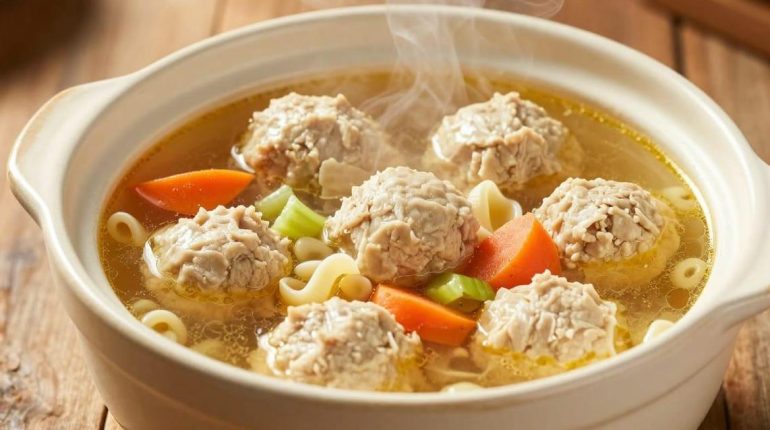
This chicken meatball soup defies all expectations: 17 minutes flat for a result that rivals grandmother’s slow-cooked stews. The secret lies in a technique as simple as it is ingenious: the meatballs are formed directly with a spoon, without prior shaping, and dive into a boiling broth enriched with freshly sautéed carrots, celery, and onion.
The magic happens from the very first step. While the golden vegetables release their aromas in olive oil, the ground chicken mixture is seasoned with oregano, garlic powder, and poultry seasoning. No methodical rolling, no laborious shaping: a spoon is enough to drop portions of meat directly into the simmering liquid. These irregular meatballs, far from being a flaw, capture the broth in their crevices and cook uniformly in 8 to 10 minutes.
The broth itself, composed of six cups of chicken stock diluted with one cup of water, then welcomes the miniature pasta which absorbs the flavors while cooking. The whole thing transforms into a comforting dish where each element retains its integrity: the meatballs stay moist thanks to the seasoned breadcrumbs, the vegetables keep their crunch, and the small shells or elbows capture the broth with every spoonful.
This no-fuss approach produces a result that looks like it required hours of preparation, even though the clock barely shows the regulation fifteen minutes.
Professional Execution Secrets
Meatball uniformity is not a matter of chance, but of a proven technique. A cookie scoop guarantees identical portions that cook simultaneously, while two spoons allow you to shape and drop the meat without direct contact. If the mixture stubbornly sticks to the utensils, ten minutes in the refrigerator or simply wetting the spoon solves the problem instantly.
Busy cooks adopt a restaurant trick: transfer the preparation into a freezer bag, cut off a corner, and squeeze directly into the broth. This method eliminates all handling and considerably speeds up the process. However, be careful never to bring the liquid to a rolling boil once the meatballs are immersed. A gentle simmer preserves their moist texture, whereas vigorous boiling would disintegrate them.
Seasoned breadcrumbs play a crucial double role: they bind the ingredients while providing aromatic depth. In a plain version, a pinch of Italian herbs compensates for the lack of integrated seasoning. For leftovers, cooking the pasta separately is an absolute rule. Added only at the time of serving, they avoid swelling and absorbing all the broth during storage, thus preserving the perfect balance between solids and liquid that makes this soup so charming.
Customization And Gourmet Variations
Ground chicken can easily be substituted with turkey or pork depending on preference, each meat bringing its own nuance without compromising the structure of the recipe. Homemade meatballs can even give way to 450 grams of frozen meatballs, reducing preparation to a simple five-minute simmer before adding the pasta. This flexibility transforms a culinary emergency into a guaranteed success.
Final enrichments subtly transform the character of the dish. Spinach or kale incorporated at the very end of cooking provides a vegetal touch that wilts delicately in the residual heat. A squeeze of lemon juice instantly revives the flavors of the broth, while a sprinkle of grated parmesan introduces that umami note that catches the palate. Poultry seasoning can naturally be replaced by thyme and sage for those who prefer to compose their own herb blend.
Choice of pasta directly influences the final success. Miniature formats — shells, elbows, mini bow ties — cook quickly and capture the broth in their folds, creating that harmony between liquid and solid that defines a successful soup. Their small size also makes it easier to eat with a spoon, without requiring extra cutting that would unnecessarily cool the bowl.
Storage And Leftover Strategy
This soup stores perfectly when the pasta is cooked separately and joined to individual bowls at the time of serving. This precaution avoids excessive liquid absorption that would turn the pasta into a spongy mass after a few hours in the refrigerator. The rest of the preparation keeps for up to four days in an airtight container, preserving the tenderness of the meatballs and the freshness of the vegetables.
Freezing extends the shelf life up to three months, provided the pasta is completely excluded from the process. Overnight thawing in the refrigerator sets the stage for optimal reheating over low heat on the stove. If the consistency seems too thick after resting, a few spoonfuls of broth or water restore the original balance without diluting the flavors concentrated during storage.
This thoughtful management of leftovers transforms a seventeen-minute recipe into a strategic meal solution for the whole week. Rather than preparing daily, a single cooking session generates several portions ready to reheat, each regaining its comforting character with the addition of freshly cooked pasta. The lemon juice and grated parmesan added at the last moment complete the revival of a dish that stubbornly refuses to age.