📌 Wok and black pepper: why this Chinese stir-fried beef conquers kitchens as much as restaurants
Posted 26 February 2026 by: Admin
The Essence Of A Chinese Cuisine Classic
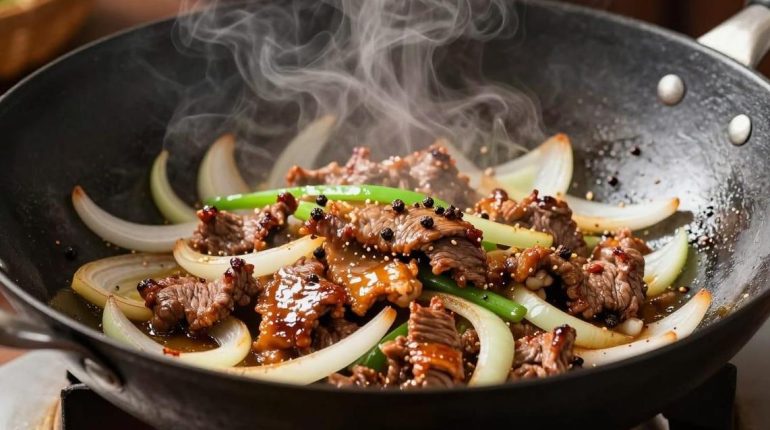
Chinese Pepper Steak with onions stands as the archetype of a successful stir-fry: a perfect trilogy where silky beef, crunchy vegetables, and a bold sauce merge into a masterful balance. This dish crosses borders from prestigious restaurants to family kitchens without ever losing its status as a must-have, proof of a formula as simple as it is infallible.
The sensory experience immediately reveals its authenticity. The characteristic hiss of the scorching wok announces the cooking, that recognizable “hiss” that signs the mastery of heat. Freshly ground black pepper then deploys its immediate punch, that liveliness that justifies the term “fiery” for the dish. But it is the contrast of textures that seals its identity: the melting tenderness of the marinated beef meets the vibrant crunch of the vegetables, creating that tactile opposition that captivates with every bite.
This signature combination — tender meat, crunchy vegetables, bold sauce — is much more than a recipe. It embodies a culinary philosophy where simplicity of preparation never sacrifices depth of flavor. The dish requires neither rare ingredients nor esoteric techniques, yet it consistently delivers that deep satisfaction that explains its longevity. A timeless favorite that owes its success to the obviousness of its concept and the precision of its execution.
The Fundamentals: Ingredients And Flavors
This flavor architecture rests on four pillars whose hierarchy deserves decoding. Beef occupies the role of the central protein, but its function goes beyond simple substance: correctly sliced against the grain and briefly marinated, it becomes the primary vector that absorbs and transports the flavors of the sauce. Onions and bell peppers are not mere extras — their crunch provides the necessary structure, their water content tempers the intensity of the sauce, and their slight caramelization under high heat introduces a subtle sweetness that balances the whole.
The savory sauce functions as the aromatic binder that unifies these disparate elements. Generally composed of soy sauce, broth, garlic, and cornstarch, it coats each piece without ever drowning the textures. But the truly identity-defining element, the one that justifies the name of the dish and its “fiery” character, remains freshly ground black pepper. Not the pre-ground pepper that sleeps in cupboards — but freshly crushed pepper that releases its volatile oils upon contact with heat, creating that pungent liveliness that tickles the palate without brutality.
This combination is non-negotiable: remove one of these components, and the dish loses its identity. Each fulfills a precise function in building the final flavor profile, forming a system where balance takes precedence over predominance.
Mastery Of Wok Cooking Methods
This system of flavor balance would not survive without the technique that reveals it: stir-frying at high temperature in a correctly prepared wok. The intense heat — ideally above 200°C — causes that characteristic hiss when the ingredients touch the burning metal. This “hiss” is not just a picturesque sound effect: it signals the express Maillard reaction that caramelizes the beef proteins in seconds, sealing the juices inside while creating a savory external crust.
Managing differentiated cooking times constitutes the real technical challenge. The beef requires a maximum of 90 seconds in the scorching wok to reach optimal tenderness without becoming rubbery. The vegetables require an opposite approach: added just after the meat is temporarily removed, they cook for 2 to 3 minutes to maintain their structural crunch. The sauce comes in last, thickening upon contact with residual heat while the beef returns to the wok for a final 30-second toss.
This culinary choreography transforms raw ingredients into a coherent dish where each component retains its textural integrity. The constant temperature of the wok remains the critical factor: a drop in heat produces soggy vegetables and boiled rather than seared meat. Mastering this timed sequence separates the amateur from the savvy cook, revealing why this classic requires as much technique as ingredient quality.
Practical Tips And Serving Suggestions
This technical mastery is accompanied by concrete tips that transform wok intimidation into culinary confidence. For beginners, three rules suffice: prepare all ingredients before lighting the fire (rigorous mise en place), use an oil with a high smoke point like peanut oil, and resist the temptation to stir constantly — letting each element sear for 20 seconds without intervention promotes caramelization. Advanced cooks will refine by marinating the beef for 15 minutes in soy sauce and cornstarch, a technique that creates a protective film amplifying tenderness.
The dish is ideally served on a bed of steaming jasmine rice whose neutrality absorbs the bold sauce, or accompanied by stir-fried noodles for a texture-on-texture experience. A final touch of sliced green onions and toasted sesame seeds adds freshness and contrasting crunch. Some prefer to serve it directly from the wok to the table, preserving the residual heat that maintains the aromatic hiss for a few extra seconds.
This recipe works as both a quick weeknight dinner and a culinary demonstration during a meal with friends. Its clear structure — marinade, searing, assembly — teaches the fundamentals of Chinese stir-fry without unnecessary complexity. Adaptable according to available vegetables (peppers, mushrooms, broccoli), it allows for improvisation while guaranteeing consistent results, provided the heat-timing-quality trilogy is respected.