📌 White chocolate-raspberry cheesecake: the water bath technique for a perfect creamy texture in 1h15
Posted 2 February 2026 by: Admin
The Fundamental Base: A Three-Component Cheesecake
This iconic dessert relies on a meticulously calibrated tripartite architecture. The graham cracker crust combines 150g of crumbs with 25g of granulated sugar and 85g of melted unsalted butter, creating a crunchy and stable foundation. Above it, the luxurious filling marries 225g of premium white chocolate with 900g of full-fat cream cheese, 240ml of sour cream, and four whole eggs. The raspberry swirl, composed of 170g of fresh or frozen fruit enhanced with 25g of sugar and a tablespoon of lemon juice, provides the essential tart contrast.
Proportions are calculated for a 9-inch pan generating 12 to 14 generous servings. Preparation requires 30 minutes of active work, followed by 1h15 of baking. But patience remains the invisible ingredient: gradual cooling and prolonged refrigeration transform this assembly of premium ingredients into a characteristic silky-textured cheesecake.
This three-layer structure is not just aesthetic. Each component fulfills a precise function: the crust offers structural support, the white chocolate filling delivers creaminess, while the raspberry swirl balances the richness with its natural acidity. The harmony of the dessert depends entirely on the execution quality of each of these layers, starting with the one that anchors the whole.
The Perfect Crust: Crunchy And Buttery Foundation
This first layer determines the structural stability of the whole. The 150g of graham cracker crumbs must be finely crumbled to ensure optimal cohesion. Grinding in a food processor generates a homogeneous texture without residual pieces that could compromise the final compactness.
Granulated sugar (25g) is not limited to sweetening: it acts as a complementary binding agent. Mixed dry with the crumbs before adding the butter, it distributes evenly throughout the mass. The 85g of melted – but not hot – unsalted butter coats every graham cracker particle. The temperature of the butter matters: too hot, it softens excessively; lukewarm, it binds without soaking.
Assembly requires firm and uniform pressure. Pour the mixture into the previously lined 9-inch pan. Use the bottom of a glass to pack methodically, insisting on the corners where the crust tends to thin. Constant thickness prevents weak spots during unmolding.
This proven ratio – 150g/25g/85g – generates a base that is both firm and crumbly. Too much butter would produce a greasy crust; not enough, it crumbles. This crunchy foundation deliberately contrasts with the creaminess of the filling, creating the characteristic play of textures. But it is the next element that visually transforms this classic cheesecake.
The Raspberry Swirl: Tart And Visual Contrast
After securing the structural base, it is this component that metamorphoses the appearance of the dessert. The 170g of raspberries – fresh or frozen indifferently – undergo a brief cooking with 25g of granulated sugar. This step is not decorative: it concentrates the flavors while reducing excess moisture that could destabilize the creamy filling.
Fresh lemon juice (1 tablespoon) plays a double role. It enhances the natural acidity of the raspberries, creating that essential contrast to the sweetness of the white chocolate. Simultaneously, it preserves the vibrant ruby color by preventing oxidation during the long baking process. Without this lemon addition, the mixture would turn a dull brown.
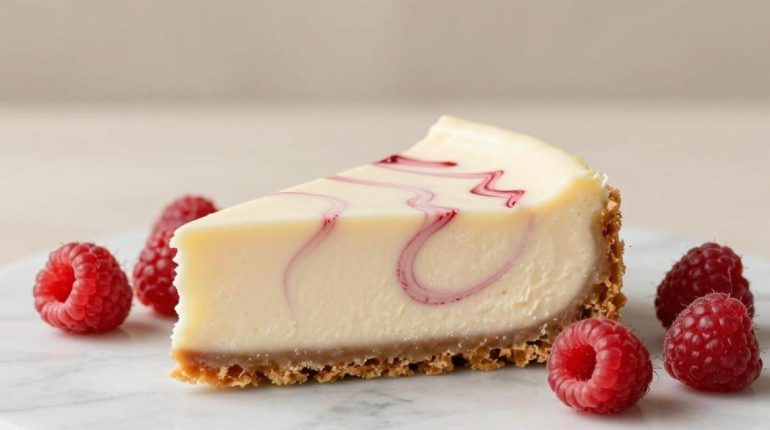
The swirl technique requires precision and restraint. After pouring the white chocolate filling into the pan, drop spoonfuls of raspberry coulis at strategic points on the surface. With the tip of a knife or a skewer, trace circular or zigzag movements without over-mixing. The goal: to obtain distinct marbled veins, not a uniform pink tint that would dilute the visual impact.
This tart layer balances the upcoming milky richness. It also brings a fruity freshness that lightens the density of the cream cheese. But it is the final filling that gives this cheesecake its status as a luxurious creation.
The White Chocolate Filling: Luxurious Creaminess
This final layer determines the overall success. The 225g of white chocolate require impeccable quality: prioritize bars containing at least 30% cocoa butter. Low-end chocolate, packed with hydrogenated vegetable oils, produces a grainy texture and a waxy aftertaste. Finely chop the pieces for even melting without residual hard spots.
The room temperature of dairy products is the other technical pillar. The 900g of cream cheese (4 blocks of 8 oz) must sit out of the refrigerator for at least 2 hours. Cold cream cheese forms lumps that are impossible to eliminate, even with prolonged beating. The sour cream (240ml) and the 4 whole eggs follow the same rule: their incorporation at a similar temperature guarantees a stable emulsion.
The assembly protocol follows a strict order. First, beat the softened cream cheese with the 200g of sugar until an airy consistency is achieved. Incorporate the cooled melted white chocolate, then the sour cream. Add the eggs one by one, beating at minimum speed after each addition to avoid incorporating too much air – a source of cracks during baking. Finish with the teaspoon of pure vanilla and the pinch of salt that amplifies all flavors.
This silky filling will require slow and controlled baking to reveal its characteristic texture, dense yet melting, which slices without collapsing.