Follow us
7 June 2026

Ultra-Crispy Oven-Roasted Potatoes

Prep Time
15 minutes
Cook Time
50 minutes
Total Time
65 minutes
Servings
4 servings

Almost everyone has tried making crispy potatoes in the oven and ended up with something… okay. Golden on the surface, soft underneath, without that crisp bite that separates a side dish you eat from one you devour. This isn’t about talent—it’s about method, and a few precise steps change everything.
Advertisement
Final result
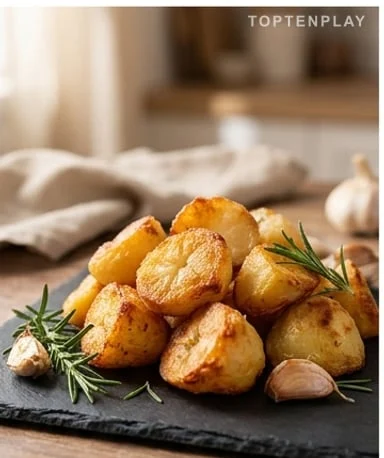
A promise kept: a crust that cracks, an interior that melts. All thanks to a few precise steps that no one has ever clearly explained to you.

When they come out of the oven, the edges are irregular, almost jagged, and you can see it. The color ranges from pale gold to amber brown depending on the bumps. When you stick the fork in, the crust resists for a split second before cracking—that dry, clean sound is the reward. The inside gives way immediately: melting, slightly grainy, like only a well-cooked potato can be, with the warm smell of rosemary clinging to every piece.

Why you’ll love this recipe

Long-lasting crispiness : Unlike pan-fried potatoes, these maintain their texture for several minutes after coming out of the oven. You can plate, season, serve—they stay crunchy.
Hands-off oven time : Once in the oven, they only need a flip halfway through. The rest of the time, the oven does the work while you do something else—perfect for lazy Sundays.
Technique, not ingredients : No need for duck fat or special equipment. A few tablespoons of olive oil and a pinch of semolina do all the work, as long as you follow the steps in order.
Universal side dish : Roast chicken, baked fish, braised vegetables—these potatoes go with almost anything without ever overpowering the main dish.
Easy to customize at the end : Grated Parmesan, mild chili, fresh parsley, a knob of butter—you can adapt without touching the base method, which stays the same regardless of the variation.

Ingredient Notes

Ingredients

Nothing exotic here—it’s the fine semolina that makes the difference. It creates that slightly grainy layer on the surface that turns into a perfect golden crust in the oven.

  • Firm-fleshed potatoes (baby, Charlotte, Amandine) — 1 kg : Firm flesh holds up to parboiling without falling apart and contains just enough starch to make the surface grainy after shaking. Avoid floury varieties like Bintje at all costs: they collapse during parboiling and give you an accidental mash at the bottom of the pot before they even reach the oven.
  • Olive oil — 3 to 4 tablespoons : It coats each piece and conducts the oven’s heat directly against the surface to brown it. No need for premium oil here—the key is quantity: too little and the potatoes dry out and stick, too much and they fry limply in their own fat.
  • Fine semolina (or flour) — 1 tablespoon : This is the ingredient that really makes the difference. The semolina clings to the bumps created by shaking and forms a fine powdery layer that turns into a crackling crust when exposed to heat. Regular flour also works, but semolina gives a slightly more rustic and pronounced texture. One tablespoon is enough—if you use too much, it forms a sticky paste and you lose the effect.
  • Garlic — 2 cloves : Added whole or roughly crushed, it perfumes the oil and potatoes during cooking without burning if not chopped too fine. At the end of cooking, it becomes confit, melting, almost sweet—you can crush it directly over the potatoes when serving.
  • Rosemary (or thyme) — 1 sprig : Rosemary withstands high oven temperatures without losing its aroma, unlike parsley or chives which burn and turn bitter. One sprig is enough: its essential oil infuses into the fat and permeates the whole tray during cooking, without needing more.
  • Paprika — 1 teaspoon (optional) : It adds a deeper golden-orange color and a slight smoky note without really changing the taste. If your oven heats unevenly and some potatoes remain pale on one side, paprika visually corrects this flaw and evens out the final look of the dish.

Parboiling: the step everyone wrongly skips

People tend to skip this step because it lengthens prep time and they think the oven will do the job alone. That’s a mistake that explains most failures. Without parboiling, the outside browns well before the inside is cooked—you get burnt pieces on the surface with a hard, tasteless center. Count 8 to 10 minutes in a large pot of well-salted boiling water, no more. The potato should be tender when you insert the tip of a knife, but still slightly firm in the center—it must absolutely not be fully cooked. The salted water is not a trivial detail: it seasons the flesh from the inside, where you can no longer really reach once the pieces are coated in oil and semolina.

Parboiling: the step everyone wrongly skips
The move that changes everything: shaking the parboiled potatoes in the pot. The edges get crushed, become irregular, and it’s exactly those bumps that will crisp up.

Shaking: the brutal move that creates the crust

Once drained, the potatoes go back into the empty pot. Cover with the lid and shake vigorously for a few seconds—not gently, really hard. This abrupt movement deliberately damages the edges: corners break off, the surface becomes rough and irregular, a bit as if the pieces were lightly hammered. That’s exactly the state we’re looking for, because those bumps are the ones that will brown first in contact with heat and form the crust. A perfectly smooth potato cooks evenly but without that pronounced crispiness—it browns, but it doesn’t crack under the fork. After shaking, you can see a light floury film forming on the surface of the pieces: that’s the starch coming up, and that’s exactly what we wanted.

Semolina and spices: season now, not in the oven

On the still-hot and slightly moist potatoes, pour the olive oil first, then salt, pepper, herbs, paprika if using—and finally the semolina. The latter clings to the rough surfaces and residual moisture, forming a fine powdery layer around each piece. Mix gently to avoid crushing the bumps we just created, turning two or three times rather than stirring. If you see clumps of stuck semolina, that means there was too much residual moisture—next time, let the potatoes air-dry a minute before adding the oil. The goal is a fine, discreet coating, not a visible breading.

In the oven: the temperature is non-negotiable

The oven must be preheated to 400°F (200°C), and that’s not negotiable down to 350°F (180°C) out of caution. It’s the high temperature that triggers the Maillard reaction on the surface—the transformation that creates brown color, roasted aromas, and a crackling texture. Arrange the potatoes on a baking sheet lined with parchment paper, spacing them well apart: each piece must have air all around. If you crowd them, they cook in their own steam and stay soft, no matter the oven temperature. Halfway through, around 20-25 minutes, flip them gently with a spatula—you can hear the dry scraping of the crust that has already formed underneath. After 45 to 55 minutes total, depending on the size of the pieces, they are uniformly golden-brown, with slightly darker and almost caramelized edges.

In the oven: the temperature is non-negotiable
Well-spaced on the sheet at 400°F (200°C)—no crowding allowed. If they touch, they steam and you get soft potatoes. Each piece must have air.

Tips & Tricks
  • Drain thoroughly and let air-dry for 1 to 2 minutes before adding oil—excess water creates steam when it hits the oven’s heat, which softens the surface instead of crisping it. This is the main cause of failure when everything else is done right.
  • Use two sheets instead of one too-full sheet if the potatoes touch each other—overlapping or stuck pieces will steam each other and stay soft in the center of the tray, regardless of temperature.
  • Flip halfway through with a flat spatula, not tongs: tongs exert pinpoint pressure that crushes the pieces and breaks the crust as it forms. The spatula slides under each piece and flips it in one go, preserving the entire crispy surface.
  • Serve within 5 to 10 minutes after coming out of the oven—crispiness peaks immediately and gradually fades. To reheat leftovers, the oven at 400°F (200°C) for 10 minutes restores some texture, but never identical to the first time.
Close-up
This close-up says it all: the cracked crust that breaks under the fork, the melting heart that contrasts. It’s the result of parboiling + rough surface + high dry heat.
FAQs

Why do my potatoes stay soft despite an hour in the oven?

The most common cause is an overcrowded sheet: the pieces suffocate each other and cook in their own steam instead of roasting. The other culprit is residual moisture after draining—if the potatoes are still very wet when you add the oil, that water turns into steam in the oven and prevents the crust from forming. Space the pieces well and let them air-dry for one to two minutes before seasoning.

Can I skip the parboiling to save time?

Technically yes, but the result won’t be the same. Without parboiling, the outside browns well before the inside is cooked, and you end up with burnt pieces on the surface and still hard in the center. The 8- to 10-minute parboiling also enables the shaking—you can’t create irregular edges with a raw potato; it doesn’t crush the same way.

Which potato variety is best for maximum crispiness?

Firm-fleshed varieties like Charlotte, Amandine, or baby potatoes are ideal: they hold up to parboiling without falling apart and have the right starch content to make the surface grainy after shaking. Avoid Bintje or floury varieties—they disintegrate during parboiling and give a pasty, not crispy, texture.

Is fine semolina really useful or just a marketing trick?

It’s a real plus, not a gimmick. Semolina clings to the bumps created by shaking and forms a light layer that enhances the browning reaction in the oven. Regular flour also works if you don’t have semolina, but semolina gives a slightly more pronounced and rustic texture. It’s not essential if you do everything else correctly, but it clearly makes a difference on the final crust.

Can I prepare the potatoes in advance and bake later?

Yes, up to the seasoning stage. You can parboil, shake, and coat with oil-semolina-spices up to an hour in advance, then let the pieces rest at room temperature on the sheet. Avoid refrigerating at this stage: cold condenses moisture on the surface and compromises crispiness. Bake directly when ready.

How do I reheat leftovers without losing everything?

The microwave is forbidden—it softens the crust in seconds and never returns it. The oven at 400°F (200°C) for 8 to 10 minutes in a single layer on a sheet restores some crispiness, but never identical to the first bake. If you know there will be leftovers, it’s better to cook them slightly less time initially to have a margin when reheating.

Ultra-Crispy Oven-Roasted Potatoes

Ultra-Crispy Oven-Roasted Potatoes

Easy
French
Side dish

Prep Time
15 minutes
Cook Time
50 minutes
Total Time
65 minutes
Servings
4 servings

The three-step method—parboil, shake, semolina—that transforms an ordinary side dish into golden potatoes, melting inside and crackling under the fork.

Ingredients

  • 1 kg firm-fleshed potatoes (Charlotte, Amandine, or baby potatoes)
  • 4 tbsp olive oil
  • 1 tbsp fine semolina (or all-purpose flour)
  • 2 garlic cloves, whole or lightly crushed
  • 1 sprig of rosemary (or thyme)
  • 1 tsp sweet paprika (optional)
  • 1 tsp salt (+ salt for parboiling water)
  • freshly ground black pepper

Instructions

  1. 1Peel the potatoes (or leave the skin on if organic) and cut into even pieces about 1.5 inches (4 cm).
  2. 2Plunge into a large pot of well-salted boiling water and cook for 8 to 10 minutes: the pieces should be tender on the surface but still slightly firm in the center.
  3. 3Drain thoroughly and let air-dry for 1 to 2 minutes—do not rinse with cold water.
  4. 4Return the potatoes to the empty pot, cover with the lid, and shake vigorously for a few seconds to roughen the edges and create bumps.
  5. 5Preheat the oven to 400°F (200°C) (convection if available).
  6. 6Add olive oil, salt, pepper, herbs, paprika, and semolina to the still-hot potatoes. Mix gently by turning two to three times without crushing.
  7. 7Spread in a single layer, well spaced, on a baking sheet lined with parchment paper. Tuck the garlic cloves between the pieces.
  8. 8Bake for 45 to 55 minutes. Flip gently with a flat spatula halfway through. Serve immediately.

Notes

• Never skip the parboiling: it enables the shaking and guarantees a melting interior without prolonging oven time.

• If the potatoes touch on the sheet, use two sheets instead of one overcrowded—steam is the enemy of crispiness.

• To reheat leftovers: 10 minutes in the oven at 400°F (200°C) in a single layer, never microwave.

• Parmesan variation: sprinkle grated Parmesan in the last 5 minutes of baking.

Nutrition Facts (per serving, estimated)

315 kcalCalories 5gProtein 42gCarbs 14gFat
Advertisement
Share on Facebook