Follow us
7 June 2026

Thin Reblochon and Potato Tart

Prep Time
20 minutes
Cook Time
30 minutes
Total Time
50 minutes
Servings
4 servings

We often imagine a thin tart as a restaurant dish, precise and technical, reserved for ambitious Sundays. The reality is much more generous: it’s one of the most honest weekend recipes, one that asks for almost nothing and gives back more than we hoped. Forty minutes, a baking sheet, and the oven does the rest.
Advertisement
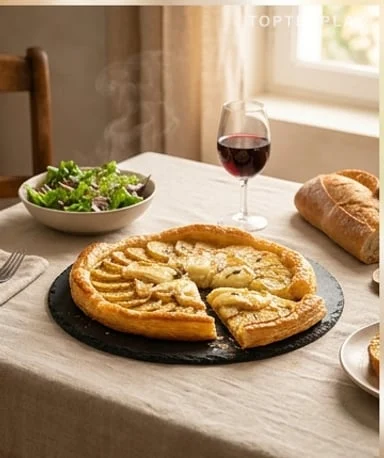
Final result
The tart comes out of the oven with perfectly melted reblochon and a nicely golden pastry.

What comes out of the oven has that color you don’t try to reproduce — a deep golden on the edges of the dough, almost amber, with slices of reblochon that have melted and slightly caramelized on top. The potatoes have absorbed the cream and the juice of the cheese. It smells like the mountains without the fuss: something simple, warm, direct. The crust cracks when you cut it, and that fine resistance under the knife already announces the texture to come.
Why you’ll love this recipe

The reblochon works on its own : No need for complex sauce or binding: the cheese melts over the potatoes and creates its own creaminess. Just slice it and place it.
The pastry stays really crispy : Unlike a quiche or a gratin, here the filling is thin and not very moist. The puff pastry stays crispy from the first to the last slice.
Twenty minutes of prep, not a minute more : The steps are short and require no special equipment. You can prepare this tart after grocery shopping on Saturday morning and have it out of the oven before noon.
A recipe that tolerates approximations : A little more or less reblochon, a smaller onion, variable-sized potatoes: nothing is critical. The margin for error is wide and the result remains convincing.

Ingredient Notes

Ingredients

Everything you need: puff pastry, reblochon, potatoes, turkey bacon, and an onion. Simple and effective.

  • Puff pastry : It plays the role of crispy base and structure. A good quality store-bought puff pastry (all-butter, if possible) works perfectly — the difference with homemade is minimal here, since the filling is the real focus. If using refrigerated pastry, take it out 10 minutes before rolling to prevent it from shrinking when moved.
  • Reblochon : It gives the tart its character: a creamy paste, a washed rind that develops a subtle aroma of milk and cellar as it melts. No need to look for the best farmhouse reblochon for this recipe — standard quality is enough; the important thing is that it is at room temperature when used, to melt evenly. If you can’t find it, a slightly firm camembert can work as a substitute, but the result will be more pronounced.
  • Potatoes : They serve as the main ingredient, both melting and slightly firm under the cheese. Prefer a waxy variety (Charlotte, Amandine, Ratte) that holds up well during parboiling without disintegrating. Floury varieties like Bintje absorb too much water and risk mashing during assembly.
  • Crème fraîche (thick) : It acts as a subtle binder between the dough and the potatoes, preventing the filling from sliding during baking. Two tablespoons are enough — no more, otherwise the pastry softens underneath. A 30% fat cream gives the best result, but a light cream also works if it is thick enough.
  • Onion : Slowly cooked, it loses its sharpness and becomes almost sweet, with a melting texture that contrasts well with the crispness of the pastry. It’s an ingredient we tend to rush, but taking the time to cook it over low heat until translucent really changes the final result. A red onion can replace the yellow for a slightly sweeter note.
  • Turkey bacon : It brings the salty touch and chew that traditional lardons would have given. Cook it in the same pan as the onion until it starts to brown on the edges — this slight caramelization develops a deeper aroma than simply reheated bacon. If you want a vegetarian version, sliced mushrooms sautéed over high heat fill this role very well.

Parboiling the potatoes: the step you want to skip (and shouldn’t)

The temptation is strong to put them raw directly on the pastry. That would be a mistake: in 25 minutes of baking, a raw potato slice remains firm and floury in the center, where we want tenderness. Parboiling in salted boiling water for 10 minutes solves this problem effortlessly. The slices come out slightly translucent on the edges, still firm in the center — they will finish cooking in the oven. Peel them first, cut them into regular slices about 3 millimeters thick. No need for a mandoline if your knife is good, but regularity matters: a thick slice slows cooking while a thin one next to it will already be melted. Drain them and let them cool flat on a towel to remove excess moisture before assembly — a too-wet potato will soak the cream and eventually the dough.

Parboiling the potatoes: the step you want to skip (and shouldn't)
The parboiled potato slices are arranged on the crème fraîche — this is where it all comes together.

The pan and the two ingredients that make the flavor

The turkey bacon and onion are prepared together, in this order: the bacon first, over medium heat, until the edges are lightly golden and a grilled smell starts to rise. This precise stage — not burnt, not yet soft — is what gives depth to the filling. Then add the sliced onion to the rendered fat and lower the heat. It should cook slowly, for 6 to 8 minutes, stirring occasionally, until it becomes transparent and almost sticky. At this point, it has nothing aggressive: it is sweet, slightly caramelized, and it will bind the rest of the filling. Set aside off the heat while you prepare the dough.

Assembly: a matter of order and lightness

Preheat the oven to 180°C. Unroll the pastry on its baking paper, place it directly on the cold baking sheet — it’s the thermal shock with the oven heat that will help the pastry rise. Prick the bottom with a fork, but not too much: you want to slow down the rising, not prevent it completely. Spread the crème fraîche in a thin layer, leaving a 1.5 cm border all around. Then the potato slices, overlapping slightly like scales. The bacon-onion filling comes next, spread evenly. Finish with the slices of reblochon generously placed on top — they will melt and cover everything else during baking. Season with pepper and salt sparingly (the cheese and turkey bacon are already salty), and bake.

The baking that decides everything

25 to 30 minutes at 180°C, and the tart gradually transforms. Around 15 minutes, the cheese starts to melt and gently bubble at the edges of the slices. Around 20 minutes, the edges of the pastry begin to brown. At 25 minutes, the top is lightly gratinated, the pastry edges are nicely colored, and the kitchen smells of warm buttery pastry and melted cheese. That’s when you need to look, not the timer: a well-cooked tart has edges that are deeply golden, almost amber, and cheese that is evenly melted, not burnt. If the edges brown too quickly while the center is still pale, cover them with a thin strip of aluminum foil for the last minutes. Remove the tart, let it rest for 5 minutes on the sheet before cutting — the filling needs to set slightly so the slices stay neat.

What to eat with it, and why it matters

The tart is rich — reblochon, cream, buttery puff pastry — and it calls for something acidic and fresh on the side. A green salad with a sharp mustard vinaigrette is the classic pairing, and it’s classic for good reasons: the slight bitterness of the salad and the acidity of the vinaigrette cut through the richness of the melted cheese. Avoid hot or heavy sides that would duplicate the richness. If you serve this tart for brunch, a rocket salad with a few radish slices and a squeeze of lemon works very well. Cut into squares, it can also be eaten by hand for a standing aperitif — the pastry holds well and doesn’t crumble if it has rested.

What to eat with it, and why it matters
The cheese melts, the pastry puffs up, the kitchen smells great: just 5 more minutes and it’s ready.

Tips & Tricks
  • Place the baking sheet on the middle rack, not the bottom: heat from below would cook the dough before the top is ready, and you’d end up with still-soft cheese on a burnt crust.
  • Let the tart rest for 5 minutes out of the oven before cutting: the filling is liquid when it comes out, it needs a few minutes to solidify slightly, otherwise the slices collapse when cut.
  • Don’t overload the filling in the center: a thin tart means a thin layer of each element. The more you pile, the more the pastry softens and the more uneven the baking becomes — the limit is one layer of each, no more.
  • Take the reblochon out of the refrigerator 15 minutes before assembling the tart: a cold cheese melts less evenly in the oven and can remain firm in places where it should be runny.
Close-up
This crunchy-melty texture is exactly why we make this tart again.
FAQs

Can I use another cheese instead of reblochon?

Yes, no problem. A slightly firm camembert gives a more pronounced and slightly runnier result. Munster also works, but its taste is stronger — reserve it if you like bold flavors. The important thing is to choose a soft cheese that melts easily in the oven without separating.

Can I prepare the tart in advance?

You can prepare the potatoes and the bacon-onion filling the day before and keep them in the refrigerator. However, assemble and bake the tart at the last moment: raw puff pastry hates waiting under a moist filling, it softens quickly. Assembly takes less than 5 minutes once the elements are ready.

How to store leftovers and reheat them without losing crispiness?

The tart keeps for 2 days in the refrigerator, well wrapped. To reheat, put it in the oven at 180°C on a rack for 10 to 12 minutes — the bottom regains its crispiness. Avoid the microwave: it irreversibly softens the pastry and makes the filling rubbery.

Is it really necessary to parboil the potatoes?

Yes, it’s non-negotiable for this recipe. In 25-30 minutes of oven baking, a raw potato slice remains hard in the center. The 10-minute parboil in salted boiling water brings them to an ideal semi-cooked state: they finish melting in the oven without turning into mash. Remove them from the water as soon as they yield slightly under the tip of a knife.

Which potato variety should I choose?

Choose a waxy variety: Charlotte, Amandine or Ratte. They hold up well during parboiling and maintain a good shape during assembly. Floury varieties like Bintje absorb too much water, easily mash, and make the filling soggy. If in doubt, check the label — packets usually indicate the recommended use.

Can I freeze the tart?

Freezing is possible but the result is disappointing: puff pastry loses its flakiness after thawing and becomes soft, even when reheated in the oven. Better to freeze the cooked filling separately and make fresh pastry on the day. If you really want to freeze the whole tart, do it before baking and bake directly from frozen, adding 10 minutes.

Thin Reblochon and Potato Tart

Thin Reblochon and Potato Tart

Easy
French
Savory tart

Prep Time
20 minutes
Cook Time
30 minutes
Total Time
50 minutes
Servings
4 servings

A crispy puff pastry tart filled with tender potatoes, caramelized onion, golden turkey bacon, and melted reblochon. Ready in under an hour, it brings together everything you want from a weekend meal without any complexity.

Ingredients

  • 1 all-butter puff pastry (about 230 g)
  • 400 g waxy potatoes (Charlotte or Amandine)
  • 125 g reblochon (½ reblochon)
  • 75 g turkey bacon lardons
  • 1 medium onion
  • 2 tbsp crème fraîche (30% fat)
  • 1 tsp fresh thyme leaves (optional)
  • fine salt
  • black pepper from the mill

Instructions

  1. 1Peel the potatoes and cut them into 3 mm thick slices. Parboil them for 10 minutes in a pot of salted boiling water, drain them, and let them cool flat on a towel.
  2. 2Cook the turkey bacon in a frying pan over medium heat until the edges are lightly golden. Add the sliced onion, lower the heat and cook for 6 to 8 minutes, stirring regularly, until soft and translucent. Remove from heat.
  3. 3Preheat the oven to 180°C. Unroll the puff pastry on its baking paper and place it on a cold baking sheet. Prick the bottom with a fork. Spread the crème fraîche in a thin layer, leaving a 1.5 cm border all around.
  4. 4Arrange the potato slices in a slightly overlapping pattern, like scales. Spread the bacon-onion filling evenly. Slice the reblochon and place the slices over the entire filling.
  5. 5Season with pepper and a light pinch of salt. Bake on the middle rack for 25 to 30 minutes, until the pastry edges are well browned and the cheese is melted and lightly gratinated.
  6. 6Remove the tart from the oven and let it rest for 5 minutes before cutting. Sprinkle with fresh thyme if desired. Serve warm, accompanied by a green salad with mustard vinaigrette.

Notes

• Be sure to use a waxy potato variety (Charlotte, Amandine, Ratte): floury varieties mash during parboiling and make the filling soggy.

• Take the reblochon out of the refrigerator 15 minutes before use so it melts evenly in the oven.

• Do not overload the center of the tart: a thin layer of each element guarantees a crispy pastry under the entire surface.

• To reheat leftovers, put them in the oven at 180°C on a rack for 10 to 12 minutes — avoid the microwave which permanently softens the pastry.

Nutrition Facts (per serving, estimated)

480 kcalCalories 16 gProtein 36 gCarbs 30 gFat
Advertisement
Share on Facebook