📌 The little red comb: how a cheap dye and the Industrial Revolution transformed a status object into a global cultural artifact
Posted 17 January 2026 by: Admin
The Forgotten Object That Crosses Centuries
Stuck between a roll of aluminum foil and half-used birthday candles, it waited at the back of the kitchen drawer. This little red comb, with its fine, close-set teeth and plastic polished by use, was no longer than a finger. Insignificant in appearance, yet instantly recognizable. Almost universal.
But where does this object come from, passing through generations without anyone paying attention? Why does it exist? The answer has roots much deeper than one might imagine.
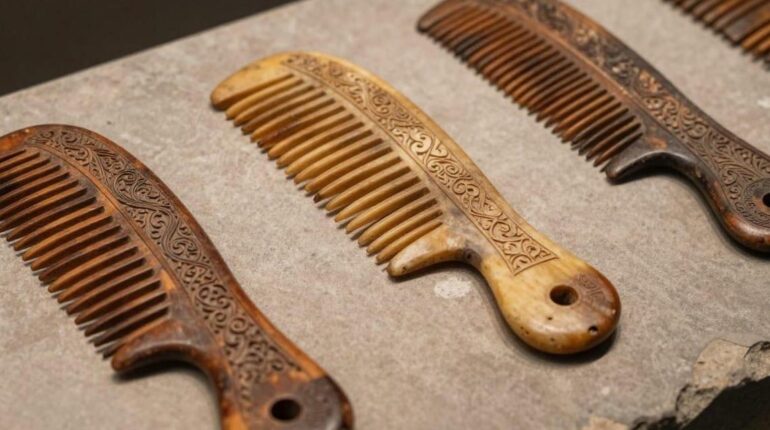
Combs have accompanied humanity for millennia. Archaeologists have unearthed them in Egyptian tombs, Roman ruins, and ancient Asian sites. Crafted from bone, wood, ivory, or shell, they were not mere tools: they embodied identity and social status. Long, well-groomed hair symbolized health and power. Certain hairstyles signaled age, marital status, or tribal affiliation.
In many ancient societies, combs were personal, sometimes sacred. Adorned with complex patterns or religious symbols, they represented much more than a grooming accessory. They were prestige objects, hand-carved, reserved for an elite.
Industrialization changed everything. What was once expensive and handcrafted became accessible to all. The comb, a symbol of luxury, was democratized to become a daily necessity. And it was with the invention of plastic that this little red object would conquer the world.
The Industrial Revolution Of The Red Comb
The 18th and 19th centuries transformed the production of combs. What once required hours of artisanal labor could now come out of factories by the thousands. Manufactories broke the monopoly of luxury: everyone, not just the privileged, could afford a proper grooming tool.
The real turning point occurred with the appearance of plastics. Celluloid first, then polystyrene, allowed for the production of lightweight, resistant, and remarkably cheap objects. The modern red comb was born.
Why this color specifically? Nothing symbolic, everything pragmatic. Red dye was inexpensive and hid wear better than light shades. Its brightness made it hard to lose in a bag or a cluttered drawer. Manufacturers understood that this visibility constituted a discreet but decisive commercial advantage. Red established itself as the standard, forging the very identity of this object.
Its miniature size was not a matter of chance either. Designed for absolute portability, it slipped into a shirt pocket, a wallet, or a handbag. Lightweight, unbreakable, replaceable without regret if it disappeared. This discretion made it the ally of the working classes, travelers, students, soldiers, and hairdressers.
An object so mundane that its presence was forgotten. So practical that one never truly parted with it.
Symbol Of Dignity And Companion Of Migration
This discretion made the red comb much more than a simple accessory. In 20th-century hair salons, it embodied cleanliness and self-care. Barbers distributed them after every cut, transforming a commercial gesture into a ritual of dignity. For working-class men and immigrants, carrying this comb meant something: a form of personal respect, even with few means.
When waves of migration crossed continents, the little red comb traveled in cramped suitcases. Too compact to be a burden, too useful to abandon. In crowded boarding schools, train stations, and factories, it offered a reassuring constancy. Getting up, washing, combing, facing the day. This simple routine constituted an anchor in the face of uncertainty.
The comb thus became a companion for daily survival. Not an object of vanity, but a tool for mental preparation. In a world where so much escaped control, this morning gesture offered a modest but tangible mastery. A discreet reminder that appearance, even minimal, remained a form of resistance.
From America to Asia, from Europe to Africa, the same red object circulated silently in pockets, carrying with it stories of departure, adaptation, and resilience. No advertising campaign ever celebrated it. It imposed itself by its utility alone, becoming one of the few truly universal artifacts of our time.
From The Kitchen Drawer To Collective Memory
This universal companion often ends its journey in the junk drawer, stuck between dead batteries and rubber bands. Not out of negligence, but because it occupies that paradoxical space of everyday objects: too small to deserve dedicated storage, too useful to be thrown away, too familiar for its presence to be questioned.
This kitchen drawer is actually an involuntary domestic museum. The red comb becomes an emotional relic there, a carrier of diffuse memories. We remember a parent slipping it into their pocket before leaving for work. A grandfather taking it out mechanically after lunch. These trivial gestures weave an invisible continuity between generations.
The object crosses borders without ever having been marketed as a global product. No dominant brand, no marketing strategy. Yet, from Vancouver to Tokyo, from Dakar to Buenos Aires, the same red profile appears in drawers all over the world. A silent artifact of globalization through use, it imposed itself through pure functionality.
Today, electric tools and elaborate hair routines have reduced its presence. But it persists. In the pockets of forgotten jackets, dusty toiletry bags, memory boxes. Because the red comb never truly disappears. It waits, patient, for someone to find it and remember why it was there.