Follow us
7 June 2026

Stuffed Cabbage Rolls in Tomato Sauce

Prep Time
35 minutes
Cook Time
90 minutes
Total Time
2 hours 5 minutes
Servings
6 servings

You know that moment when a dish takes time to prepare, but once it’s on the table, everyone is silent for the first two minutes? That’s exactly the effect of stuffed cabbage rolls. No mysterious technique, no hard-to-find ingredients — just a dish that requires a bit of organization and a lot of patience while it simmers.
Advertisement
Final result
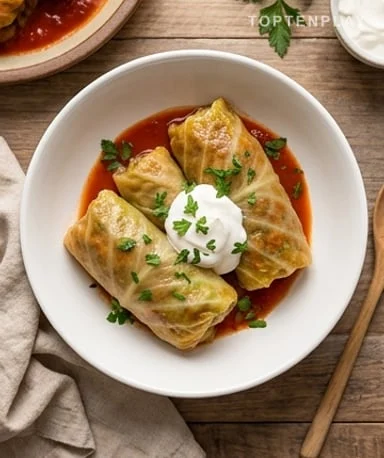
Tight rolls, a simmering tomato sauce — the kind of dish that truly warms you.

What you see first is the color — a deep, almost brick red of the tomato sauce that has simmered long enough to lose any aggressive acidity. The rolls are tight, well-aligned in the pot, each slightly domed in the center. When you lift the lid, the smell hits first: concentrated tomatoes, melted onion, a discreet paprika note that has settled in over an hour and a half. When you cut the first roll with a spoon, the filling crumbles gently — rice and beef amalgamated into something tender that you’ve been anticipating since the kitchen.
Why you’ll love this recipe

A complete meal in one dish : The beef and rice filling is self-sufficient. Bread for dipping, and that’s all you need.
The sauce does all the work : It permeates the leaves during cooking. Each bite is soaked with tomatoes and aromatics without you having done anything more than covering and letting it simmer.
Even better the next day : This is one of those dishes that improves with time. Reheated on low heat, the sauce has thickened, the flavors have concentrated, and the cabbage has softened just right.
Impressive without being intimidating : Rolling might seem tricky at first glance. Two rolls later, you’ve got the hang of it — and the result on the plate doesn’t give away that it’s your first time.

Ingredient Notes

Ingredients

No frills: cabbage, meat, rice, and a good tomato sauce. That’s all it takes.

  • Green cabbage (1 large) : It serves as both wrapper and cooking support — the outer leaf must be pliable after blanching, not crunchy, to fold without cracking. Choose a large cabbage with wide, loose leaves rather than a compact head: you’ll get whole leaves, easy to handle, with less waste.
  • Ground beef (500g, 80/20) : Fat is essential here. Too lean beef gives a dry filling that crumbles when cut after 90 minutes of cooking. 80/20 stays juicy, absorbs spices, and holds well when sliced. If you want a lighter option, a half-beef half-ground turkey mix works very well — provided you add a drizzle of olive oil to the filling to compensate.
  • Round rice (80g, raw) : This gives the filling its tender and compact texture. Added raw, it swells during cooking by absorbing meat juices and sauce — result: a cohesive, not sandy, texture. Avoid long-grain or basmati rice, which remain firmer and don’t play the same binding role.
  • Crushed tomatoes (400g canned) : The base of the sauce, and the ingredient that will determine its final taste. Prefer a can with dense flesh and little juice (San Marzano, if you can find them) rather than out-of-season fresh tomatoes that would release too much water and dilute everything. A pinch of sugar at the end of cooking corrects any residual acidity without masking the flavor.
  • Yellow onion (2 medium) : It appears in two places: chopped and sautéed in the filling to add tenderness and sweetness that balances the meat, then sliced and browned in the sauce where it completely melts after 90 minutes. In the filling, always add it cooked — raw, it would release water during cooking and unbalance the texture.
  • Smoked sweet paprika : Not mandatory, but it gives that slightly woody depth in the filling. One teaspoon is enough. Spanish pimentón (smoked) is more interesting than standard Hungarian paprika for this dish — it evokes slow cooking and adds a dimension that simple pepper does not cover.

Softening the cabbage without breaking it

The first hurdle of this recipe is the cabbage. A raw leaf will snap if you try to bend it — you need to blanch it just enough to make it pliable without cooking it through, because it will finish cooking in the sauce. Bring a large pot of generously salted water to a boil, plunge the whole cabbage head in for two to three minutes, take it out, and remove the outer leaves that come off easily. Put the cabbage back in the water and repeat until you have about a dozen usable leaves. A well-blanched leaf folds in half without resistance and takes the shape you give it — if it still cracks at the central vein, it’s not ready. For particularly thick veins, run a peeler or knife over the bulge: thinning it by a few millimeters removes the point of resistance that makes the leaf tear when rolling.

Softening the cabbage without breaking it
Rolling is the step that requires a bit of patience — but you’ll get the hang of it quickly.

The filling: proportions and seasoning

In a bowl, combine the ground beef, raw rice, onion sautéed until translucent and cooled, crushed garlic, smoked paprika, salt, and pepper. The onion must be cooked before going into the filling — raw, it would release water during cooking and destabilize the texture. The desired consistency is close to a soft mince that holds into a ball without being compact: it should yield under your fingers, not resist. If it seems too dry, a spoonful of tomato paste or a drizzle of olive oil fixes the problem immediately. Season generously, more than you usually would — the filling will give up some of its flavor to the sauce during cooking and end up perfectly balanced. A timidly salted filling at this stage will be bland on the plate.

Rolling: consistency over perfection

Place a leaf flat, curved side down. Place two to three tablespoons of filling in the lower part of the leaf, near the stem. Fold the lateral edges inward — like a wrap — then roll firmly from bottom to top while maintaining constant tension. The roll should be tight, but not so tight as to compress the filling: the rice needs room to swell during cooking. Too loose, it falls apart in the sauce. Uniformity of size matters more than aesthetics — if all the rolls are roughly the same volume, they will have the same cooking time and final texture. Arrange them in the pot seam side down, which keeps them closed naturally without needing to fasten them otherwise.

Cooking: letting the sauce do the work

In the bottom of the pot, sauté a sliced onion in olive oil until golden — this step takes six to eight minutes and is worth not rushing, because this is where the sauce base builds. Add the crushed tomatoes, a glass of hot water, salt, pepper, and the pinch of sugar. Arrange the rolls tightly against each other in one or two layers if necessary — this density is intentional, it prevents them from floating and coming apart. The sauce should reach halfway up the rolls, not cover them entirely. Cover and simmer over very low heat for 90 minutes. Halfway through, baste the top rolls with the sauce so they don’t dry out. You hear the gentle bubbling through the lid, the sauce gradually thickens, and the smell in the kitchen becomes increasingly hard to ignore. During the last half hour, leave the lid slightly ajar to allow the sauce to reduce and concentrate.

Serving and adjusting

Remove the rolls carefully — they are fragile right after cooking — and place them in a shallow dish with sauce ladled over. A spoonful of plain yogurt or thick crème fraîche on the side adds a fresh contrast and softens any residual tomato acidity. If the sauce is too thin, remove the rolls and reduce over high heat for three to four minutes before pouring. If it has thickened too much, a splash of hot water and a minute of cooking loosen it without losing flavor. This dish reheats perfectly the next day over low heat with a bit of water added — it’s often at that point that you realize you should have made double.

Serving and adjusting
They simmer covered in the sauce: the longer they cook, the better.

Tips & Tricks
  • Thin the central vein of each leaf with a peeler before rolling — a too-thick vein creates a point of resistance that makes the leaf crack when folding and results in an uneven roll that opens during cooking.
  • Add raw rice to the filling, never pre-cooked — it absorbs meat juices and sauce during the 90 minutes of cooking, producing that cohesive and tender texture you expect. Pre-cooked rice would swell too quickly and turn into a floury paste.
  • Don’t salt the sauce at the final assembly without tasting it first — the filling has already released salt during cooking, and an oversalted sauce midway becomes really too salty once reduced.
  • Freeze the cooked rolls with sauce in individual portions. They freeze perfectly and reheat directly in a small saucepan over low heat with a splash of water — no thawing needed, in twenty minutes.
Close-up
Inside: tender filling, perfectly soft rice, cabbage leaf slightly caramelized by the sauce.
FAQs

Can you prepare stuffed cabbage rolls the day before?

Yes, and it’s even recommended. A night in the refrigerator allows the sauce to concentrate and the flavors to meld — the result is noticeably tastier than served the same day. Reheat covered over very low heat with a splash of water added if the sauce has thickened too much.

How to prevent the rolls from falling apart during cooking?

Two critical points: roll firmly with the lateral edges well folded inward, and arrange the rolls seam side down in the pot. Density also plays a role — tight rolls against each other support each other and move less in the sauce.

Should you cook the rice before adding it to the filling?

No, and it’s important not to. Raw rice absorbs meat juices and sauce during the 90 minutes of cooking, giving the filling its cohesive and tender texture. Pre-cooked rice would swell too quickly and turn into a compact paste that crumbles.

Which variety of cabbage should you choose for this recipe?

A large green cabbage with wide, loose leaves is ideal — the outer leaves are larger and easier to handle after blanching. Avoid very compact heads whose inner leaves remain small and rigid even after cooking.

My sauce is too thin at the end of cooking. How to fix it?

Carefully remove the rolls with a spatula and set them aside in a dish. Reduce the sauce over high heat, uncovered, for three to five minutes until the desired consistency, then pour over the rolls. Do not leave them in the pot during reduction — they would continue to absorb liquid and become too soft.

Do stuffed cabbage rolls freeze well?

Very well. Place them in airtight containers with enough sauce to cover, and freeze for up to three months. To reheat, transfer directly to a saucepan over low heat with a splash of water — no thawing needed — and cover for about 20 minutes.

Stuffed Cabbage Rolls in Tomato Sauce

Stuffed Cabbage Rolls in Tomato Sauce

Medium
Eastern European
Main course

Prep Time
35 minutes
Cook Time
90 minutes
Total Time
2 hours 5 minutes
Servings
6 servings

Cabbage leaves softened in broth wrap a filling of ground beef and raw rice, simmered for 90 minutes in a concentrated tomato sauce. A complete, rustic, and comforting evening dish that gets better the next day.

Ingredients

  • 1 large green cabbage (about 1.5 kg)
  • 500g 80/20 ground beef
  • 80g raw round rice
  • 2 medium yellow onions
  • 3 cloves garlic
  • 400g canned crushed tomatoes
  • 1 tbsp tomato paste
  • 200ml hot water
  • 1 tsp smoked sweet paprika
  • 1 pinch sugar
  • 2 tbsp olive oil
  • Salt and black pepper to taste
  • Plain yogurt or crème fraîche for serving (optional)

Instructions

  1. 1Bring a large pot of salted water to a boil. Plunge the whole cabbage for 2-3 minutes, remove and peel off the softened outer leaves. Return to water and repeat until you have 12 leaves. Thin the thick central veins with a peeler.
  2. 2Finely chop 1 onion. Sauté in 1 tablespoon olive oil over medium heat, 6 to 8 minutes, until translucent. Let cool completely.
  3. 3In a bowl, mix the ground beef, raw rice, cooled sautéed onion, 2 crushed garlic cloves, smoked paprika, 1 teaspoon salt, and pepper. Mix until a homogeneous and soft filling forms.
  4. 4Place a cabbage leaf flat. Place 2 to 3 tablespoons of filling at the base. Fold the lateral edges inward, then roll firmly from bottom to top. Repeat for all leaves.
  5. 5In a pot, sauté the second chopped onion in the remaining olive oil until golden, 6 to 8 minutes. Add the crushed tomatoes, tomato paste, the 200ml water, the remaining crushed garlic clove, salt, pepper, and the pinch of sugar. Stir.
  6. 6Arrange the rolls tightly in the pot, seam side down, in one or two layers. The sauce should reach halfway up the rolls.
  7. 7Cover and simmer over very low heat for 90 minutes. Halfway through, baste the top rolls with the sauce. During the last 30 minutes, leave the lid slightly ajar to let the sauce reduce.
  8. 8Serve in a shallow dish with the sauce, accompanied by a spoonful of plain yogurt or crème fraîche.

Notes

• For a lighter filling, replace half the beef with ground turkey and add a drizzle of olive oil to maintain tenderness.

• Prepared the day before and reheated over low heat, the rolls are even better: the sauce concentrates its flavors overnight.

• The rolls freeze with their sauce for up to 3 months. Reheat directly in a saucepan over low heat, without thawing, 20 minutes with a splash of water added.

Nutrition Facts (per serving, estimated)

348 kcalCalories 22gProtein 23gCarbs 18gFat
Advertisement
Share on Facebook