Sticky noodles have a reputation as a restaurant dish — the kind of thing you order for delivery because you think it’s too technical to make yourself. That’s false. The reality is one wok, thinly sliced beef, a five-ingredient sauce — and twenty minutes over high heat.
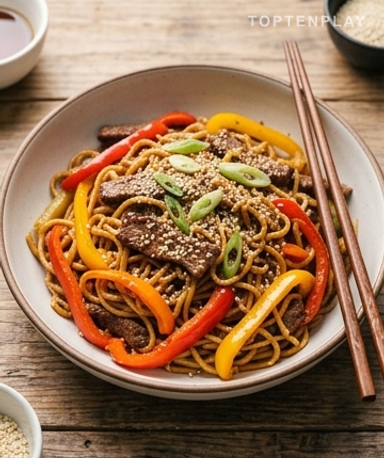
Imagine the noodles: each strand glistening with a dark, almost lacquered caramel sauce, with that shine you see in Asian restaurant windows. The beef is thinly sliced, the edges slightly crispy, contrasting with peppers that have kept a bit of bite. It smells of toasted soy, fresh ginger, and a small sweet hint of caramelized lime at the bottom of the wok. A scent like nothing else.
Why you’ll love this recipe
Ingredient Notes

Everything needed for express noodles: sirloin, colorful peppers, egg noodles, and that caramelized sauce that changes everything.
- Sirloin : It’s the ideal choice because it stays tender even when seared hard. Cut it very thin — 3 to 4 mm, against the grain. If the piece comes straight from the fridge, it slices much more easily than at room temperature.
- Egg noodles : Not rice vermicelli, not soba. Real thick egg noodles with a good bite. You can find them in the Asian section of most supermarkets. Cook them al dente — they will finish cooking in the sauce and absorb everything.
- Dark soy sauce : Dark soy gives that deep caramel color and a rounder flavor, less salty than acidic. Light soy works too, the result will just be a bit paler. Kikkoman or any Asian brand will do the trick.
- Lime : This is what cuts through the umami and prevents the dish from becoming heavy. A whole lime, zest included. The grated zest added off the heat at the very end really changes things — don’t skip it.
- Fresh ginger : Not powdered ginger. Freshly grated has a sharp, almost floral heat that is the signature of this type of dish. A 3 cm piece is enough.
Preparing the sauce: five minutes that change everything
The sauce is the heart of the dish — might as well do it right. Mix the dark soy sauce, a spoonful of honey, the juice and half the lime zest, grated ginger, a pinch of chili flakes, and a spoonful of sesame oil. Whisk until the honey is dissolved. Taste before cooking: it should be distinctly salty-sweet-acidic, as it dilutes slightly in contact with the hot wok. Note that sesame oil shouldn’t be ‘cooked’ away — you’ll add a second spoonful off the heat at the very end to preserve its roasted nutty aroma, which disappears completely under high heat.

Searing the beef — the part everyone gets wrong
The wok must be truly hot before you put the meat in. Hold your palm 10 cm above it — if you feel intense heat in less than two seconds, it’s ready. A drizzle of neutral oil, then the beef slices in a single layer, without overlapping. Don’t touch them for 90 seconds. This moment of stillness is what creates the crust. You’ll hear a loud, almost aggressive sizzling — that’s exactly what we want. Flip only once, another 60 seconds. Remove the beef to a plate and let it rest. It will finish cooking when it rejoins the noodles.
The vegetables: keep the crunch, not the mush
In the same wok without cleaning it — all the cooking juices stay, and that’s a good thing — sauté the peppers over high heat. Two minutes maximum. The goal isn’t to soften them, but to color them slightly while keeping that resistance to the bite. You’ll see the edges go from bright red to a darker, slightly charred red. That’s the moment to aim for. Add the sliced garlic only for the last 30 seconds — garlic burns fast and becomes bitter, so we add it last.
The final assembly: when everything caramelizes together
The drained noodles join the vegetables in the wok, then the sauce goes over them all at once. High heat. Mix with tongs using wide movements from the bottom up — every noodle must be coated. The sauce will reduce and thicken in 2 to 3 minutes: you’ll see the bottom of the wok go from liquid to syrupy, and the noodles take on that lacquered shine. Put the beef back in, one last mix. Off the heat: the sesame oil, the rest of the lime zest, and some sesame seeds if you have them.

Tips & Tricks
- Put the meat in the freezer for 15 minutes before cutting — it will be firmer, you’ll get even slices, and cooking will be more consistent.
- Never sauté meat and vegetables at the same time: the wok loses too much temperature and everything starts to boil instead of searing. Everything separately, assembly at the end.
- If your sauce is too thick at the end of cooking, add a tablespoon of hot water. Too liquid? Max heat for 30 seconds without stirring, it reduces quickly.
- Cook the noodles al dente, almost slightly undercooked to your usual taste. They finish cooking in the sauce and absorb the liquid — if they start too soft, the result will be mushy.

Can I replace the sirloin with another cut of beef?
Yes, no problem. Rump steak and ribeye work very well. Pre-sliced beef from the supermarket gives a decent result if you sear at a very high heat to prevent it from releasing too much water. Avoid braising cuts like chuck — they take too long to tenderize for this type of quick cooking.
Does it work without a wok?
Yes, a large stainless steel or cast iron skillet does the job, provided it’s very hot before adding the meat. The ideal remains a wok or a high-sided pan to mix the noodles without making a mess.
Encore une histoire pour vous
When Fear Takes Over: The Psychology of Everyday Panic
It started as a routine dog walk and ended in uncontrollable laughter — but not before a full spiral into panic. The story of…
Encore une histoire pour vous
An Unfinished Woodland Cabin That Lets You Build on Your Own Terms
On a quiet, partially wooded lot of 0.167 acres, an unfinished cabin sits waiting — not as a…
Voir ici
What Doctors Really Say About Eating Bananas Every Day
Bananas are one of the most consumed fruits on the planet, and for good reason. Packed with essential…
Voir ici
Tammy Slaton loses 440 pounds: a life-changing transformation
Tammy Slaton, star of the reality series 1000-Lb. Sisters, has lost 440 pounds following years of medical intervention,…
Voir ici