The scent of asparagus gently sweating in its foil, sweet and a bit earthy at the same time — that’s how this Saturday begins. This recipe by Julien Médard, Michelin-starred chef of Maison Médard in Boulleret, is not meant to be rushed. It is meant to be savored.
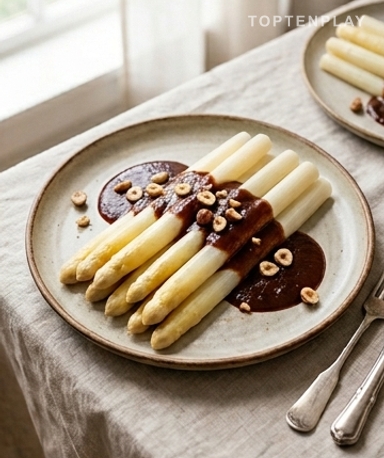
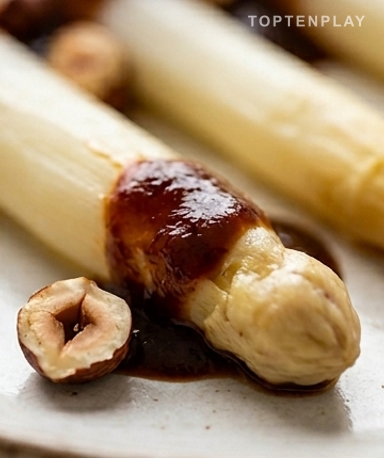
On the plate, the asparagus are an almost pearly ivory white, with tips turning a slightly tender green. The plant-based barbecue sauce spreads like a dark mirror — mahogany-colored, almost lacquered, with glints announcing something smoky and deep. A few crushed hazelnuts break the surface, reddish-brown and matte. And in the mouth, it’s that unexpected combination: the starchy sweetness of the asparagus, the sweet-smoky bite of the sauce, and the dry crunch of the hazelnut.
Why you’ll love this recipe
Ingredient Notes
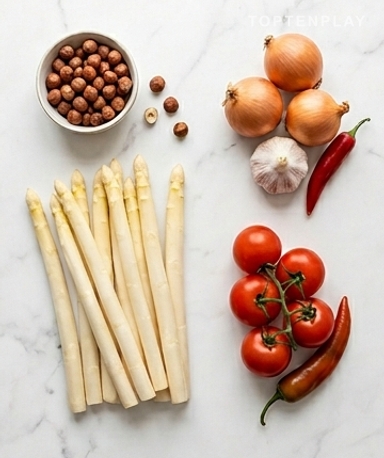
The seasonal ingredients: plump white asparagus, vegetables for the sauce, and fresh hazelnuts — simple and beautiful.
- White asparagus : Take the largest ones you find — minimum 14-16 mm caliber. An asparagus that is too thin dries out when smothered instead of gently confitting. Choose them firm, with tight tips and a base that doesn’t fray. Asparagus from La Charité-sur-Loire if you come across them, otherwise any beautiful seasonal white asparagus will do perfectly.
- Red bell peppers (for the sauce) : The sweet and fleshy base of the sauce. You need to roast them until the skin blisters and blackens — that’s where the smoky flavor really builds up. No shortcuts with jarred peppers: the texture will be different and the flavor less pronounced.
- Smoked paprika : Get Spanish Pimentón de la Vera if you can. It’s what gives that barbecue character without embers. A level teaspoon is enough — its intensity rises quickly and turns bitter if you overdo it.
- Whole hazelnuts : To be dry-roasted in a pan until the skin cracks and the smell becomes distinctly toasted hazelnut — 4 to 5 minutes over medium heat. Avoid store-bought pre-roasted hazelnuts: they are often too salty and the aroma is stale. Let cool before roughly chopping with a knife.
The sauce first — always
Start with the sauce because it needs time. Roast your peppers directly over the gas flame or under the oven grill — the skin must become black and blistered all over. Put them in a bowl covered with plastic wrap for 10 minutes: the steam does the work, and the skin falls off in shreds. Meanwhile, melt the onion and garlic in a drizzle of oil over low heat — 8 good minutes, no less, until they are translucent and smell almost like confit. Add the peeled, roughly chopped peppers, tomato paste, smoked paprika, a drizzle of cider vinegar, and a bit of maple syrup. Simmer for 15 minutes, then blend. The sauce should have that dark mahogany color and lightly coat the spoon — if it’s still watery, put it back on the heat for a few minutes.
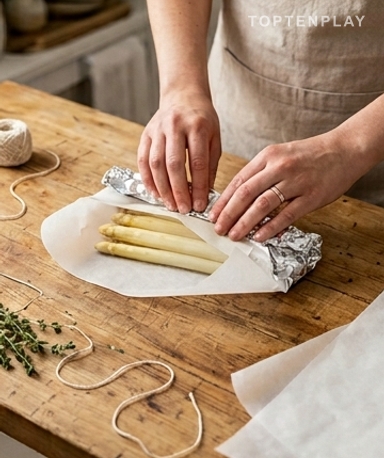
Preparing the asparagus
Peel the asparagus from the bottom third to the base — press firmly with the vegetable peeler, the outer white skin is thick. Trim the stem by 1 cm. Form bundles of 3 or 4 asparagus, wrap in parchment paper and then in a tightly sealed sheet of aluminum foil. Before closing, slip a drizzle of olive oil and a pinch of fleur de sel between the asparagus. Tighten the edges of the foil to create a truly airtight packet — no steam should escape during cooking.
Smothered cooking — now, patience
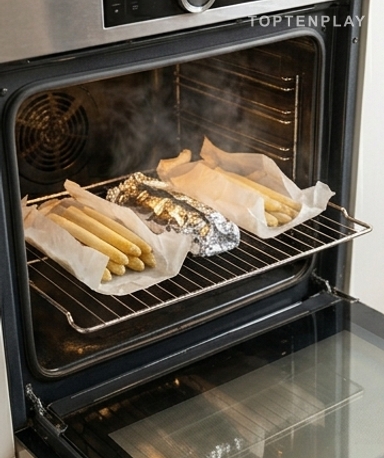
Oven at 180°C, fan setting. Place the packets directly on the rack, not in a dish, so the heat circulates all around. Thirty minutes. Resist the urge to open to check: every opening releases the steam that does all the work. When you finally open the packets, a cloud of steam rises — it smells of concentrated, almost sweet asparagus, with that slightly earthy vegetal base you don’t get with water cooking. The asparagus should be yield under finger pressure but not collapsed. If they crush, it’s two minutes too long.
Plating
Gently reheat the sauce in a small saucepan while the asparagus rests for 2 minutes out of the packet. Arrange the bundles in shallow bowls slightly warmed in the oven. Drizzle the sauce, don’t flood it — you want to see the asparagus, not drown them. The crushed hazelnuts go last, just before serving, so they keep that dry crunch. A pinch of fleur de sel on the tips, and it’s ready.
Tips & Tricks
- Make the sauce the day before: reheated the next day, it’s even better. The flavors have had time to meld and the paprika has mellowed.
- If your asparagus exceed 18 mm, add 5 minutes to the cooking time. If they are as thin as a pencil, go down to 20 minutes — otherwise they end up mushy.
- The plant-based BBQ sauce freezes very well in small jars. Make double while you’re at it — it works great with grilled vegetables, rice, as a marinade, or on almost anything.
Can I use green asparagus instead of white?
Yes, but the result will be different. Green asparagus are thinner and more fibrous — reduce the cooking time to 18-22 minutes depending on their size. The flavor will be more vegetal and herbaceous, less sweet than white. The recipe works, but the pairing with BBQ sauce is a bit less obvious.
Can I prepare the plant-based barbecue sauce in advance?
It is actually recommended. Prepared the day before and kept in the refrigerator, the sauce is better: the smoky and tangy flavors have had time to balance out. It keeps for 5 days in the fridge in a closed jar and freezes very well in small portions.
How do I know if the asparagus are properly cooked without opening the packet?
Count 30 minutes for standard caliber (14-16 mm) asparagus at 180°C — it’s reliable. Upon opening, test with the tip of a knife: it should sink in with slight resistance, not slide in like butter. If the knife enters without effort, they had 3-4 minutes too long.
Is it absolutely necessary to use BOTH parchment paper and foil?
The parchment paper protects the asparagus from direct contact with the aluminum and prevents any acid reaction. The foil ensures airtightness and retains the steam. Technically, you could use only foil, but you’d need to double the sheets to avoid leaks. The pair gives a cleaner result.
Can this recipe serve as a main course?
As a generous starter, yes. As a main course, it will need to be accompanied: basmati rice, red lentils, or a parsnip puree absorb the sauce well and compensate for the lack of caloric density. Optionally, add poached eggs to the plate if you want more protein.
Do leftovers keep well?
Smothered asparagus keep for 2 days in the refrigerator but don’t reheat very well — they soften. Eat them cold, in a salad with a drizzle of olive oil and lemon. The sauce, however, reheats very well over low heat by adding a little water if it has thickened too much.
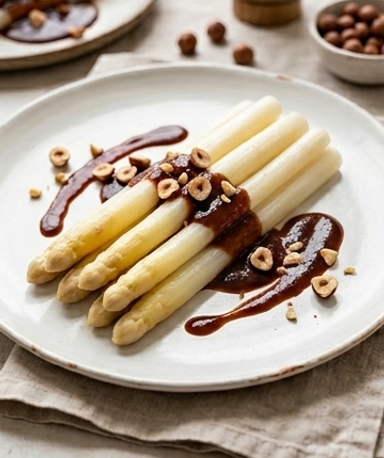
Smothered Asparagus and Plant-Based Barbecue Sauce
French
Starter
White asparagus cooked in their own juices, served with a smoky plant-based barbecue sauce made from roasted peppers and toasted hazelnuts. A chef’s recipe that only requires patience.
Ingredients
- 800g white asparagus (minimum 14-16 mm caliber)
- 20ml olive oil
- 4g fleur de sel
- 1 pinch freshly ground black pepper
- 3 red bell peppers (about 450g)
- 1 medium onion (about 150g)
- 3 garlic cloves
- 30g tomato paste (2 tablespoons)
- 3g smoked paprika (1 level teaspoon)
- 30ml cider vinegar (2 tablespoons)
- 20ml maple syrup (1 tablespoon)
- 15ml olive oil for the sauce (1 tablespoon)
- 2g fine salt for the sauce
- 60g whole hazelnuts
Instructions
- 1Roast the whole peppers directly over the gas flame or under the oven grill until the skin is black and blistered all over (about 15 minutes, turning occasionally).
- 2Place the peppers in a bowl covered with plastic wrap for 10 minutes, then peel them and remove the seeds.
- 3Sauté the chopped onion and garlic in 15ml of olive oil over low heat for 8 minutes, until they are translucent.
- 4Add the peeled, roughly chopped peppers, tomato paste, smoked paprika, cider vinegar, and maple syrup. Salt and simmer for 15 minutes over low heat.
- 5Blend the sauce until a smooth texture is obtained. Strain if you want a silkier consistency. Set aside.
- 6Preheat the oven to 180°C fan setting.
- 7Peel the asparagus from the lower third to the base with a peeler. Trim the ends by 1 cm.
- 8Form bundles of 3 to 4 asparagus. Wrap each bundle in a sheet of parchment paper, then in a tightly sealed sheet of aluminum foil. Add a drizzle of olive oil and a pinch of fleur de sel inside before sealing hermetically.
- 9Place the packets directly on the oven rack and cook for 30 minutes without opening.
- 10Meanwhile, dry-roast the hazelnuts in a pan over medium heat for 4 to 5 minutes until the skin cracks. Let cool and roughly chop with a knife.
- 11Gently reheat the sauce in a saucepan. Open the asparagus packets (be careful of the steam), and arrange the bundles in warm shallow bowls.
- 12Drizzle the sauce over the asparagus, sprinkle with crushed hazelnuts, and serve immediately.
Notes
• The plant-based barbecue sauce can be prepared up to 5 days in advance and stored in the refrigerator in a closed jar — it’s even better the next day.
• For very thick asparagus (over 18 mm), add 5 minutes of cooking. For thin asparagus (less than 12 mm), reduce to 20 minutes.
• Leftover asparagus are delicious cold in a salad with a drizzle of olive oil and a few drops of lemon — do not try to reheat them in the oven, they would lose their texture.
Nutrition Facts (per serving, estimated)
| 255 kcalCalories | 7gProtein | 21gCarbs | 16gFat |