It’s ten in the morning, the slow cooker is humming on the countertop, and the whole house is already starting to smell like beef in Worcestershire broth. In six hours, all you’ll have to do is sprinkle the cheddar and wait for it to melt. That’s real weekend cooking.
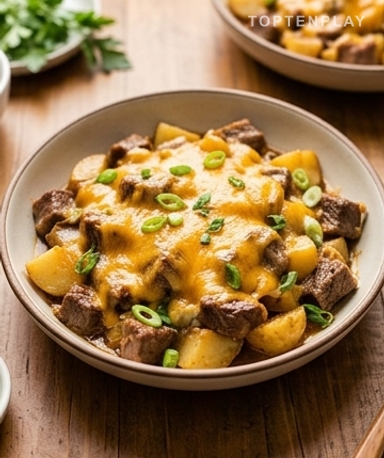
In the bowl, the beef cubes have taken on a deep amber color, almost like burnt caramel, bathing in a golden-brown juice slightly thickened by the potato starch. The potatoes are melt-in-your-mouth tender on the inside but still hold their shape—just enough so you feel them yield under the fork before they break apart. On top, the aged cheddar has melted into an irregular blanket, with slightly crispy edges that smell like toasted hazelnuts. The aroma rising from the bowl blends confit meat, paprika, and something sweet-and-savory that you couldn’t quite name but would recognize anywhere.
Why you’ll love this recipe
Ingredient Notes
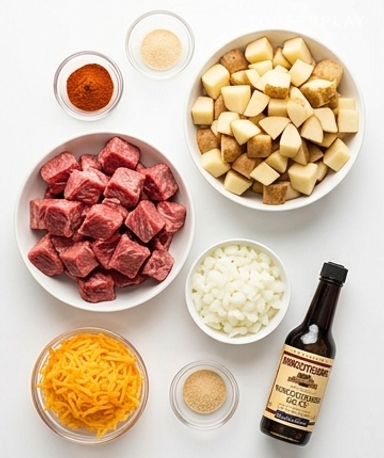
Everything you need for an ultra-comforting dish: well-marbled beef, rustic potatoes, and an aged cheddar that holds its own.
- Diced sirloin beef : Pick a piece with some visible fat on the surface—not huge amounts, but enough so the meat stays juicy. Avoid cubes that are too small (less than 3 cm), as they will disintegrate after six hours. If you can’t find sirloin, chuck roast works very well here, sometimes even better for tenderness.
- Potatoes : Russet or Bintje are the best—they withstand long cooking without turning into mash and soak up the broth like sponges. Cut them into 3-4 cm cubes, no smaller. Yukon Gold also work if you prefer a more buttery texture.
- Aged cheddar : Not the mild, plastic-wrapped sliced cheddar. Use an extra-sharp or mature cheddar, grated yourself if possible—it melts much better than pre-shredded packs which often contain anti-caking agents. The sharp taste of old cheddar is exactly what’s needed to stand up to the richness of the broth.
- Worcestershire sauce : This is the little secret of this dish. Two tablespoons might seem like nothing, but it brings an umami depth you couldn’t identify blindly—slightly vinegary, caramelized, and a bit spicy. Lea & Perrins remains the standard, but any quality brand will do.
- Paprika : If you have smoked paprika on hand, use it instead of classic sweet paprika. It gives a slightly woody background reminiscent of dishes cooked over embers. Half a teaspoon really changes the profile of the dish without anyone knowing why it’s so good.
Why I’ll never make this any other way than in a slow cooker
Diced sirloin doesn’t handle dry, fast heat well. In a hot pan, it toughens up. In a convection oven, it dries out. But six hours in a simmering broth at low temperature—and it transforms. The proteins relax slowly, the little bit of connective tissue melts into the juice, and you get something incomparably juicier than with any other method. The only real downside: you have to plan ahead. This isn’t a dish you decide to make at 7 PM.
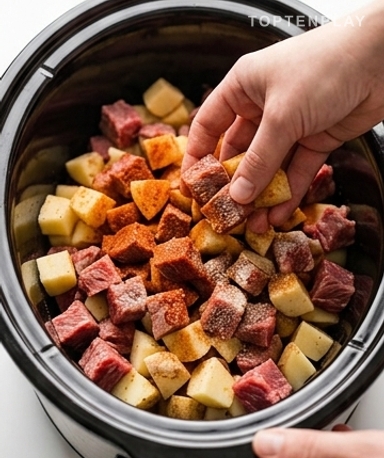
The bottom layer—where it all happens
Most people just throw the ingredients into the pot without thinking. Yet the order makes a real difference. Potatoes first, at the bottom—they cook slower than the beef and need more direct heat. The meat goes on top. Now season generously: salt, freshly cracked pepper, garlic powder, paprika. Mix with your hands directly in the pot. You should see every cube slightly pink from the spices, and feel the peppery paprika under your fingers. Only then do you pour the broth mixed with the Worcestershire—the spice layer sticks to the meat and doesn’t dilute immediately.
Six hours of patience—and that’s really all that’s asked of you
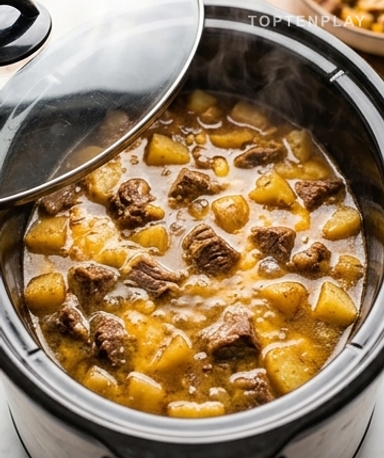
Set to LOW and resist the urge to lift the lid to check. Every opening lets out the steam that keeps everything moist—you easily lose twenty minutes of cooking time each time. Trust the process. Around the fourth hour, you’ll smell something different from the hallway: a dense stew aroma, slightly caramelized, with that sweet-and-savory Worcestershire base that has had time to integrate with everything else. That’s the signal that it’s coming along well. Do nothing.
The cheese—just before serving, not before
Fifteen minutes before eating, spread the shredded cheddar over the entire surface—evenly, not in a pile in the middle. Right to the edges. Put the lid back on without touching the heat setting. In ten to twelve minutes, the cheese will have melted into a smooth, slightly translucent blanket, with small bubbles on the edges starting to turn honey-colored. This isn’t broiled cheese—it’s cheese that fuses with the cooking juices and makes it almost creamy. Serve immediately, scraping the bottom of the pot to get all that juice.
Tips & Tricks
- Use low-sodium broth—after six hours of reduction, normal salty broth becomes much too concentrated. Always taste before adjusting at the end of cooking.
- To reheat the next day, add two tablespoons of cold broth to the pot before setting back to LOW for 30 minutes—this restores the juice without drying out the meat.
- If you want an even meltier texture, replace one-third of the potatoes with thickly sliced carrots. They release their natural sugar into the broth and provide a sweetness that balances the aged cheddar.
- Don’t despair if the juice seems too liquid when you open it—remove the lid for the last 20 minutes and switch to HIGH. Evaporation will concentrate it quickly.

Can I use a different cut of beef than sirloin?
Yes, no problem. Chuck roast (paleron) is often even better for the slow cooker because it contains more collagen, which produces an even richer juice. Stewing beef cubes work very well too. Avoid very lean cuts like tenderloin—they dry out even at low temperatures.
I only have 3 hours, can I cook on HIGH?
Yes. Set the slow cooker to HIGH and cook for 3 to 4 hours. The result will be slightly less tender than with the LOW setting, but perfectly satisfying. Check the tenderness of the beef with a fork at 3h—it should yield easily without resistance.
How long do leftovers keep and how do I reheat them?
Leftovers keep for up to 4 days in the refrigerator in an airtight container. To reheat, add a tablespoon or two of broth before using low heat on the stove or in the microwave—this prevents the meat from drying out. The dish freezes very well in individual portions for up to 3 months.
The sauce seems too thin at the end of cooking, what should I do?
Remove the lid, switch to HIGH, and cook for another 20 to 30 minutes uncovered—evaporation will naturally concentrate the juice. Alternatively, dissolve a tablespoon of cornstarch in a little cold broth and pour it into the pot, then let it thicken for 10 minutes with the lid closed.
Can I prepare the ingredients the night before?
Yes, it’s actually a great idea. Cut the beef and potatoes, mix them with the spices, and keep everything in an airtight bag in the refrigerator. In the morning, you just have to empty the bag into the pot and pour the broth. Don’t prep potatoes too early if putting them in water—dry them well before seasoning.
Can I add other vegetables to the slow cooker?
Absolutely. Thick-sliced carrots and celery hold up well to long cooking and enrich the broth. Avoid delicate vegetables like zucchini or spinach—only add them in the last third of cooking. Whole or large-cut mushrooms are also a great option.
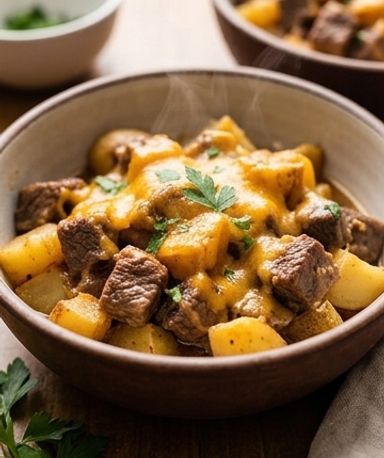
Slow Cooker Beef, Potato and Melted Cheddar Stew
American
Main course
Diced sirloin beef and tender potatoes slow-cooked for 7 hours in a Worcestershire-infused broth, topped with aged cheddar melted just before serving.
Ingredients
- 800g sirloin beef, cut into 3-4 cm cubes
- 800g Russet or Bintje potatoes, peeled and diced
- 1 large yellow onion, coarsely chopped
- 150g aged cheddar, shredded
- 400ml low-sodium beef broth
- 2 c.à.s Worcestershire sauce (30ml)
- 1 c.à.c salt
- ½ c.à.c freshly ground black pepper
- 1 c.à.c garlic powder
- 1 c.à.c paprika (sweet or smoked)
Instructions
- 1Layer the potatoes at the bottom of the slow cooker pot, then add the beef and onion on top.
- 2Sprinkle the salt, pepper, garlic powder, and paprika over everything, then mix with your hands to coat each piece thoroughly.
- 3Mix the beef broth and Worcestershire sauce in a bowl, then pour evenly over the contents of the pot.
- 4Cover and cook on LOW for 6 to 8 hours, or on HIGH for 3 to 4 hours, without lifting the lid during cooking.
- 515 minutes before serving, distribute the shredded cheddar evenly over the entire surface, replace the lid, and let melt.
- 6Serve hot directly from the pot, garnished with fresh chopped parsley or green onions if desired.
Notes
• Storage: keeps for 4 days in the refrigerator in an airtight container. Add a dash of broth when reheating to prevent the meat from drying out. Freezes in individual portions for up to 3 months.
• Veggie variation: add 2 thick-sliced carrots and a stalk of celery at the start of cooking to enrich the broth naturally.
• Make ahead: seasoned ingredients (without broth) can be prepared the night before and kept in an airtight bag in the fridge. Pour the broth just before starting the cooking.
Nutrition Facts (per serving, estimated)
| 530 kcalCalories | 42gProtein | 28gCarbs | 20gFat |