📌 Salmon Mimosa eggs: the piping bag technique that transforms this classic starter into a festive dish
Posted 6 January 2026 by: Admin
The Timeless Mimosa Egg, Star of French Tables
Whether they adorn a holiday buffet, a Sunday brunch, or a simple country picnic, Mimosa eggs with salmon or tuna hold a special place in France’s culinary heritage. This timeless appetizer appeals as much for its simplicity of execution as for its visual refinement, perfectly embodying the accessible elegance of French cuisine.
Their melting and creamy texture makes them an essential classic for all occasions. As a cocktail snack, they are easy to pick up and disappear in minutes. As a fresh starter accompanied by a side salad, they constitute a light and balanced meal without sacrificing indulgence. This versatility of use explains their constant presence on our tables, from family gatherings to more formal receptions.
An apparent paradox of this recipe: its disconcerting ease. For 4 people (8 half-eggs), it only takes 30 minutes flat – 20 minutes of preparation and 10 of cooking. No complex technique, no sophisticated equipment, just a few precise movements that transform modest ingredients into refined bites. The secret lies less in technical prowess than in the balance of flavors, that delicate alchemy that distinguishes a mundane realization from a memorable creation.
The Alchemy of Flavors: Deciphering a Perfect Balance
This gustatory harmony owes nothing to chance. The architecture of the dish rests on a meticulous sensory stratification: the neutral sweetness of the egg white offers a sober setting for the creamy softness of the mashed yolk, while the briny note of the smoked salmon or tuna provides the depth that prevents any blandness.
The genius of the recipe lies in its discreet accents. Mild mustard plays the role of a flavor enhancer here: a teaspoon is enough to enhance the whole without ever dominating, creating that palate liveliness that prevents heaviness. Fresh herbs – chives or dill depending on preference – do not act as simple decoration: their vegetal and slightly aniseed freshness counterbalances the richness of the mayonnaise and the compact texture of the yolk.
As for the finishes, they transcend the experience. A hint of sweet paprika draws an elegant chromatic contrast while bringing a subtle aromatic warmth. A refreshing alternative: a few shavings of lemon zest illuminate the preparation with a citrusy acidity that miraculously lightens the fatty perception of the whole. These tiny details, often neglected, distinguish a banal version from a creation that marks the gustatory memories.
Mastering the Technique: The Decisive Moves for Success
This irreproachable execution begins with cooking the eggs, which tolerates no approximation. The starting point: a pot of cold water in which the eggs rest even before heating. This gradual rise in temperature prevents shell cracks and guarantees uniform cooking. Exactly ten minutes of boiling – no more, no less – produce that firm but creamy yolk, free of that greenish ring indicative of overcooking. The immediate thermal shock in ice water stops residual cooking in its tracks and contracts the albumen, transforming peeling into a fluid gesture rather than a fierce struggle against a recalcitrant membrane.
The preparation of the filling requires a precise methodology. The yolks are mashed with a fork until a fine powder is obtained, without lumps: this homogeneous texture constitutes the base of a creamy filling. The incorporation of the flaked fish, mayonnaise, and mustard is done gradually, mixing after each addition to avoid pockets of poorly distributed ingredients.
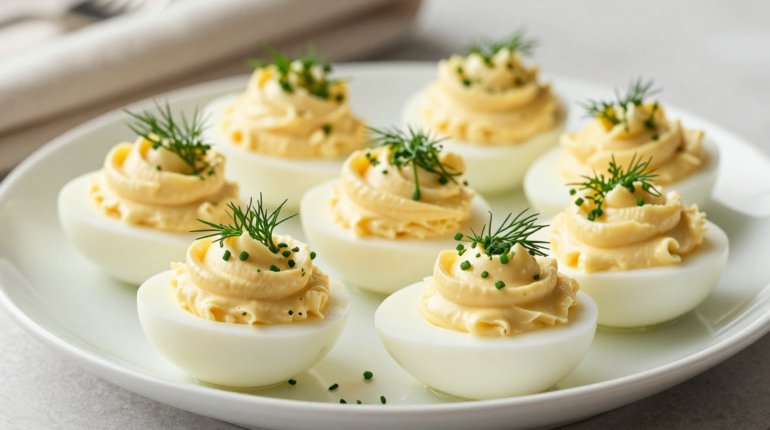
The final plating reveals the level of ambition. A small spoon allows for a generous and rustic filling, perfectly honorable. But a piping bag fitted with a star nozzle instantly transforms the appearance: regular swirls, a professional caterer effect without any particular technical skill. This visual detail, ridiculously simple to execute, multiplies the impact during presentation.
Variations and Storage Secrets to Impress
This acquired technical mastery opens the way to creative variations that personalize the recipe according to occasions and palates. Smoked salmon and tuna are the essential classics, but shredded crab brings a refined marine delicacy, while finely chopped shrimp introduces a firmer texture and a subtly sweet taste. Smoked mackerel, less conventional, appeals with its aromatic power that transforms the Mimosa egg into a bite with character.
The festive upgrade is achieved through a simple final gesture: a few salmon or trout eggs placed on top of each filled half-egg instantly create a presentation worthy of a gastronomic cocktail. These briny pearls burst delicately in the mouth, adding a textural and visual dimension that alone justifies the modest extra cost.
Advance preparation represents the major asset of this recipe for those who host: Mimosa eggs can be prepared up to four hours in advance, then stored in the refrigerator under plastic wrap. This waiting time even improves the result: the flavors fuse, the filling firms up slightly, and the freshness of the service sublimates all the components. A platter of Mimosa eggs taken out of the refrigerator fifteen minutes before the guests arrive guarantees an optimal melting texture without last-minute stress. The result: elegant bites that combine visual refinement and gustatory generosity.