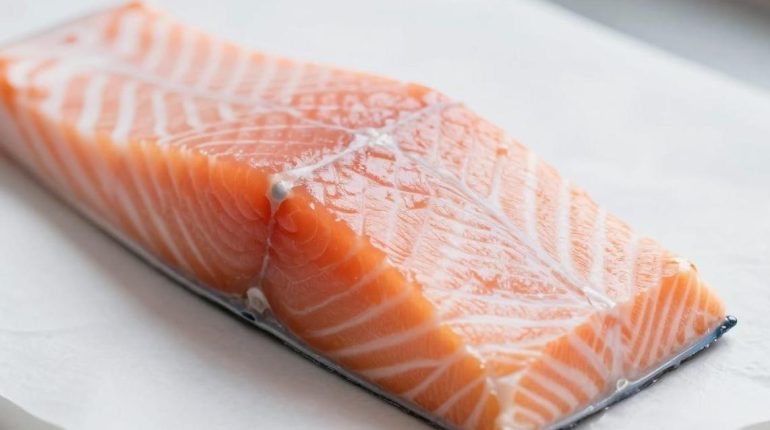
📌 Salmon in the refrigerator: this yellow spot indicates fat oxidation, not necessarily contamination
Posted 2 March 2026 by: Admin
The Mysterious Yellow Spot: A Little-Known Natural Phenomenon
This surprising discoloration has a precise scientific name: “fat bloom”. This phenomenon results from the natural rise of lipids contained in the salmon’s flesh to the surface of the fillet. Contrary to popular belief, this reaction does not systematically indicate a degradation of the fish.
The process is explained by the progressive oxidation of fats during storage in the refrigerator. Salmon, being particularly rich in omega-3 fatty acids, sees its lipids slowly migrate outward after several days of storage. Upon contact with oxygen, these fats oxidize and form characteristic pale yellow streaks or spots.
This physico-chemical transformation generally intensifies between the fifth and seventh day of refrigeration. Fatty areas of the fillet, particularly the belly, often show a more marked concentration of these discolorations. Fat bloom is more of an aesthetic alteration than a reliable indicator of health hazard.
Nevertheless, this unusual appearance raises a legitimate question: how to distinguish simple lipid oxidation from true bacterial deterioration? The answer lies in precise evaluation criteria that every consumer must master before deciding.
Fat Bloom Or Deterioration: The Criteria For Distinction
Sensory evaluation is the most reliable method for deciding between simple oxidation and bacterial contamination. The olfactory test is the first line of defense: salmon that is still edible gives off a subtle marine smell, slightly iodized, never aggressive. Conversely, any sour, ammonia-like, or frankly unpleasant scent betrays advanced microbial proliferation.
Texture also reveals determining clues. A healthy fillet retains its characteristic firmness under finger pressure, even after a week of refrigeration. The flesh returns to its initial shape without leaving a persistent imprint. On the other hand, a slimy, sticky, or abnormally wet surface signals a biological degradation incompatible with consumption.
Overall visual examination completes this analysis. Fat bloom produces pale yellow or whitish marks, relatively uniform and localized. These areas retain the general structure of the muscle, without deep alteration of the salmon’s pink-orange color. This superficial discoloration differs radically from the brownish, greenish, or grayish spots that characterize putrefaction.
The combination of these three criteria — fresh smell, firm texture, isolated yellow discoloration — generally allows for the identification of a harmless fat bloom. But faced with the slightest suspicious sign, the precautionary principle systematically prevails over any attempt at recovery.
Warning Signals Of Real Degradation
Beyond the simple visual aspect, several indicators converge to confirm an irreversible deterioration of the fish. The ammonia smell is the most eloquent signal: this pungent, chemical scent results from the decomposition of proteins by bacteria. It leaves no room for interpretation and requires immediate disposal of the product.
The transformation of texture systematically accompanies this degradation. The flesh loses its natural resistance, becomes spongy under pressure, sometimes even crumbly. A slimy or sticky film covers the surface, testifying to microbial proliferation. This tactile modification contrasts radically with the characteristic firmness of correctly stored salmon.
Brownish or greenish discolorations represent the ultimate stage of alteration. These cloudy hues, often accompanied by grayish areas around the bones, have nothing to do with the pale yellow of fat bloom. They signal a deep oxidation of the tissues, sometimes associated with toxic compounds from putrefaction.
The simultaneous presence of these three criteria — foul odor, slimy texture, suspicious discoloration — tolerates no hesitation. The risk of food poisoning far outweighs the value of the product. This vigilance applies particularly to fatty fish like salmon, whose lipid richness accelerates deterioration processes once the cold chain is broken or the storage period is exceeded.
The Final Decision: Consume Or Discard
Faced with this yellow spot, the decision rests on a methodical sensory analysis. If the salmon retains a fresh marine smell, flesh that is firm to the touch, and only the pale yellow discoloration appears, fat bloom remains the most likely explanation. In this case, cooking eliminates any residual risk and the fish remains edible, even if its appearance has lost its commercial appeal.
However, the slightest doubt dictates caution. A slightly acrid smell, even discreet, is enough to disqualify the product. Similarly, a texture that gives way too easily under pressure or leaves a wet trace on the fingers signals an onset of degradation. Altered visual quality does not systematically constitute a danger, but it requires increased vigilance regarding other parameters.
The food precautionary principle applies here without concession: after a week of refrigeration, safety margins are considerably reduced. If all criteria do not converge toward freshness, discarding the product remains the only reasonable option. Food poisoning always costs more than a fish fillet.
This vigilance is part of a broader reflection on the management of fresh products, which begins at purchase and directly conditions the optimal shelf life.